
Know what a customer is worth before you pay to acquire one.
How much you can spend on a new customer depends on what they will be worth, and that number usually lives in someone's spreadsheet. Finsi predicts lifetime value for every customer with a clear confidence tier and milestones at 1, 3, 6, 12, 24 and 36 months. SCOUT and PULSE read the same predictions, so acquisition proposals and finance agree.
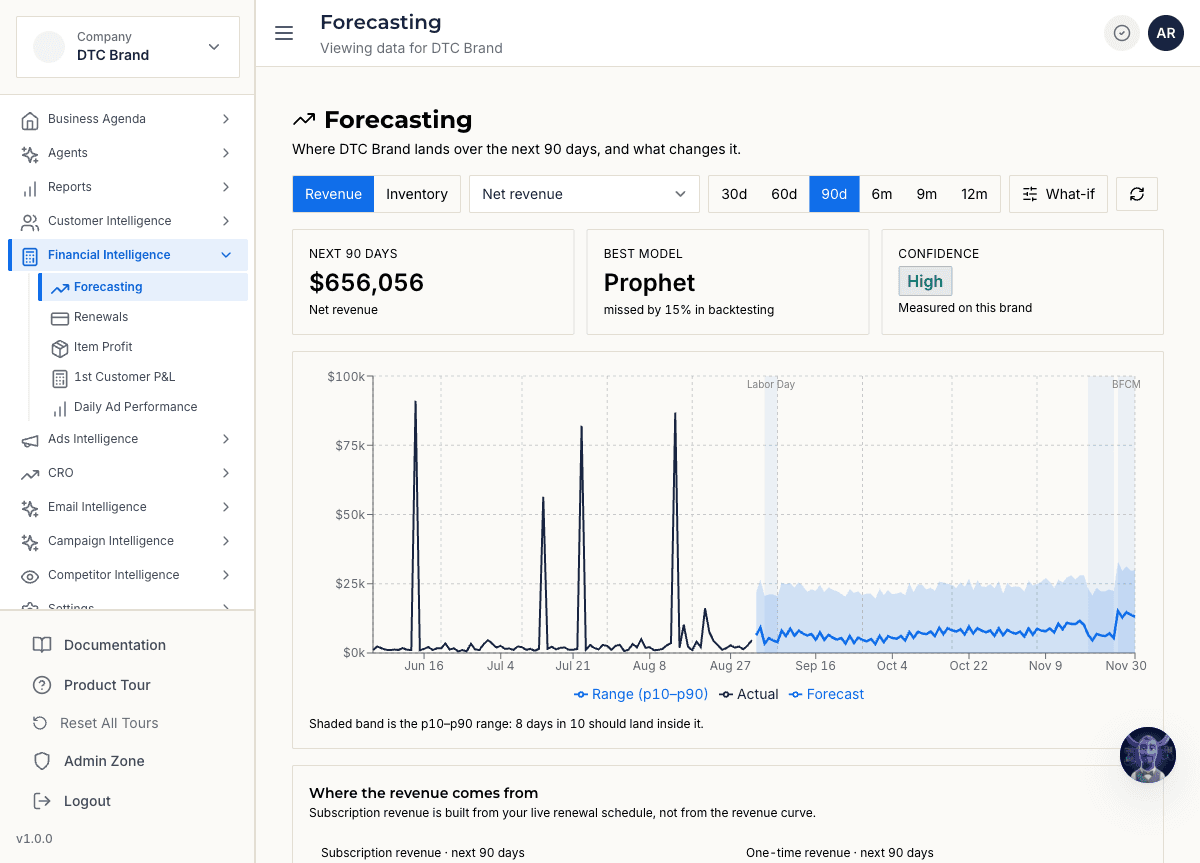
4-tier confidence system
Tier 1 uses order history alone. Tier 2 adds subscription data. Tier 3 adds first-party behavioral tracking. Tier 4 applies trained churn models. Every prediction shows which tier it came from, so you know how much weight to give it.
Milestone-based LTV
Predicted value at 1, 3, 6, 12, 24 and 36 months, so you can see how projections change as customers mature and where value speeds up or stalls.
Growth multipliers
How much value grows between milestones, for example from a 3-month to a 12-month customer, to show which segments have the most long-term potential.
Cohort projection
Newer cohorts projected from the actual curves of your mature cohorts. Finsi finds the historical cohort that most closely matches each new group and applies its trajectory.
Payback period analysis
How long it takes to recover acquisition cost, by channel, campaign and segment, so CAC targets come from your own data.
Signal detection
Early signals that point to high-LTV customers, such as second purchase timing, category exploration, subscription upgrades and engagement patterns, so you can nurture them early.
Lifetime value with the confidence shown.
Each customer's projected lifetime value appears next to its confidence tier. As more data arrives, such as subscription behavior, browsing activity and churn model scores, predictions move up to higher tiers. Filter by tier to see how reliable predictions are across your customer base.
Milestones from month 1 to month 36.
See how customer value builds over time. Finsi tracks actual vs. predicted value at each milestone and the growth multiplier between stages, and projects newer cohorts from the trajectories of your mature ones.
Explore the Platform
More work agents can take off your team
Frequently Asked Questions
1. What are the 4 tiers in Finsi's predictive LTV system?
Tier 1 uses order history only, as a baseline. Tier 2 adds subscription data (cancellations, renewals, skips, pauses). Tier 3 adds first-party behavioral tracking such as browsing patterns and email engagement. Tier 4 applies a machine-learning churn model. Confidence rises with each tier, and every prediction is labeled with the tier it came from.
2. Why show confidence at all?
Because an AI that states a number with false certainty is worse than no number. Finsi tells you how each prediction was made, and agents that use it read the same labeled figure from one set of definitions. They do not make up their own.
3. How does milestone-based LTV differ from a single LTV number?
A single LTV number hides when value is realized. Finsi projects value at 1, 3, 6, 12, 24 and 36 months separately, which shows whether value is front-loaded or builds over time, how quickly you recover acquisition costs, and where retention investment matters most.
4. How does cohort projection work for newer customer groups?
Finsi analyzes the full LTV curves of mature cohorts (customers with 12+ months of history), matches each newer group to the closest historical cohort based on early behavior, and applies that trajectory. As the newer cohort builds history, projections are refined and confidence tiers move up.
5. What is the growth multiplier?
It measures how much customer value increases between milestones. If a cohort's average value triples between month 3 and month 12, the 3-to-12-month multiplier is 3x. Multipliers help forecast long-term value from early data and show which segments compound most.
Make acquisition decisions on numbers you can trust
Tell us how your team sets CAC targets today. We will show you how Finsi predicts LTV with visible confidence and how agents use it in their proposals.