
Subscription Cancel Flow Best Practices: How to Save 30% of Churning Customers
A well-designed subscription cancellation flow saves 20-40% of customers who initiate cancellation by presenting targeted alternatives - such as pausing, switching plans, or resolving the specific issue driving their decision - at the moment they are about to leave. The cancel flow is not a dark pattern or an obstacle; it is a conversation that identifies the customer's problem and offers a genuine solution.
Most subscription brands treat cancellation as a binary event: the customer clicks cancel and the subscription ends. This approach ignores the fact that many customers who initiate cancellation are not committed to leaving - they are frustrated, cost-conscious, or simply unaware of alternatives. A well-built cancel flow gives these customers a reason to stay.
Why Cancel Flows Matter
The economics of saving a subscriber are straightforward. Acquiring a new subscriber costs 5-7x more than retaining an existing one. For a brand with 10,000 active subscribers and a 7% monthly churn rate, reducing cancellations by 30% through cancel flow optimization saves approximately 2,520 subscribers per year. At a $50 monthly subscription price, that is $126,000 in preserved annual revenue from a single UX improvement.
Cancel flow optimization also generates valuable data. Every cancellation reason survey response tells you something about your product, pricing, or customer experience. This feedback loop drives improvements that reduce churn at the source, not just at the cancellation page.
What to Include in Your Cancel Flow
Step 1: Cancellation Reason Survey
The first screen of the cancel flow should ask why the customer wants to cancel. This serves two purposes: it gives you data to improve your product, and it allows you to route the customer to a targeted retention offer.
Keep the survey to 5-7 options. Common cancellation reasons for e-commerce subscriptions include:
- Too expensive / need to cut spending
- I have too much product / shipping too frequently
- I want to try a different brand or product
- Product quality did not meet expectations
- I had a bad customer service experience
- I no longer need this product
- Other (with free text field)
The key design principle is making each option actionable. Every reason should map to a specific save offer on the next screen.
Step 2: Targeted Retention Offers
Based on the cancellation reason, present a specific offer designed to address that exact concern. Generic offers convert at 5-10%. Targeted offers based on the stated reason convert at 15-30%.
| Cancellation Reason | Targeted Offer | Expected Save Rate |
|---|---|---|
| Too expensive | Discount (20-30% for 2-3 months) or plan downgrade | 25-35% |
| Too much product | Skip next shipment or reduce frequency | 30-40% |
| Want to try another brand | Offer a free sample of a different product in your line | 10-20% |
| Quality concerns | Escalate to support + offer a replacement or refund | 15-25% |
| Bad service experience | Escalate to a senior agent + offer credit | 20-30% |
| No longer need product | Pause subscription for 1-3 months | 25-35% |
Present only one offer per screen to avoid decision paralysis. The offer should directly address the stated reason, and the copy should acknowledge the customer's concern before presenting the solution.
Step 3: The Pause Option
Pausing is the single most effective save mechanism. Customers who pause instead of canceling return to active status at rates of 40-60%, compared to win-back reactivation rates of 3-10% for fully canceled subscribers.
Offer flexible pause durations: 1 month, 2 months, or 3 months. Some brands also offer an indefinite pause that the customer reactivates manually. The pause option should be prominently displayed and feel like a natural middle ground between staying and leaving.
Design the pause screen with:
- Clear pause duration options (radio buttons or cards)
- A confirmation of what happens during the pause (no charges, no shipments)
- A note about when the subscription will automatically resume
- An easy way to resume early if the customer wants to come back sooner
Step 4: Plan Downgrade
For customers citing cost or product volume, offer a downgrade to a smaller or less expensive plan. Many subscription brands only offer one plan tier, which forces customers into an all-or-nothing decision. Adding a smaller tier - even if it has lower margins - retains customers who would otherwise cancel entirely.
Downgrades preserve 20-30% of cost-motivated cancellations and keep customers in the ecosystem where they can be upsold back to a full plan later.
Step 5: Product Education
Some customers cancel because they are not getting full value from the product. This is especially common for complex products like skincare routines, supplements, or meal kits. A brief educational screen that shows how to get better results can change the customer's perception.
Include usage tips, product tutorials, or before-and-after examples. Keep this screen concise - 2-3 bullet points maximum - and frame it as helpful rather than condescending.
Design Principles for Cancel Flows
Make Cancellation Possible
This is non-negotiable. The cancel button must be findable and functional. Cancel flows that hide or obscure the final cancellation option violate FTC guidelines and damage brand trust. The goal is to present alternatives, not to prevent cancellation.
Every screen in the cancel flow should include a visible option to proceed with cancellation. The save offers are presented as alternatives, not obstacles.
Keep It Short
The entire cancel flow should be 3-4 screens maximum. Each additional screen beyond four reduces completion rate and increases customer frustration. If a customer has to click through seven screens to cancel, they will leave negative reviews about the experience - which costs you more in brand reputation than the saved subscription was worth.
Use Empathetic Copy
Acknowledge the customer's decision without being defensive. Phrases like "We understand" and "No hard feelings" perform better than "Are you sure?" or guilt-driven messaging. The tone should be respectful, not desperate.
Show Value Before Asking Them to Stay
Before presenting a discount or incentive, briefly remind the customer of the value they will lose. This is not a guilt trip - it is a factual summary. For example: "You have earned 2,400 loyalty points and saved $145 on your last 6 orders." This reframes the decision in terms of concrete value rather than abstract loyalty.
A/B Testing Your Cancel Flow
Cancel flow optimization is iterative. A/B test the following elements to find what works for your audience:
- Offer type: Test discounts versus free gifts versus pause options
- Discount amount: 15% versus 20% versus 25%
- Pause duration options: 1 month versus 3 months versus custom
- Copy tone: Direct versus empathetic versus value-focused
- Number of screens: 2-step versus 3-step versus 4-step
- Offer placement: Before or after the reason survey
Run each test for a minimum of 500 cancellation attempts to reach statistical significance. Track both the immediate save rate and the 90-day retention rate of saved customers - a save that only delays cancellation by two weeks is not a real save.
Benchmarks for Cancel Flow Performance
| Metric | Below Average | Average | Well-Optimized |
|---|---|---|---|
| Survey completion rate | < 40% | 50-65% | 70-85% |
| Save rate (overall) | < 10% | 15-20% | 25-40% |
| Pause adoption rate | < 5% | 10-15% | 20-30% |
| Discount acceptance rate | < 8% | 12-18% | 20-30% |
| 90-day retention of saved customers | < 30% | 40-55% | 60-75% |
The 90-day retention metric is critical. If saved customers churn within three months anyway, your cancel flow is delaying churn, not preventing it. Sustainable save rates come from addressing the root cause of cancellation, not just applying a temporary discount.
Connecting Cancel Flows to Your Retention Strategy
The cancel flow is one component of a broader retention intelligence strategy. Data from the cancellation reason survey should feed back into your product development, pricing strategy, and customer experience improvements.
If 35% of cancellations cite "too expensive," that is a pricing signal. If 20% cite quality issues, that is a product signal. If 15% cite bad service experiences, that is an operations signal. The cancel flow is not just a save mechanism - it is a research tool.
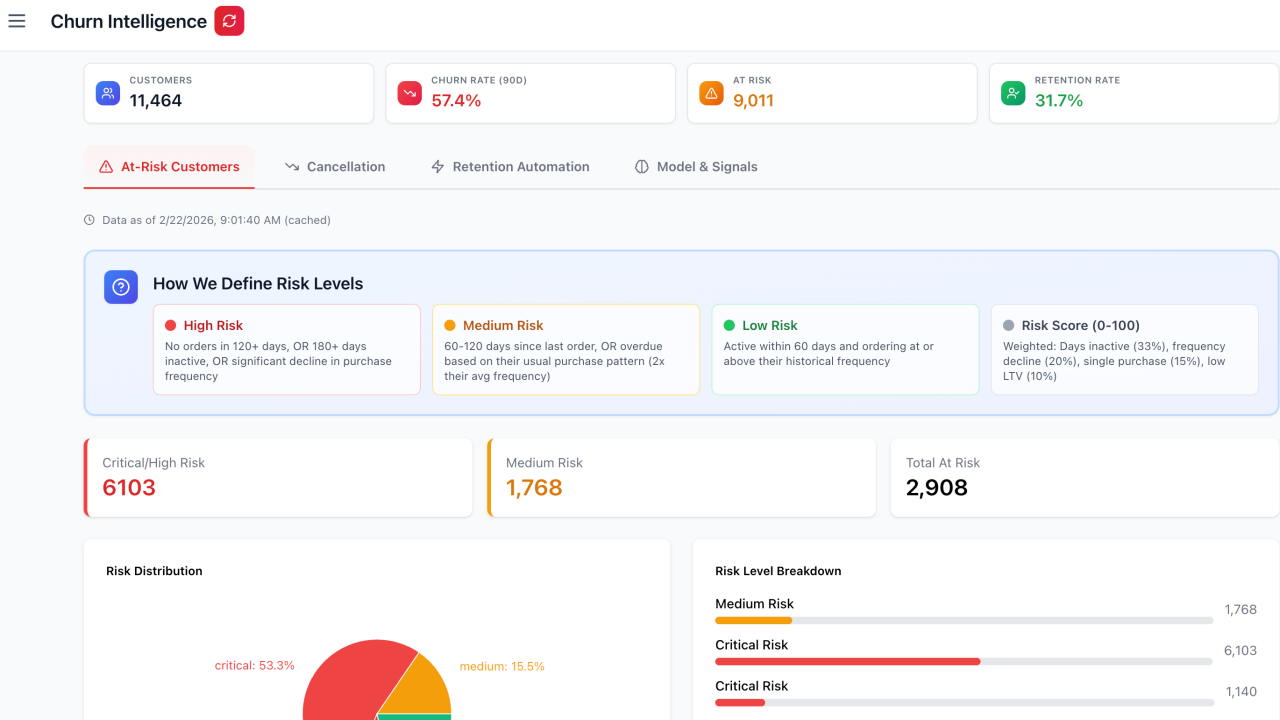
Finsi integrates cancel flow data with customer health scores, purchase behavior, and engagement signals to identify at-risk subscribers before they reach the cancel page, enabling proactive retention interventions that are more effective and less costly than reactive save offers.
Frequently Asked Questions
What is a subscription cancel flow?
A cancel flow is the multi-step experience a subscriber goes through when they initiate cancellation. Rather than immediately ending the subscription with a single click, a well-designed cancel flow presents a short survey to understand the reason for leaving, followed by a targeted retention offer that addresses the specific concern. It typically includes alternatives like pausing, downgrading, or adjusting delivery frequency. The goal is not to trap customers - the cancel button must always be accessible - but to surface options the subscriber may not have known existed.
How can I reduce subscription cancellations?
The most effective approach combines a well-designed cancel flow with proactive retention efforts upstream. In the cancel flow itself, match retention offers to stated cancellation reasons (discount for price-sensitive customers, pause for product accumulation, support escalation for service complaints). Outside the cancel flow, use retention intelligence to identify at-risk subscribers through engagement signals and intervene before they reach the cancel page. Reducing involuntary churn through dunning optimization is often the quickest win, since those subscribers did not choose to leave.
What does a well-designed cancel flow look like?
An effective cancel flow is three to four screens maximum. Screen one is a cancellation reason survey with five to seven specific, actionable options. Screen two presents a single targeted offer based on the selected reason - such as a pause option for "too much product" or a discount for "too expensive." Include a visible option to proceed with cancellation on every screen. Use empathetic copy that acknowledges the customer's decision without guilt. Before presenting offers, briefly show the concrete value the customer will lose (loyalty points earned, money saved). Retention teams should A/B test offer types, discount amounts, and copy tone to optimize save rates over time.
What retention offers work best in cancel flows?
Pause options are the single most effective mechanism - customers who pause resume at 40-60% rates, compared to 3-10% win-back rates for fully cancelled subscribers. For price-sensitive customers, a 20-30% discount for two to three months converts at 25-35%. Frequency adjustments (switching from monthly to bi-monthly) address product accumulation concerns effectively. The key is matching the offer to the stated reason: generic offers convert at 5-10%, while targeted offers convert at 15-30%. Track 90-day retention of saved customers to ensure your offers are preventing churn, not just delaying it.
What are good benchmarks for cancel flow performance?
A well-optimized cancel flow achieves a 25-40% overall save rate, with 70-85% survey completion, 20-30% pause adoption, and 60-75% 90-day retention among saved customers. If your overall save rate is below 10%, there is significant room for improvement. The 90-day retention metric is critical - if saved customers churn within three months, you are delaying rather than preventing churn. Start a free trial to see how Finsi connects cancel flow data with customer health scores, churn analysis, and behavioral signals to build a complete picture of subscriber retention.
Stop guessing. Start knowing.
Finsi connects your e-commerce data, tells you what to do, and executes it — email campaigns, ad optimization, retention flows. Free 30-day trial.
Start Free Trial