
What Is CAC Payback Period?
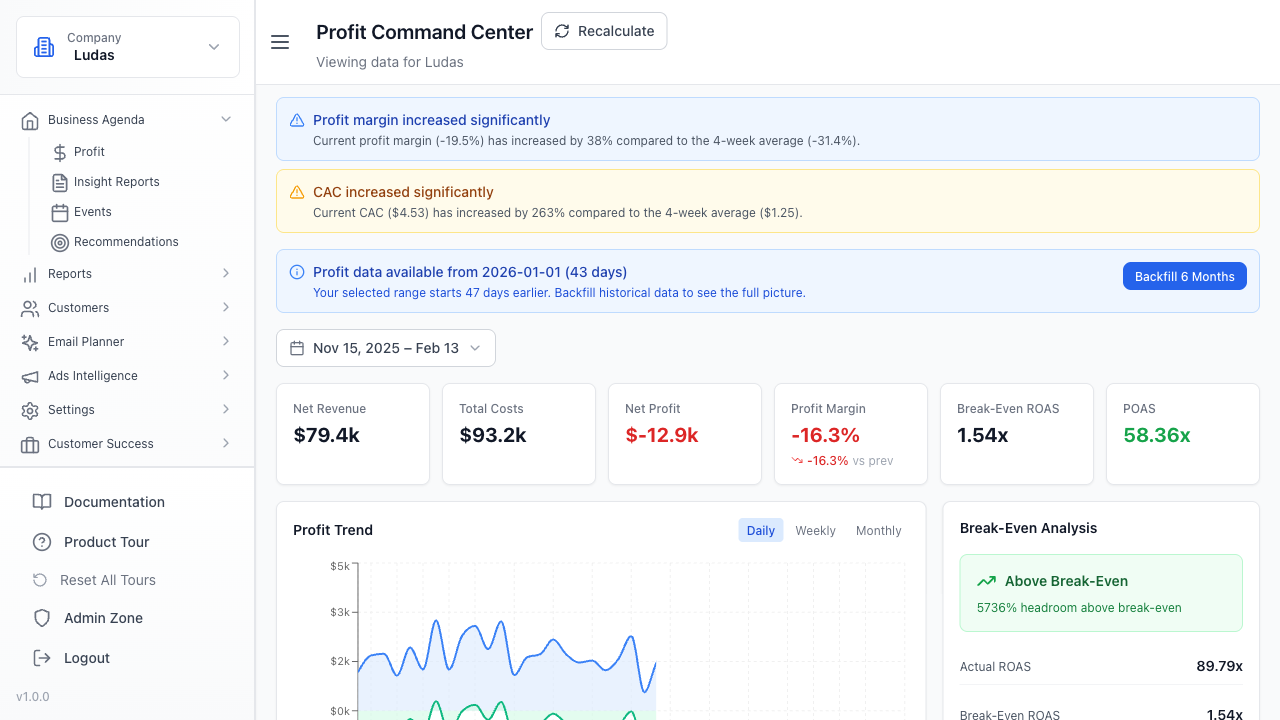
CAC payback period is the number of months required for a customer to generate enough gross profit to repay the customer acquisition cost (CAC) spent to acquire them.
Why CAC Payback Period Matters
CAC payback period answers a survival question: how long until a new customer pays for themselves? It bridges unit economics and cash flow. A brand spending $50 to acquire a customer who generates $100 in gross margin needs to know whether that payback happens in 2 months or 12 months. The difference determines whether growth is self-funding or requires constant external capital.
Growth teams often optimize for CAC ratio (CAC divided by first-year gross margin) or LTV:CAC, but those are rearview metrics. Payback period is forward - looking. It tells operators whether the cash generated by customers acquired today will be available to fund acquisition tomorrow. In a rising rate environment or with tightening venture capital, payback period became the metric that separates sustainable growth from cash burn.
For DTC and subscription businesses, payback period also signals unit economics health. A 6-month payback on a 12-month subscription is healthy. A 12-month payback on a 12-month subscription is a warning. A 18-month payback on a 12-month subscription is unsustainable without external funding.
The Formula and What Goes Into It
The basic formula is straightforward: CAC Payback Period (months) = CAC / (Monthly Gross Margin per Customer). But the numerator and denominator require precision.
CAC is the fully-loaded cost to acquire one customer. This includes paid media spend, affiliate commissions, content production, tools, salaries allocated to acquisition, and creative testing. Many teams undercount CAC by excluding overhead. If a growth team costs $200k per month and acquires 1,000 customers, that's $200 per customer in payroll alone, before any media spend.
Monthly gross margin per customer is revenue minus cost of goods sold (or cost of service), divided by the number of active customers that month. For SaaS, this is subscription revenue minus hosting and payment processing. For DTC, it's revenue minus product cost, fulfillment, and returns. Do not use net margin - payback period specifically measures the cash available to reinvest in growth, which is gross margin.
Example: An apparel brand spends $40 CAC (media + overhead). Average customer spends $120 first month, with 65% gross margin ($78). Monthly gross margin per customer is $78. Payback period = $40 / $78 = 0.51 months, or roughly 15 days. That's strong. If the same brand has 30% repeat rate and $50 average order value in month two, the calculation changes - but payback period typically measures the initial acquisition payback, not lifetime.
Benchmarks by Business Model
Payback period varies dramatically by model. Subscription businesses typically target 6 - 12 months. E-commerce targets 2 - 6 months. High-ticket B2B targets 12 - 24 months or longer.
For DTC subscription (apparel, beauty, food), 3 - 6 months is healthy. Brands like Warby Parker and Dollar Shave Club built on payback periods under 6 months because the subscription model meant repeat revenue was predictable. A 12-month payback on a 12-month subscription means you're breaking even at churn - not ideal.
For DTC e-commerce (one-time purchase focus), payback can be 1 - 3 months because the entire CAC must be recovered from a single transaction or a short window of repeat purchases. Brands with strong repeat rates (40%+) can sustain longer payback periods. Brands with weak repeat (under 20%) need payback under 2 months or they're underwater.
For SaaS and B2B, payback periods of 12 - 24 months are common because customer lifetime value is much higher and sales cycles are longer. A $5,000 CAC with $500 monthly gross margin takes 10 months to payback - acceptable in enterprise SaaS. But if CAC is $20,000 and monthly gross margin is $500, payback is 40 months, which is unsustainable.
How Payback Period Drives Growth Decisions
Payback period is the constraint that shapes channel mix. A channel with a 2-month payback can be scaled aggressively. A channel with an 8-month payback requires either higher LTV confidence or external capital. Teams often run multiple channels with different payback periods - paid search might be 3 months, brand awareness might be 12 months. The portfolio payback is the weighted average.
When payback extends beyond acceptable range, operators have three levers: reduce CAC, increase gross margin, or increase repeat purchase rate. Reducing CAC means optimizing creative, audience targeting, or shifting to cheaper channels. Increasing gross margin means raising prices, reducing COGS, or improving fulfillment efficiency. Increasing repeat rate means improving product quality, email retention, or loyalty programs. Most operators pull all three levers simultaneously.
Payback period also determines cash flow timing. A 3-month payback means cash from customer acquisition is reinvested within the quarter. A 12-month payback means capital is tied up for a year. In a capital-constrained environment, shorter payback periods allow faster scaling because the same dollar can be recycled multiple times per year. This is why venture-backed growth teams often obsess over payback period - it's the multiplier on their capital efficiency.
Common Mistakes in Calculating Payback Period
The most common error is using net margin instead of gross margin. Net margin includes overhead, rent, and corporate salaries - costs that don't scale with customer acquisition. Payback period measures the cash available to reinvest in growth, which is gross margin only. Using net margin makes payback look worse than it is and leads to false conclusions about channel viability.
The second error is excluding overhead from CAC. Many teams count only paid media spend and call that CAC. But if a growth team has 5 people and spends $500k annually, that's $100k per person per year. If they acquire 10,000 customers annually, that's $50 CAC from payroll alone. Excluding this inflates payback period accuracy and makes channels appear more efficient than they are.
The third error is using annual gross margin instead of monthly. A customer acquired in January might have different repeat behavior in February, March, and beyond. Payback period should measure the monthly gross margin generated by that cohort in the months immediately following acquisition. Using annual average masks seasonal patterns and cohort quality differences.
The fourth error is conflating payback period with profitability. A 6-month payback period does not mean the customer is profitable. It means the customer has repaid their acquisition cost. Profitability depends on LTV, churn rate, and repeat purchase patterns over the full customer lifetime. Payback period is a cash flow metric, not a profitability metric.
Payback Period in Practice Across Channels
Paid search typically has the shortest payback period because intent is high and conversion happens quickly. A brand might spend $20 CAC on search and see $50 gross margin in the first month, yielding a 0.4-month payback. This is why search is often the first channel to scale - it's self-funding almost immediately.
Social media advertising (Facebook, TikTok, Instagram) typically has longer payback because intent is lower and repeat purchase is required to achieve positive payback. A brand might spend $30 CAC on social, see $40 gross margin in month one, and need month two repeat purchases to fully payback. Payback might be 1.5 - 2 months. This requires confidence in repeat rate.
Email and organic channels have zero CAC (or near-zero), so payback is immediate. But these channels are typically slower to scale and require audience building. Influencer and affiliate channels have variable payback depending on commission structure - if commission is 20% of revenue, payback depends entirely on repeat rate and LTV.
Offline channels (events, PR, partnerships) are harder to measure but typically have longer payback periods because attribution is fuzzy and repeat purchase is delayed. Many brands use offline for brand building and accept longer payback periods, treating it as a LTV play rather than a cash flow play.
Improving Payback Period Without Killing Growth
The tension in growth is that aggressive acquisition spending extends payback period. Scaling media spend often increases CAC because you're moving down the funnel to less-qualified audiences. The goal is to extend payback period only as much as LTV justifies, then stop.
One approach is to segment payback period by cohort quality. High-intent customers acquired through search might have a 2-month payback. Low-intent customers acquired through brand awareness might have a 6-month payback. If LTV supports it, both are worth acquiring. But the portfolio payback period should remain within acceptable range.
Another approach is to improve gross margin through pricing, bundling, or upsell. A $5 price increase on a $50 product is a 10% gross margin lift. If that translates to $5 additional monthly gross margin per customer, payback period drops by 10%. Pricing optimization is often faster than reducing CAC.
A third approach is to improve repeat purchase rate through product, retention, and loyalty. A brand with 20% repeat rate has fundamentally different payback economics than a brand with 50% repeat rate. Investing in retention - better onboarding, email sequences, loyalty programs - extends LTV and justifies longer payback periods on acquisition.
FAQ
What's a good CAC payback period?
It depends on business model. DTC e-commerce should target 2 - 6 months. DTC subscription should target 3 - 12 months. SaaS should target 12 - 24 months. The shorter the payback, the faster capital recycles and the more sustainable growth becomes. Payback periods longer than 18 months require high confidence in LTV and retention.
How does payback period differ from LTV:CAC ratio?
LTV:CAC ratio measures lifetime value relative to acquisition cost (e.g., 3:1 is healthy). Payback period measures months to recover CAC from gross margin. They're related but different. A 3:1 LTV:CAC ratio with a 24-month payback means the customer is profitable but capital is tied up for 2 years. A 2:1 LTV:CAC ratio with a 3-month payback means lower lifetime value but faster cash recycling.
Should payback period include customer service and support costs?
No. Payback period uses gross margin, which excludes all operating expenses including customer service. Service costs are part of net margin and affect profitability, but not payback period. Payback period specifically measures the cash available to reinvest in growth. If you want to measure true profitability, use contribution margin or net margin instead.
How do I calculate payback period for a customer acquired in month one who makes purchases in months one and two?
Sum the gross margin from all purchases in the payback window, then divide CAC by that sum. Example: CAC is $50. Customer generates $30 gross margin in month one and $25 in month two. Total gross margin is $55. Payback period is $50 / $55 = 0.91 months. If the customer only generated $30 in month one, payback would be $50 / $30 = 1.67 months, meaning payback occurs partway through month two.
FAQ
What's a good CAC payback period?
It depends on business model. DTC e-commerce should target 2 - 6 months. DTC subscription should target 3 - 12 months. SaaS should target 12 - 24 months. The shorter the payback, the faster capital recycles and the more sustainable growth becomes. Payback periods longer than 18 months require high confidence in LTV and retention.
How does payback period differ from LTV:CAC ratio?
LTV:CAC ratio measures lifetime value relative to acquisition cost (e.g., 3:1 is healthy). Payback period measures months to recover CAC from gross margin. They're related but different. A 3:1 LTV:CAC ratio with a 24-month payback means the customer is profitable but capital is tied up for 2 years. A 2:1 LTV:CAC ratio with a 3-month payback means lower lifetime value but faster cash recycling.
Should payback period include customer service and support costs?
No. Payback period uses gross margin, which excludes all operating expenses including customer service. Service costs are part of net margin and affect profitability, but not payback period. Payback period specifically measures the cash available to reinvest in growth. If you want to measure true profitability, use contribution margin or net margin instead.
How do I calculate payback period for a customer acquired in month one who makes purchases in months one and two?
Sum the gross margin from all purchases in the payback window, then divide CAC by that sum. Example: CAC is $50. Customer generates $30 gross margin in month one and $25 in month two. Total gross margin is $55. Payback period is $50 / $55 = 0.91 months. If the customer only generated $30 in month one, payback would be $50 / $30 = 1.67 months, meaning payback occurs partway through month two.