
What Is Contribution Margin in Ecommerce?
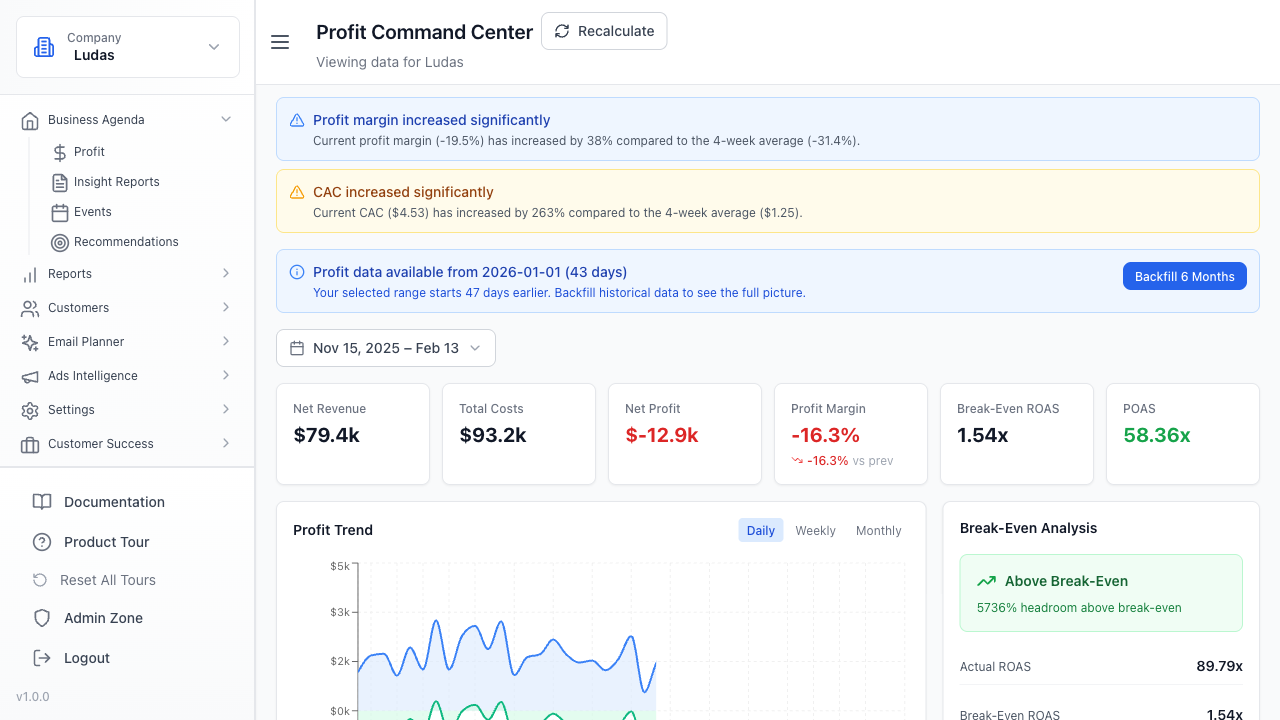
Contribution margin is the amount of revenue remaining after variable costs are subtracted, expressed as a dollar amount or percentage of sales.
Definition and Core Formula
Contribution margin is the portion of revenue available to cover fixed costs and generate profit after all variable costs are paid. It answers a straightforward question: how much of each dollar sold actually contributes to covering overhead and profit?
The formula is simple: Contribution Margin = Revenue - Variable Costs. If an order generates $100 in revenue and variable costs total $35, the contribution margin is $65. Expressed as a percentage (contribution margin ratio), that's 65%.
This metric sits directly on your P&L between gross profit and operating profit. Gross profit accounts for cost of goods sold (COGS) only. Contribution margin goes further by excluding all variable operating expenses - fulfillment labor, payment processing fees, packaging, shipping subsidies, and affiliate commissions. Fixed costs like rent, salaries, and software subscriptions stay above the line.
Variable vs. Fixed Costs: The Critical Distinction
Contribution margin only subtracts variable costs - expenses that scale with order volume. A DTC brand shipping 100 units incurs 100x the fulfillment labor and packaging. A brand shipping 1,000 units incurs 10x the fulfillment labor and packaging. These costs move with revenue.
Fixed costs do not scale with volume in the short term. Warehouse rent, salaried staff, platform subscriptions, and brand marketing budgets remain constant whether you ship 100 or 1,000 units this month. They appear below the contribution margin line on the P&L.
The distinction matters because contribution margin shows the incremental profit from each additional sale. If contribution margin is 60%, selling one more $100 order generates $60 toward fixed costs and profit. This is why operators obsess over contribution margin - it directly measures whether each sale moves the business closer to profitability.
Calculating Contribution Margin: Step by Step
Start with total revenue for the period. For a DTC brand, this is net sales after returns and discounts.
Identify all variable costs. Common ones include: COGS (materials, manufacturing), fulfillment labor (picking, packing, QA), shipping costs (actual carrier fees, not subsidies), payment processing fees (2-3% of revenue for most processors), packaging materials, and affiliate or referral commissions. Some brands also include variable customer service labor if it scales with order volume.
Subtract total variable costs from revenue. The result is contribution margin in dollars. Divide contribution margin by revenue to get the contribution margin ratio as a percentage.
Example: A skincare brand with $500k monthly revenue, $150k COGS, $40k fulfillment labor, $30k shipping, $15k payment fees, and $10k affiliate commissions has variable costs of $245k. Contribution margin is $255k, or 51% of revenue.
Contribution Margin vs. Gross Profit on the P&L
Gross profit appears first on the P&L: Revenue - COGS = Gross Profit. For the skincare example above, gross profit is $350k (70% gross margin).
Contribution margin appears next: Gross Profit - Variable Operating Expenses = Contribution Margin. That's $350k - $95k in operating variable costs = $255k (51% contribution margin).
The gap between gross margin and contribution margin reveals the cost of operations. A 70% gross margin looks healthy until you subtract fulfillment, shipping, and payment processing - then you're at 51%. This is why many DTC brands with strong gross margins still struggle to reach operating profitability. High-touch fulfillment, subsidized shipping, and affiliate spend compress contribution margin significantly.
Fixed costs (salaries, rent, software, brand marketing) come next: Contribution Margin - Fixed Costs = Operating Profit. Breakeven occurs when contribution margin equals fixed costs.
Why Contribution Margin Matters for DTC Operators
Contribution margin is the metric that determines how much runway a brand has before cash runs out. If fixed costs are $100k per month and contribution margin is only $80k, the business burns $20k monthly. If contribution margin is $120k, the business generates $20k in profit and can reinvest or extend runway.
It also reveals which products, channels, or customer segments are actually profitable. A high-AOV product might have strong gross margin but terrible contribution margin if it requires expensive fulfillment or high affiliate commissions. A low-AOV product might have weak gross margin but strong contribution margin if it ships efficiently.
Contribution margin ratio benchmarks vary by category. Apparel brands typically run 40-55% contribution margin. Beauty and supplements often hit 50-65%. Luxury goods can exceed 70%. Knowing your benchmark helps identify whether operational efficiency is competitive or lagging.
For unit economics, contribution margin per order is the metric that matters most. If average order value is $75 and contribution margin is 50%, each order contributes $37.50 toward fixed costs. With $100k in monthly fixed costs, the brand needs roughly 2,667 orders to break even.
Optimizing Contribution Margin
Increasing contribution margin requires either raising revenue per order or reducing variable costs. Most operators focus on variable cost reduction because it directly improves unit economics without requiring customer acquisition.
Fulfillment optimization is the biggest lever for most DTC brands. Negotiating better shipping rates, consolidating warehouses, or switching to a more efficient 3PL can reduce fulfillment costs by 10-20%. Automation in picking and packing also scales labor more efficiently as volume grows.
Payment processing fees are often overlooked. Switching processors, negotiating volume discounts, or offering ACH payment options can save 0.5-1% of revenue. For a $1M revenue brand, that's $5k-10k annually.
Packaging and materials optimization matters too. Downsizing boxes, reducing insert materials, or switching suppliers can cut packaging costs by 15-30% without harming unboxing experience. The savings flow directly to contribution margin.
On the revenue side, raising AOV through bundling, upsells, or premium product tiers increases contribution margin dollars without proportional increases in variable costs. A $10 upsell with 40% contribution margin adds $4 per order - significant at scale.
Common Pitfalls in Contribution Margin Calculation
Misclassifying costs is the most common error. Shipping subsidies should be subtracted as variable costs, not hidden in COGS. If a brand pays $8 to ship but charges customers $5, the $3 subsidy is a variable cost that reduces contribution margin. Many operators ignore this and overstate profitability.
Excluding affiliate or referral commissions from variable costs is another mistake. These scale directly with revenue and should reduce contribution margin. Failing to account for them makes contribution margin appear stronger than it actually is.
Treating all labor as fixed is tempting but wrong if fulfillment or customer service labor scales with volume. Seasonal brands especially need to track variable labor separately. Fixed salaries for permanent staff stay above the line; hourly fulfillment labor belongs in variable costs.
Ignoring returns and refunds distorts contribution margin. If 15% of orders are returned, revenue should be net of returns, and the associated variable costs (return shipping, restocking labor) should be subtracted. Gross revenue overstates contribution margin.
FAQ
How is contribution margin different from gross profit?
Gross profit is revenue minus COGS only. Contribution margin is revenue minus all variable costs, including COGS plus fulfillment, shipping, payment processing, and commissions. Contribution margin is always lower than gross profit and shows the true incremental profit from each sale after all variable operating expenses.
What's a good contribution margin ratio for ecommerce?
Benchmarks vary by category. Apparel typically runs 40-55%, beauty and supplements 50-65%, luxury goods 65-75%. The key is whether your ratio is improving over time and competitive within your category. Contribution margin below 40% makes it difficult to cover fixed costs and reach profitability at typical DTC scale.
Should I include shipping subsidies in contribution margin?
Yes, absolutely. If you charge customers $5 for shipping but pay the carrier $8, the $3 subsidy is a variable cost that reduces contribution margin. Many operators hide shipping subsidies and overstate profitability. Track actual carrier costs, not customer-facing shipping charges.
How do I use contribution margin to forecast profitability?
Divide monthly fixed costs by contribution margin ratio to find the revenue needed to break even. If fixed costs are $100k and contribution margin ratio is 50%, breakeven revenue is $200k. Contribution margin dollars minus fixed costs equals operating profit. This shows exactly how much profit each revenue dollar generates after covering overhead.
FAQ
How is contribution margin different from gross profit?
Gross profit is revenue minus COGS only. Contribution margin is revenue minus all variable costs, including COGS plus fulfillment, shipping, payment processing, and commissions. Contribution margin is always lower than gross profit and shows the true incremental profit from each sale after all variable operating expenses.
What's a good contribution margin ratio for ecommerce?
Benchmarks vary by category. Apparel typically runs 40-55%, beauty and supplements 50-65%, luxury goods 65-75%. The key is whether your ratio is improving over time and competitive within your category. Contribution margin below 40% makes it difficult to cover fixed costs and reach profitability at typical DTC scale.
Should I include shipping subsidies in contribution margin?
Yes, absolutely. If you charge customers $5 for shipping but pay the carrier $8, the $3 subsidy is a variable cost that reduces contribution margin. Many operators hide shipping subsidies and overstate profitability. Track actual carrier costs, not customer-facing shipping charges.
How do I use contribution margin to forecast profitability?
Divide monthly fixed costs by contribution margin ratio to find the revenue needed to break even. If fixed costs are $100k and contribution margin ratio is 50%, breakeven revenue is $200k. Contribution margin dollars minus fixed costs equals operating profit. This shows exactly how much profit each revenue dollar generates after covering overhead.