
What Is an AI CMO? (And Why Shopify Brands Are Hiring One in 2026)
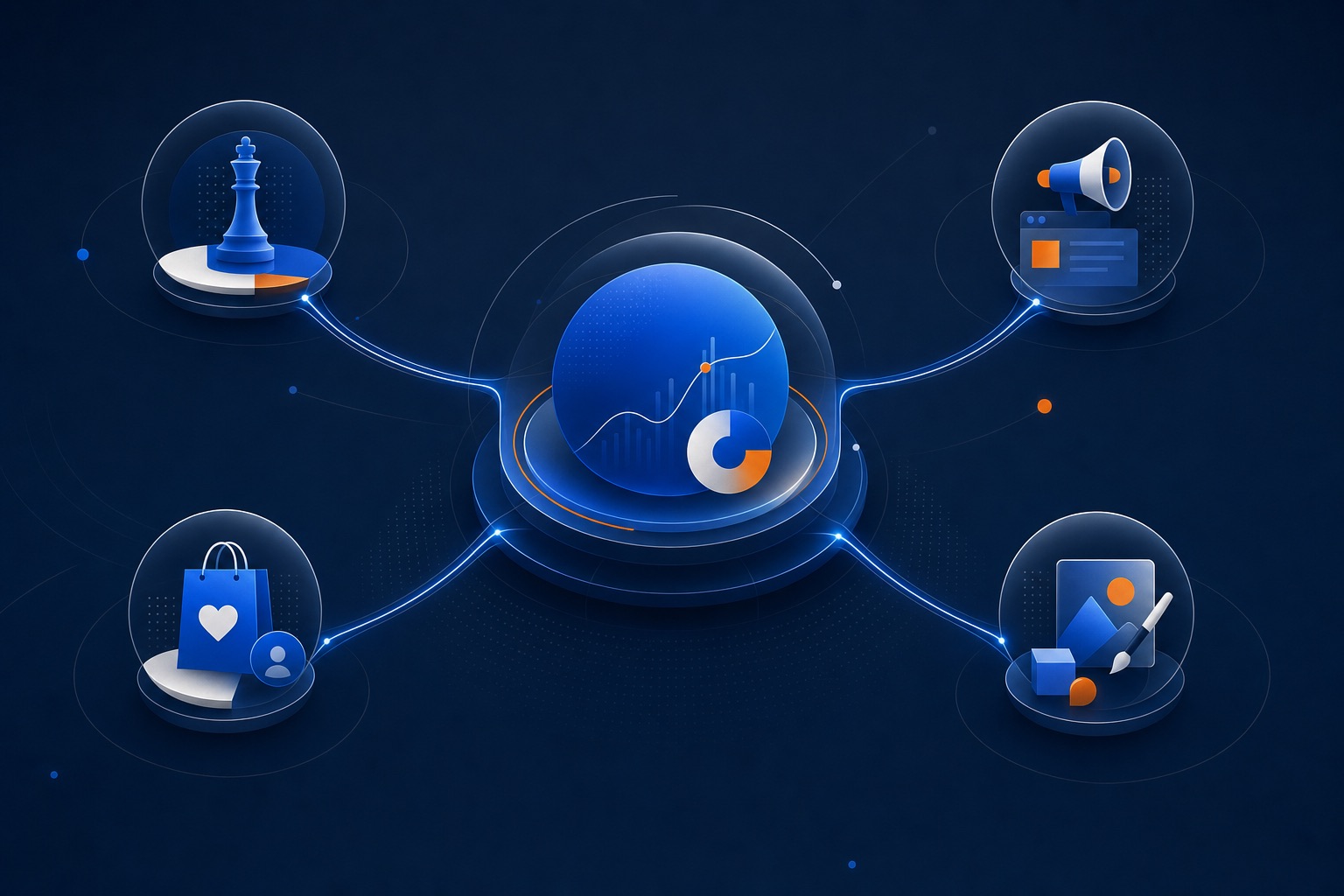
An AI CMO is a software system that owns weekly growth strategy, ad budget allocation, retention experiments, and campaign execution for a Shopify or DTC brand. It covers the marketing leadership layer most $1M-$50M brands need and cannot reasonably fill with a $200K-per-year human CMO. The category exists in 2026 because large language models can reason about marketing tradeoffs, creative, and customer behavior well enough to propose decisions a competent marketing leader would make, then execute them in the stack.
This guide covers what an AI CMO does day to day, what it integrates with, where it beats a human, where it loses, and how the economics compare to fractional and full-time CMO alternatives.
What a CMO actually does under $50M revenue
For an ecommerce brand under $50M, the CMO function breaks into four buckets.
Strategy (about 10-15% of the role at this stage): growth priorities for the quarter and the week - which segments to invest in, which channels to scale, which retention problems to solve now.
Allocation (about 25-35%): how to split budget across Meta, Google, and TikTok, and within each channel (prospecting versus retargeting, creative formats, audiences). On the retention side: dunning versus winback versus loyalty spend of time and offers.
Execution oversight (about 35-50%): reviewing campaigns, flows, and creative; catching mistakes; approving big spends; coordinating with finance, support, and product.
Learning and adjustment (about 15-20%): watching outcomes, deciding what changes next week, reviewing experiments, reading platform changes.
An AI CMO does the same four jobs with a different time mix. It spends almost no time on human execution oversight because it executes directly, and more time on allocation and learning because it can review more data continuously.
A typical week with an AI CMO
Example: an AI CMO running a $5M Shopify brand.
Monday morning. A review of last week lands in Slack. Revenue $98,400 (up 6% week over week), blended ROAS 2.7 (down from 2.9), CAC up $4 on Meta and down $2 on Google, 12-month retention for the May 2025 cohort three points above the April cohort. Three leverage points for the week: fatigued Meta creative dragging ROAS, a winback overdue for March at-risk subscribers, and a budget shift from non-incremental Google brand search into TikTok prospecting where new creative is working.
Monday through Friday. Work runs against those three priorities. New Meta creative is generated, sent for human approval, then launched. A Klaviyo winback is built with segment-specific copy for the largest churn reasons and deployed. Budget moves. Smaller decisions continue all week: a saturated TikTok ad set is paused after approval, a welcome flow is pointed at a higher-margin SKU, a dunning email is rewritten after recovery rate drops two points.
Friday. A weekly summary lands in Slack: attribution-cleaned channel performance, cohort retention, profit by channel and product, and next week's three priorities with expected impact.
That work would not look out of place from a strong fractional CMO on 10 hours a week. The AI version runs every day and costs on the order of a marketing manager stipend on the Finsi Startup plan ($500/month), not a full CMO seat.
Where an AI CMO outperforms a human
Decision frequency. A human might review channel allocation weekly. An AI CMO can re-evaluate as often as the data justifies. Audience fatigue and creative decay move on a hours-to-days clock. Brands that reallocate daily on clean data often see better blended ROAS than brands that only review weekly - 10-20% is a common range cited in operator practice, and your mileage depends on creative supply and auction noise.
Cross-data reasoning. A human looks at the dashboards they open. An AI CMO can join Shopify orders, Klaviyo engagement, Meta auction data, support tickets, and subscription churn signals. Example: support volume spikes that track a paid acquisition channel, which means that channel is buying poor-fit customers. That pattern only appears if someone joins support and ads. The AI joins them by default.
Where a human CMO still wins
Brand identity and taste. What the brand stands for, how it speaks, which partnerships are on-brand, how to handle a PR moment. An AI can generate variations inside a defined tone. It does not invent the tone.
Major strategic transitions. New category, new geography, restructuring the mix in a recession, investor and board context. Those decisions need information the AI does not have.
Org design and people. Hiring, firing, agency selection, building a marketing org remain human-leader work.
Practical framing: an AI CMO covers the operating layer (most of the daily and weekly work). A founder or advisor covers the strategic layer. The combination is cheaper and more consistent than hiring one human CMO to do both for a mid-market brand.
The economics
For a $5M Shopify brand:
| Path | Monthly cost | Coverage |
|---|---|---|
| Full-time human CMO | $20K-$35K loaded | All four buckets, ~50 hours/week |
| Fractional CMO | $5K-$15K | Strategy and oversight, few hours/week |
| AI CMO (Finsi Startup) | $500 platform | Continuous operating layer |
The gap is not only dollars. The AI version runs continuously and reviews more data than a fractional schedule allows. For brands under $10M, that is often the deciding argument.
Integrations that matter
Minimum useful set: Shopify, Meta Ads, Google Ads, Klaviyo (or equivalent), and a subscription platform if you sell subscriptions (Recharge, Skio, Loop, Bold). TikTok helps if you spend there. Support tools improve retention prediction. Deeper integrations improve decision quality; they are not required on day one.
Most brands get this wrong
They buy another dashboard and call it AI. Analytics ends when the chart loads. An AI CMO starts there and ends with a campaign change, a flow update, or a winback in market - after approval where spend or customers are affected.
They also hire a fractional CMO and an agency and still have no one joining ads to retention to margin every day. The missing role is the always-on operating layer, not another monthly PDF.
What to do next
List your last four weeks of CAC by channel, repeat rate, and contribution margin if you have it. If nobody on the team can produce that without a Sunday scrape, you have an operating gap. Book a Finsi demo if you want that layer productized: https://www.finsi.ai/demo
Related: AI CMO page, lifecycle marketing, customer retention platform.
FAQ
What is an AI CMO?
An AI CMO is a software system that performs the strategic and execution work of a Chief Marketing Officer: setting weekly growth priorities, allocating advertising budget across channels based on contribution margin, designing retention experiments, generating ad creative and email copy, and running the campaigns it designs. The difference from a marketing analytics tool is that an AI CMO acts - it does not only report. The difference from a virtual assistant is that an AI CMO owns strategy, not only execution.
How does an AI CMO differ from marketing analytics software?
Analytics software shows you what happened - revenue, churn, ROAS, attribution. An AI CMO uses that same data to decide what to do next, then executes the decision. Analytics ends at the dashboard; an AI CMO begins with the dashboard and ends with a campaign live in Meta Ads, an email flow updated in Klaviyo, a winback offer sent to at-risk subscribers, or a fatigued ad creative paused and replaced.
Can an AI CMO replace a human CMO?
For most Shopify and DTC brands between $1M and $50M in revenue, yes - the operational and tactical work that consumes a CMO at this stage is exactly what an AI CMO can run continuously and cheaper. A human CMO becomes essential again at the brand-strategy, fundraising, organizational-design, and stakeholder-management level, which typically matters most above $50M in revenue or during major strategic transitions. The right framing is not replacement; it is that an AI CMO covers the layer where most brands cannot afford to hire a full-time CMO yet still need the function done.
What does an AI CMO actually do in a typical week?
On a typical Monday it reviews last weeks outcomes (revenue, CAC by channel, retention cohorts, profit margin) and sets the weeks growth priorities. Through the week it reallocates ad budget based on incremental performance, generates and tests new creative, updates email lifecycle flows, prioritizes which at-risk customers to win back, and runs experiments - pricing tests, landing page variants, retention offers. On Friday it produces a weekly performance summary with attribution-cleaned numbers and the next week`s recommended actions.
How much does an AI CMO cost vs hiring a human CMO?
A full-time CMO at a Shopify or DTC brand typically costs $150K-$250K base, often $200K-$400K total compensation with equity and bonus. A fractional CMO runs $5K-$15K per month for a few hours a week. An AI CMO like Finsi runs $500 per month for the platform, with all execution included. The dollar gap is not the whole story - the AI CMO runs continuously, makes decisions on data the human would not have time to review, and never goes on vacation - but for brands under $10M in revenue, the AI version delivers most of the CMO function at less than the cost of a part-time consultant.
Is an AI CMO right for early-stage brands?
Early-stage brands (sub-$1M revenue) often benefit most because the founder is doing every job and marketing decisions are made between other priorities. An AI CMO at this stage acts as the always-on marketing partner the founder cannot afford to hire, owning ad spend decisions, retention setup, and email lifecycle without needing to be managed. The risk for very early brands is having insufficient data for the AI to make informed decisions - generally the model performs well from the first ~500 customers onward.
What integrations does an AI CMO need?
At minimum: Shopify for order and customer data, the major ad platforms (Meta Ads and Google Ads at minimum, often TikTok), an email and SMS platform (typically Klaviyo), and a subscription platform if the brand sells subscriptions (Recharge, Skio, Loop, or Bold). The deeper the integration set, the better the AI`s decisions: shipping carriers improve profit accuracy, customer support tools improve retention prediction, ad creative platforms enable end-to-end campaign execution.