
Triple Whale vs Northbeam vs Polar 2026: Attribution Depth vs Breadth vs Price
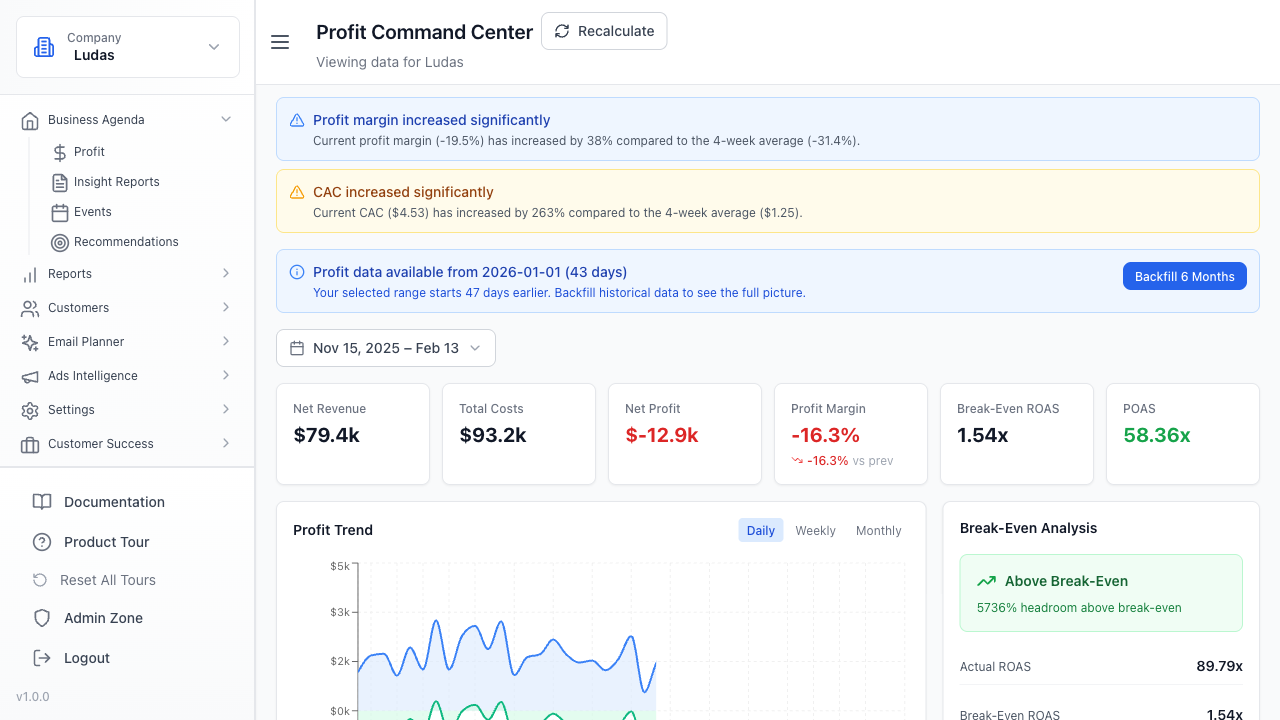
Attribution platforms map revenue to marketing touchpoints; these three differ in modeling depth, channel breadth, and pricing structure.
What Each Platform Optimizes For
Triple Whale prioritizes real-time dashboarding and operational speed. The platform surfaces daily metrics, cohort performance, and cash flow visibility in a single pane. Attribution sits alongside inventory, fulfillment, and customer data - useful for operators who need to diagnose a sales drop at 9am before standup. The trade-off: attribution modeling is lighter than competitors, leaning on first-party data and basic multi-touch rules rather than probabilistic or machine learning approaches.
Northbeam (formerly Littledata) specializes in granular, cookieless attribution. The platform reconstructs customer journeys using server-side tracking, pixel data, and offline conversions. This depth matters for brands running complex funnels across email, SMS, paid social, and search. Northbeam's model attempts to credit each touchpoint fairly in a post-cookie world, which requires more setup and ongoing tuning than plug-and-play solutions.
Polar focuses on retention analytics and cohort economics. While it includes attribution, the platform's real strength is LTV modeling, churn prediction, and repeat purchase analysis. Polar appeals to operators who already have a solid attribution tool but need better visibility into customer lifetime value and repeat revenue patterns. It's narrower in scope but deeper in retention mechanics.
Attribution Modeling: Depth and Accuracy
Attribution modeling determines how much credit each marketing channel receives for a conversion. The three platforms take different approaches, each with trade-offs.
Triple Whale uses rule-based multi-touch attribution. You can set custom rules - last-click, first-click, linear, time-decay - and apply them across channels. This is transparent and auditable, but it doesn't adapt to your actual customer behavior. If a customer sees a Facebook ad, clicks an email, and buys via organic search, the rules you set determine the split. No machine learning adjusts for patterns.
Northbeam employs probabilistic and server-side attribution. The platform ingests conversion data from your Shopify store, then backtracks to reconstruct which touchpoints preceded it. Because Northbeam runs server-side, it captures conversions that pixel-based competitors miss - especially in iOS environments where app tracking transparency limits browser cookies. The model is more accurate for multi-channel journeys, but requires proper implementation and ongoing data validation.
Polar doesn't position itself as an attribution specialist. Instead, it layers retention cohorts on top of attribution data you already have (from Shopify, GA4, or another source). This means Polar's strength is answering 'which cohorts have the highest LTV' rather than 'which channel deserves credit for this sale.' If you need both, you'll run Polar alongside another tool.
Channel Coverage and Integration Breadth
Channel coverage determines whether the platform can track all your marketing touchpoints. Gaps in coverage create blind spots in attribution.
Triple Whale integrates with Shopify natively and pulls data from major ad platforms - Facebook, Google, TikTok, Klaviyo, Gorgias. The integration list is solid for a typical DTC stack, but it's not exhaustive. If you run custom email workflows via a smaller ESP, or use a niche affiliate network, you may need to manually log those touchpoints or accept that they won't feed into attribution.
Northbeam's integration depth is broader. It connects to Shopify, Klaviyo, Gorgias, and most major ad platforms, but also supports custom events via API. This matters if you run a complex tech stack - Northbeam can ingest data from tools that don't have pre-built connectors. The trade-off is setup time; you may need engineering support to map custom events correctly.
Polar integrates with Shopify and common analytics platforms, but it's not a channel connector in the same way. Polar assumes you've already solved attribution elsewhere and wants to layer cohort analysis on top. If your attribution data lives in GA4 or a custom warehouse, Polar can read it. But Polar won't directly connect to your ad platforms to pull spend data.
Pricing and Cost Structure
Pricing varies significantly, and the cheapest option isn't always the best fit for your revenue scale or complexity.
Triple Whale charges based on Shopify revenue. Brands under $1M ARR typically pay $99 - $299 per month. As revenue scales, the fee increases - roughly 0.5% - 1% of revenue for brands doing $5M - $20M ARR. This model aligns cost with scale, but it can become expensive for high-revenue operators. A $50M brand might pay $250K - $500K annually, which is steep if you only need dashboarding and basic attribution.
Northbeam uses a tiered model based on monthly tracked conversions. Entry plans start around $500 - $1000 per month for up to 10K conversions. Mid-market brands (50K - 100K conversions monthly) typically pay $3K - $8K per month. Northbeam's pricing is predictable and doesn't scale with revenue, which favors high-AOV, lower-volume businesses. A luxury brand with $30M revenue but only 5K monthly orders might pay less than a $5M brand with 50K orders.
Polar's pricing is also tiered, starting around $500 - $1000 per month for smaller cohorts and scaling with data volume. Like Northbeam, it's conversion or event-based rather than revenue-based. Polar is typically the cheapest option for brands under $10M revenue, but it's not a standalone attribution tool - you'll need to budget for a second platform if you don't already have one.
Implementation and Setup Friction
Setup time and ongoing maintenance vary. A quick implementation doesn't guarantee accurate data.
Triple Whale is the fastest to deploy. Connect your Shopify store and ad accounts, and dashboards populate within hours. No custom code required. The downside: because setup is minimal, data quality depends entirely on how well your ad platforms and Shopify are configured. If your Facebook pixel is misconfigured, Triple Whale will reflect that error faithfully.
Northbeam requires more setup but delivers higher data quality in return. You'll configure server-side tracking, map custom events, and validate that conversions are being captured correctly. This typically takes 1 - 2 weeks with engineering support. Once live, Northbeam's server-side approach is more resilient to tracking breakage - if a pixel fails, server-side events still flow.
Polar assumes you've already solved tracking elsewhere. Setup is quick - connect your Shopify and analytics source - but the value depends on the quality of data feeding in. If your attribution is broken upstream, Polar's cohort analysis will be built on a faulty foundation.
Use Case Matching: Which Platform for Which Operator
Choosing between these three depends on your priorities and constraints.
Choose Triple Whale if you need a single dashboard for daily operations. You're running $2M - $20M ARR, you want to see cash flow, inventory, and customer data alongside attribution, and you're willing to accept simpler attribution modeling in exchange for speed and visibility. Triple Whale is best for operators who check metrics multiple times daily and need to spot trends quickly.
Choose Northbeam if attribution accuracy is your primary concern. You're running a complex multi-channel funnel, you have engineering resources to support implementation, and you're willing to pay per conversion rather than per revenue dollar. Northbeam is best for brands where a 5% - 10% error in channel attribution translates to significant budget misallocation.
Choose Polar if you're optimizing for repeat revenue and customer lifetime value. You already have an attribution tool (or you're comfortable with basic Shopify attribution), and you want to understand which cohorts are most valuable long-term. Polar is best for subscription or high-repeat-purchase businesses where LTV modeling drives strategy more than first-order attribution.
Key Metrics to Compare Before Deciding
Before committing, audit these dimensions against your specific needs.
Attribution model accuracy: Run a test campaign and compare how each platform credits it. If you're spending $10K on Facebook and $5K on email, does each platform agree on the split? Northbeam typically shows the highest agreement with actual customer behavior, but only if implemented correctly. Triple Whale may show wider variance because it relies on rules rather than probabilistic modeling.
Time to insight: How long after a conversion does each platform report it? Triple Whale updates near real-time (within hours). Northbeam may lag by 24 - 48 hours as it processes server-side data. Polar updates daily. If you need to optimize campaigns within hours, real-time matters.
Cost per tracked conversion: Divide your annual platform fee by your monthly conversions. For Northbeam, this is explicit. For Triple Whale, calculate it based on your revenue tier. For Polar, it's also explicit. A brand doing 50K conversions monthly might pay $0.01 - $0.05 per conversion depending on the platform.
Integration coverage: List every channel you run ads on, every email tool you use, and every custom data source. Check each platform's integration list. If more than 20% of your channels aren't covered, you'll have blind spots.
FAQ
Can I use Triple Whale and Northbeam together?
Yes. Many operators run both. Triple Whale handles dashboarding and operational metrics; Northbeam handles deep attribution. They don't conflict because they serve different purposes. The cost is higher, but if attribution accuracy is critical and you also need daily operational visibility, the combination is defensible.
Which platform is best for iOS tracking post-ATT?
Northbeam. Because it uses server-side tracking, it captures conversions that pixel-based competitors miss in iOS environments. Triple Whale relies more on pixel data, so iOS conversions may be undercounted. Polar doesn't specialize in this problem - it depends on the upstream attribution source.
Does Polar replace an attribution tool?
No. Polar is a retention and LTV analytics layer. It assumes you already have attribution data flowing in from Shopify, GA4, or another source. If you don't have attribution set up, start with Triple Whale or Northbeam first, then add Polar.
How often should I audit attribution accuracy?
Quarterly. Run a test campaign where you control the channel mix and customer journey, then compare what each platform reports. Attribution models drift as customer behavior changes, so regular audits catch errors before they skew budget allocation decisions.
FAQ
Can I use Triple Whale and Northbeam together?
Yes. Many operators run both. Triple Whale handles dashboarding and operational metrics; Northbeam handles deep attribution. They don't conflict because they serve different purposes. The cost is higher, but if attribution accuracy is critical and you also need daily operational visibility, the combination is defensible.
Which platform is best for iOS tracking post-ATT?
Northbeam. Because it uses server-side tracking, it captures conversions that pixel-based competitors miss in iOS environments. Triple Whale relies more on pixel data, so iOS conversions may be undercounted. Polar doesn't specialize in this problem - it depends on the upstream attribution source.
Does Polar replace an attribution tool?
No. Polar is a retention and LTV analytics layer. It assumes you already have attribution data flowing in from Shopify, GA4, or another source. If you don't have attribution set up, start with Triple Whale or Northbeam first, then add Polar.
How often should I audit attribution accuracy?
Quarterly. Run a test campaign where you control the channel mix and customer journey, then compare what each platform reports. Attribution models drift as customer behavior changes, so regular audits catch errors before they skew budget allocation decisions.