
Repeat Purchase Rate 2026: DTC Benchmarks by Vertical + 7 Proven Ways to Improve It
Repeat purchase rate is the percentage of customers who return to make a second (or subsequent) purchase within a defined time period, and the average DTC brand sees a repeat purchase rate of 25-30%. It is one of the most direct indicators of customer loyalty and product-market fit - a high repeat purchase rate means customers found enough value in their first experience to come back, while a low rate signals problems with the product, pricing, or post-purchase experience.
First orders rarely clear profit after acquisition cost, shipping, and returns. Second and third purchases are where margin shows up. Brands that only buy first-time customers stay on the acquisition treadmill.
How to calculate repeat purchase rate
The formula for repeat purchase rate is straightforward:
Repeat Purchase Rate = (Number of Customers Who Purchased More Than Once / Total Number of Customers) x 100
For a time-bound calculation (recommended for tracking trends):
Repeat Purchase Rate (12-month) = (Customers with 2+ orders in the last 12 months / All customers who placed at least 1 order in the last 12 months) x 100
Example Calculation
If your store had 8,000 unique customers in the past 12 months and 2,400 of them placed two or more orders, your repeat purchase rate is:
(2,400 / 8,000) x 100 = 30%
Important Nuances
- Time window matters. A 90-day repeat purchase rate will be much lower than a 12-month rate. Always specify the time window when reporting or comparing.
- Exclude first-time buyers from short windows. A customer who bought for the first time yesterday has not had time to become a repeat buyer. For short windows (30-90 days), consider only customers whose first purchase was at least one purchase cycle ago.
- Distinguish repeat purchase rate from retention rate. Retention rate measures how many customers from a specific cohort are still active. Repeat purchase rate measures how many customers across all cohorts have purchased more than once. Both are valuable; they answer different questions.
Repeat purchase rate benchmarks by vertical
Repeat purchase rates vary significantly by product category, purchase frequency, and business model. Here are benchmarks based on aggregated industry data:
| Vertical | Repeat Purchase Rate (12-month) | Notes |
|---|---|---|
| Consumables (supplements, food, pet) | 35-45% | High natural repurchase cycle |
| Beauty and skincare | 30-40% | Strong brand loyalty, routine purchases |
| Health and wellness | 30-38% | Product efficacy drives repeat buying |
| Apparel (mid-market) | 25-32% | Seasonal purchasing patterns |
| Home goods | 18-25% | Longer purchase cycles |
| Electronics and gadgets | 12-18% | Infrequent, high-AOV purchases |
| Luxury goods | 15-22% | High AOV offsets lower frequency |
| Subscription boxes | 40-55% | Built-in repeat by design |
| DTC average (all categories) | 25-30% | Blended across verticals |
How to Interpret Your Rate
- Below 20%: Your business is acquisition-dependent. Focus on post-purchase experience and second-order conversion before scaling ad spend.
- 20-30%: Average performance. Incremental improvements in retention will have outsized impact on profitability.
- 30-40%: Strong retention. Focus on increasing order frequency and AOV among repeat customers.
- Above 40%: Excellent. You have strong product-market fit and should invest in loyalty programs, referrals, and expanding wallet share.
How repeat purchase rate relates to clv
Repeat purchase rate is a leading indicator of customer lifetime value. The relationship is multiplicative:
CLV = AOV x Purchase Frequency x Customer Lifespan
Repeat purchase rate directly influences purchase frequency (customers who buy again tend to keep buying) and customer lifespan (repeat buyers stay active longer). A 10-percentage-point increase in repeat purchase rate typically corresponds to a 25-40% increase in average CLV, because the customers who make a second purchase are significantly more likely to make a third, fourth, and fifth.
The second purchase is the critical inflection point. Industry data shows that customers who make a second purchase are 45% more likely to make a third. Customers who make a third purchase are 54% more likely to make a fourth. The probability of the next purchase increases with each transaction, which is why driving the first-to-second conversion is the single highest-use retention activity.
Strategies to improve repeat purchase rate
1. Optimize the Post-Purchase Experience
The window between the first and second purchase is where most brands lose customers. Within the first 14 days after purchase, your brand should:
- Send a shipping confirmation with tracking and delivery estimate
- Deliver a post-purchase email with product usage tips or setup guidance
- Follow up 3-5 days after delivery asking about satisfaction
- Send a personalized product recommendation based on what they bought
Brands that implement a structured post-purchase email series see second-order rates 20-35% higher than those using only transactional emails.
2. Use Replenishment Reminders
For consumable products, timing a replenishment reminder to coincide with when the product is likely running out is one of the most effective repeat purchase drivers. Calculate the typical consumption period for each product and trigger an email or SMS at 70-80% of that period.
Replenishment reminders convert at 8-15%, compared to 1-3% for general promotional emails. They work because they arrive when the customer actually needs the product.
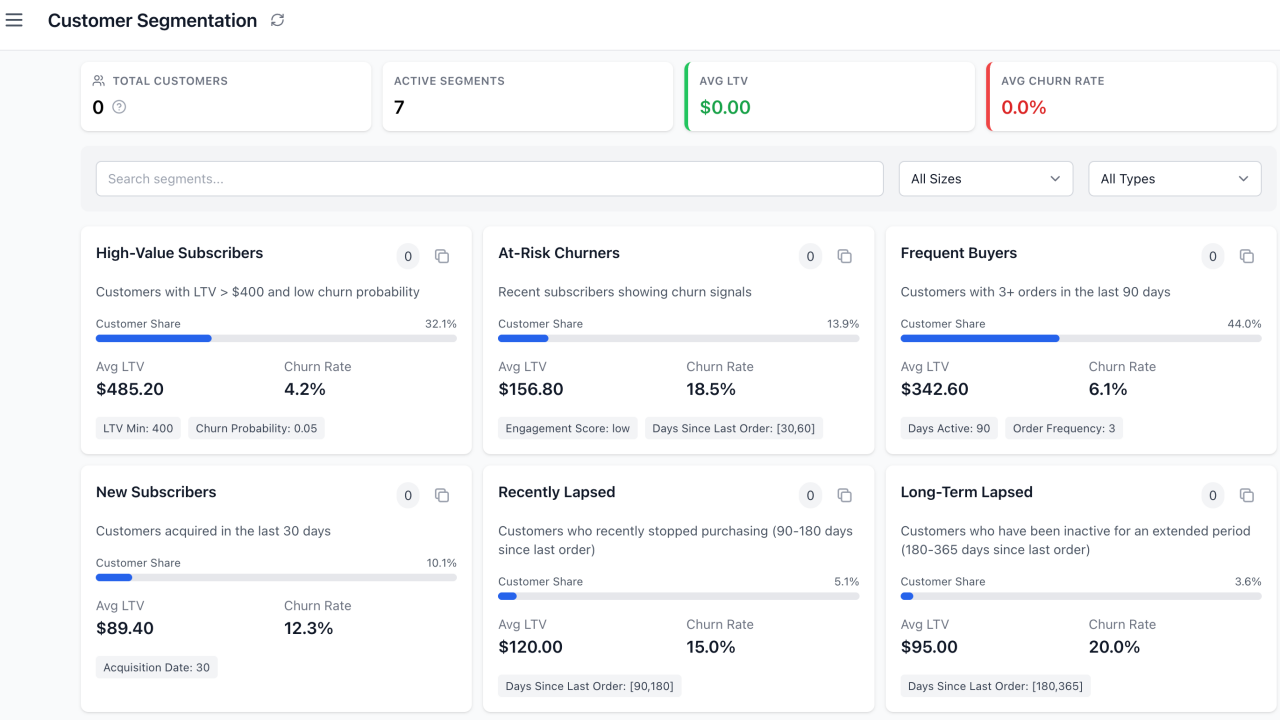
3. Implement Smart Segmentation
Not all first-time buyers have the same probability of becoming repeat customers. Smart segmentation identifies high-potential first-time buyers based on their acquisition channel, first-order composition, and early engagement signals. Focus your retention investment on the segments most likely to convert.
Customers who arrive via organic search or referral have 30-50% higher repeat purchase rates than those acquired through paid social ads. Customers whose first order includes multiple items or higher-AOV products also repeat at higher rates.
4. Launch a Loyalty or Rewards Program
Loyalty programs increase repeat purchase rates by 15-25% by adding an extrinsic reward layer on top of the intrinsic value of the product. The most effective programs make the first reward achievable within 1-2 purchases, creating immediate engagement with the program.
5. Offer Subscription Options
Subscriptions convert the repeat purchase decision from active to passive. Instead of deciding to buy again, the customer decides whether to cancel - and inertia favors retention. For brands with consumable products, offering subscription pricing with a 10-15% discount converts 15-25% of eligible one-time orders to subscriptions.
6. Use Win-Back Campaigns
For customers who have passed the expected repurchase window, win-back campaigns re-engage them with targeted offers and personalized messaging. A structured 3-email win-back sequence recovers 5-10% of lapsed customers who would otherwise be permanently lost.
7. Improve Product Quality and Consistency
No marketing tactic compensates for a product that disappoints. Monitor product reviews, NPS scores, and return rates as indicators of quality issues. Brands with NPS above 50 consistently have repeat purchase rates 15-20 percentage points higher than brands with NPS below 30.
Tracking repeat purchase rate over time
Repeat purchase rate should be tracked at two levels:
Aggregate Level
Track the overall repeat purchase rate monthly. This gives you a high-level view of whether your retention efforts are working. Plot it alongside acquisition volume to understand whether growth is coming from repeat buyers or new customer acquisition.
Cohort Level
Track repeat purchase rate by monthly acquisition cohort. This tells you whether customers acquired in January 2026 repeat at a different rate than those acquired in November 2025. Cohort analysis reveals whether changes to your product, onboarding, or post-purchase experience are actually improving retention.
| Cohort | 30-Day Repeat Rate | 60-Day Repeat Rate | 90-Day Repeat Rate | 12-Month Repeat Rate |
|---|---|---|---|---|
| Q1 2025 | 8% | 15% | 20% | 28% |
| Q2 2025 | 9% | 16% | 22% | 31% |
| Q3 2025 | 10% | 18% | 25% | - |
| Q4 2025 | 11% | 19% | - | - |
If later cohorts are repeating at higher rates at the same time intervals, your retention improvements are working.
Finsi's retention intelligence tracks repeat purchase rates automatically at both the aggregate and cohort level, surfaces the drivers behind repeat purchasing trends, and identifies which customer segments have the highest potential for repeat conversion through profit intelligence analysis.
Frequently asked questions
What is a good repeat purchase rate for e-commerce?
A good repeat purchase rate depends on your product category, but the average DTC brand sees 25-30% over a 12-month window. Consumable products like supplements, food, and pet supplies tend to achieve 35-45% due to natural replenishment cycles, while beauty and skincare brands see 30-40%. Apparel typically falls in the 25-32% range, and home goods and electronics run lower at 12-25% because of longer purchase cycles. If your rate is below 20%, your business is overly dependent on acquisition and should prioritize post-purchase experience and second-order conversion. Retention teams can benchmark against their specific vertical using Finsi's retention intelligence platform.
How do you calculate repeat purchase rate?
The formula is: Repeat Purchase Rate = (Number of Customers Who Purchased More Than Once / Total Number of Customers) x 100. For a time-bound version, divide the number of customers with 2+ orders in a given period by all customers who placed at least one order in that same period. For example, if 2,400 out of 8,000 customers placed two or more orders in the last 12 months, your repeat purchase rate is 30%. Always specify your time window (90-day, 6-month, or 12-month) when reporting, since shorter windows will naturally produce lower rates. Track this metric at both the aggregate and cohort level to understand whether recent changes are improving retention.
How can I improve my repeat purchase rate?
The highest-use strategies are: optimizing the post-purchase experience with product usage tips, satisfaction follow-ups, and personalized recommendations within 14 days of the first order (this alone lifts second-order rates by 20-35%); sending replenishment reminders timed to when the product is running out (these convert at 8-15% vs. 1-3% for general promos); implementing a loyalty program that makes the first reward achievable within 1-2 purchases; and offering subscription options with a 10-15% discount for consumable products. Growth teams should also use smart segmentation to focus retention investment on first-time buyers with the highest repeat potential. Start a free trial to identify which customers are most likely to convert into repeat buyers.
What is the difference between repeat purchase rate and retention rate?
Repeat purchase rate measures the percentage of all customers within a time window who have purchased more than once - it is a snapshot of purchasing behavior across your entire customer base. Retention rate measures how many customers from a specific acquisition cohort are still active after a defined period - it tracks whether customers from a particular group continue buying over time. Both metrics are valuable but answer different questions: repeat purchase rate tells you how much of your business comes from returning customers, while retention rate reveals whether your onboarding and product experience keep specific cohorts engaged. Finsi's retention intelligence tracks both metrics automatically and surfaces the drivers behind changes in each.
What are repeat purchase rate benchmarks by industry?
Industry benchmarks for 12-month repeat purchase rates: subscription boxes lead at 40-55% because repeat purchasing is built into the model. Consumables (supplements, food, pet products) achieve 35-45% driven by natural replenishment needs. Beauty and skincare brands see 30-40%, and health and wellness runs 30-38%. Mid-market apparel falls in the 25-32% range with seasonal patterns. Home goods average 18-25%, luxury goods 15-22%, and electronics 12-18% due to infrequent high-AOV purchases. If your rate falls below your vertical benchmark, prioritize the first-to-second purchase conversion - customers who make a second purchase are 45% more likely to make a third. Use profit intelligence to understand which segments and channels drive the highest repeat rates for your brand.
Stop guessing. Start knowing.
Finsi connects your e-commerce data, tells you what to do, and executes it — email campaigns, ad optimization, retention flows. Free 30-day trial.
Start Free Trial