
How to Reduce Involuntary Churn in 30 Days: A Week-by-Week Ops Plan
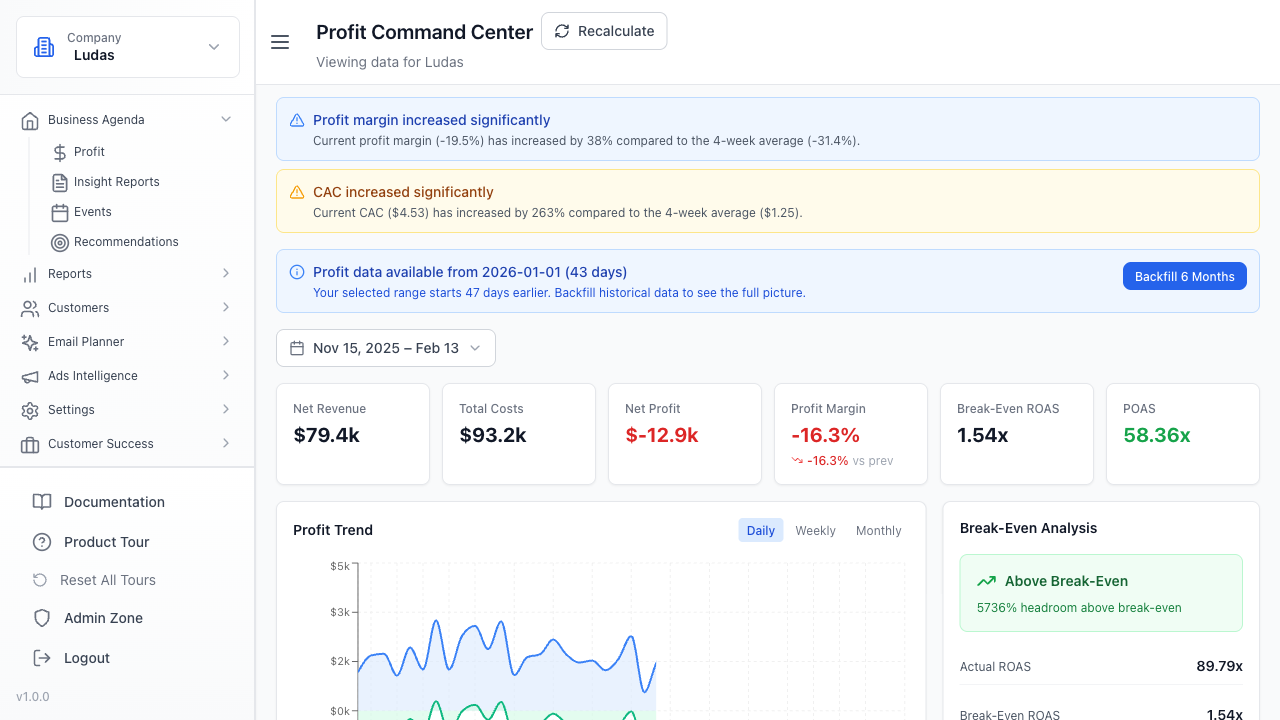
Involuntary churn occurs when a customer's subscription cancels due to a failed payment, not customer choice, and represents recoverable revenue if addressed within 72 hours.
Why 30 Days Matters for Involuntary Churn
Involuntary churn typically accounts for 20 - 40% of total subscription cancellations in DTC brands. Unlike voluntary churn, which signals product or market fit issues, involuntary churn is a payment operations problem. A failed credit card, expired card, or insufficient funds can kill a subscription in seconds. The operator's job is to recover it before the customer notices.
The 30-day window is critical because payment retry windows close fast. Most processors allow 3 - 5 retry attempts over 7 - 14 days before marking an account as failed. After day 14, recovery rates drop 60 - 70%. This plan front-loads recovery work into weeks 1 and 2, then hardens your retry logic and monitoring in weeks 3 and 4 to prevent future failures.
Week 1: Audit and Triage Failed Payments
Start by pulling a complete list of all failed payment attempts from the past 60 days. Export from your payment processor (Stripe, Adyen, etc.) and segment by failure reason: expired card, insufficient funds, processor decline, 3D Secure challenge, or other. This taxonomy matters because recovery tactics differ. An expired card needs a new payment method; insufficient funds might recover in 3 days if the customer's cash flow improves.
Prioritize by revenue impact and recency. A customer who failed 2 days ago has a 40 - 50% recovery rate if contacted today. A customer who failed 10 days ago drops to 15 - 20%. Focus week 1 outreach on failures from the past 5 days. Calculate the total at-risk MRR: multiply failed subscription count by average subscription value. This number drives urgency and budget allocation for the next three weeks.
Set up a daily monitoring dashboard. Track failed payments by reason, customer segment (new vs. returning), and time-to-contact. Assign ownership: who owns payment recovery? If it's split between finance and customer success, clarify roles now. Ambiguity kills recovery rates.
- Export 60-day failed payment history; segment by failure reason
- Calculate at-risk MRR and prioritize customers who failed in past 5 days
- Build daily monitoring dashboard; assign single owner for recovery workflow
Week 2: Execute Multi-Channel Recovery Outreach
Deploy a tiered outreach sequence. Tier 1 (day 1 - 2 after failure): automated email explaining the payment failed and linking to a self-service payment update page. Include a direct link to your billing portal so the customer can re-enter their card without friction. Tier 2 (day 3 - 4): SMS if you have the number, with a shorter message and link. Tier 3 (day 5 - 7): phone call or live chat offer if the customer is high-value (LTV > $500 or annual contract). Tier 4 (day 8+): final email with a discount incentive (5 - 10% off next month) to re-engage.
Measure response and conversion at each tier. Track open rate, click-through rate, and payment completion rate. Most operators see 15 - 25% of Tier 1 emails result in payment recovery. SMS typically converts 2 - 3x higher than email. Phone calls for high-value customers can recover 50%+ if the customer answers. Use these benchmarks to calibrate your sequence.
Avoid common mistakes: don't send generic 'payment failed' messages. Personalize with the last 4 digits of the card, the subscription product, and the next billing date. Don't bury the payment link. Make it the primary CTA. Don't wait for the customer to reach out; assume they won't notice the failure for days.
- Tier 1: automated email with self-service payment link (day 1 - 2)
- Tier 2: SMS outreach (day 3 - 4); Tier 3: phone for high-value customers (day 5 - 7)
- Measure conversion at each tier; benchmark against 15 - 25% email recovery rate
Week 3: Optimize Retry Logic and Payment Methods
Work with your payment processor or engineering team to optimize automatic retry logic. Most processors retry failed payments on a fixed schedule: immediately, then 3 days later, then 5 days later. This is often too passive. Implement smarter retry timing: if a card fails due to insufficient funds, retry in 2 days (cash flow recovery window). If it fails due to expiration, don't retry - go straight to customer outreach. If it's a processor decline (fraud check), retry in 24 hours after the customer has had time to contact their bank.
Expand payment method options. Many involuntary churn events happen because the customer's primary card is expired or compromised. Offer a fallback: store a second payment method during signup, or allow customers to choose between card, ACH bank transfer, or digital wallet (Apple Pay, Google Pay). ACH has lower decline rates than card for recurring billing. Digital wallets reduce friction on mobile. Each additional method can recover 5 - 10% of otherwise failed payments.
Implement dunning logic. A dunning page is a branded, customer-facing page that appears when a payment fails, asking the customer to update their payment method immediately. It's more effective than email because it interrupts the customer in real-time. Dunning pages typically recover 20 - 30% of failed payments on first view. Pair it with a follow-up email sequence for customers who don't interact with the page.
- Implement smart retry logic based on failure reason (insufficient funds, expiration, fraud)
- Add secondary payment methods (ACH, digital wallet) during signup
- Deploy dunning page for real-time payment recovery; expect 20 - 30% recovery rate
Week 4: Harden Monitoring and Build Predictive Alerts
Set up automated alerts for payment anomalies. If your daily failed payment count spikes 50% above the 7-day average, alert the team. If a specific payment processor or card network (Visa, Mastercard, Amex) shows elevated decline rates, investigate immediately - it may signal a processor issue or a wave of fraud. If a customer segment (e.g., new customers from a specific ad campaign) shows 2x higher involuntary churn, flag it for product or onboarding review.
Build a predictive churn model. Use historical data to identify customers at high risk of involuntary churn: those with declining engagement, multiple failed payments in the past 90 days, or cards expiring soon. Reach out proactively 7 - 10 days before their next billing date to confirm their payment method is valid. This shifts recovery from reactive (after failure) to proactive (before failure). Proactive recovery typically costs 30 - 40% less per customer and recovers 60 - 70% of at-risk subscriptions.
Document the process and assign ongoing ownership. Involuntary churn is not a one-time fix. It requires continuous monitoring and iteration. Create a weekly review cadence: every Monday, review the past week's failed payments, recovery rates by tier, and any new failure patterns. Adjust outreach timing, messaging, or payment methods based on data. Assign a single owner (finance, ops, or customer success lead) to own this metric quarter-over-quarter.
- Set up automated alerts for payment anomalies and processor issues
- Build predictive model to identify at-risk customers 7 - 10 days before billing
- Establish weekly review cadence; assign permanent owner for involuntary churn metric
Expected Outcomes and Benchmarks
A well-executed 30-day plan typically recovers 30 - 50% of involuntary churn volume. If a brand has 100 failed payments per month, this plan should recover 30 - 50 of them, preventing $5,000 - $10,000 in monthly churn (assuming $100 - $200 average subscription value). The payback period is immediate: the cost of outreach (email, SMS, phone) is typically $0.50 - $2.00 per customer, so ROI is 50:1 or higher.
By week 4, involuntary churn should drop from 20 - 40% of total churn to 10 - 15%. This frees up mental energy and resources to focus on voluntary churn, which requires product and marketing interventions. Involuntary churn is the easiest churn to fix operationally, so fix it first.
Common Pitfalls to Avoid
Pitfall 1: Assuming customers will fix their own payment method. They won't. You must reach out. Pitfall 2: Waiting too long to contact. A customer contacted on day 2 after failure is 3x more likely to re-engage than one contacted on day 7. Pitfall 3: Using generic messaging. 'Your payment failed' is weak. 'Your subscription to [Product] paused because your card ending in [1234] expired. Click here to update it in 30 seconds' is strong. Pitfall 4: Ignoring payment method diversity. If 80% of your customers use a single card network or processor, you're exposed to systemic risk. Pitfall 5: Not measuring. If you don't track recovery rates by tier, channel, and customer segment, you can't optimize. Measure everything.
FAQ
What's the difference between involuntary and voluntary churn?
Voluntary churn is when a customer actively cancels their subscription. Involuntary churn is when a subscription cancels due to a failed payment, not customer choice. Involuntary churn is recoverable within 72 hours if the customer updates their payment method. Voluntary churn requires product or pricing changes to reverse.
How much revenue can we recover in 30 days?
Recovery depends on your current involuntary churn volume and outreach effectiveness. If you have 100 failed payments per month and average subscription value of $150, you're losing $15,000 in monthly churn. A 30-day plan typically recovers 30 - 50% of that volume, so $4,500 - $7,500 in recovered MRR. The cost of execution (email, SMS, tools) is usually $500 - $2,000, so ROI is 5 - 15x.
What's the best channel for payment recovery outreach?
Email is the baseline (15 - 25% recovery rate). SMS converts 2 - 3x higher than email (30 - 60% recovery rate) but requires phone numbers. Phone calls for high-value customers (LTV > $500) can recover 50%+ if answered. Dunning pages (real-time payment update prompts) recover 20 - 30% on first view. Use all four in sequence: email first, then SMS, then dunning page, then phone for high-value customers.
Should we offer discounts to recover involuntary churn?
Discounts should be a last resort, not the first tier. Most customers will re-engage with a simple payment update prompt (Tier 1 - 2). Offering a discount too early trains customers to expect discounts and erodes unit economics. Reserve discounts for Tier 4 (day 8+) for customers who haven't re-engaged after email, SMS, and dunning page attempts. A 5 - 10% discount on the next month is typically sufficient.
FAQ
What's the difference between involuntary and voluntary churn?
Voluntary churn is when a customer actively cancels their subscription. Involuntary churn is when a subscription cancels due to a failed payment, not customer choice. Involuntary churn is recoverable within 72 hours if the customer updates their payment method. Voluntary churn requires product or pricing changes to reverse.
How much revenue can we recover in 30 days?
Recovery depends on your current involuntary churn volume and outreach effectiveness. If you have 100 failed payments per month and average subscription value of $150, you're losing $15,000 in monthly churn. A 30-day plan typically recovers 30 - 50% of that volume, so $4,500 - $7,500 in recovered MRR. The cost of execution (email, SMS, tools) is usually $500 - $2,000, so ROI is 5 - 15x.
What's the best channel for payment recovery outreach?
Email is the baseline (15 - 25% recovery rate). SMS converts 2 - 3x higher than email (30 - 60% recovery rate) but requires phone numbers. Phone calls for high-value customers (LTV > $500) can recover 50%+ if answered. Dunning pages (real-time payment update prompts) recover 20 - 30% on first view. Use all four in sequence: email first, then SMS, then dunning page, then phone for high-value customers.
Should we offer discounts to recover involuntary churn?
Discounts should be a last resort, not the first tier. Most customers will re-engage with a simple payment update prompt (Tier 1 - 2). Offering a discount too early trains customers to expect discounts and erodes unit economics. Reserve discounts for Tier 4 (day 8+) for customers who haven't re-engaged after email, SMS, and dunning page attempts. A 5 - 10% discount on the next month is typically sufficient.