
Promo Calendar and Unit Economics: The Black Friday Math Brands Skip
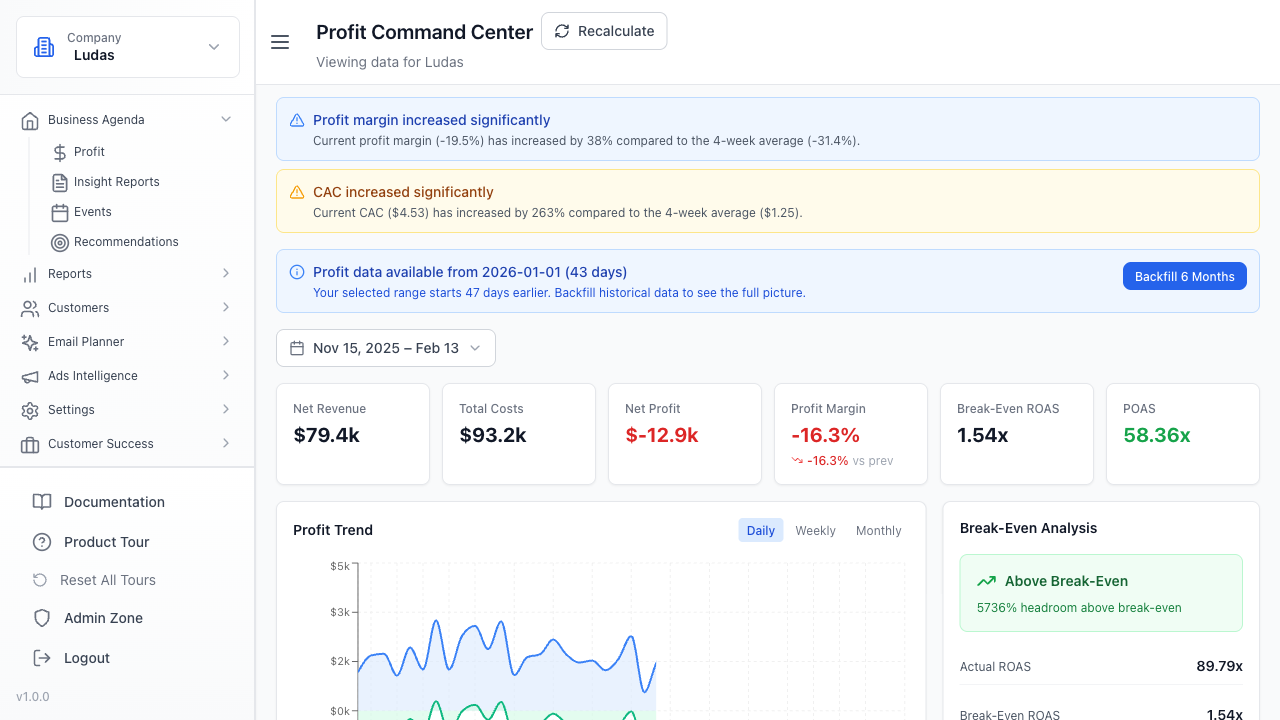
Promo calendar unit economics is the discipline of modeling margin, CAC, and inventory cost against promotional discount depth and timing to determine whether a sale actually improves unit profitability.
Why Promo Calendars Exist Without Economics
Most DTC brands build promotional calendars the same way: identify key selling moments (Black Friday, Cyber Monday, seasonal events), assign discount depths based on competitor benchmarks or historical precedent, and execute. The calendar gets locked in by August. Inventory is purchased to support the projected uplift. Paid media budgets are allocated. Then November arrives and the math breaks.
The root problem is that promotional calendars are built as marketing exercises, not as unit economics models. A brand knows it wants to run a 40% discount on Black Friday because that's what the market does. But almost no operator can articulate whether a 40% discount on a $60 item with a 55% gross margin, a $15 CAC, and 30 days of inventory carrying cost actually generates positive unit profit. The calendar becomes a revenue target, not a profitability tool.
This gap matters because promotional depth directly compresses the margin available to absorb customer acquisition cost, fulfillment, and inventory holding. A 30% discount and a 40% discount look similar on a calendar. They generate very different unit economics.
The Unit Economics Formula for Promotional Pricing
Start with the baseline: unit profit before promotion.
Unit Profit (baseline) = (Selling Price × Gross Margin %) - CAC - Fulfillment Cost
For a $60 item with 55% gross margin, $15 CAC, and $4 fulfillment: ($60 × 0.55) - $15 - $4 = $33 - $15 - $4 = $14 per unit.
Now apply the promotional discount. A 40% discount reduces the selling price to $36.
Unit Profit (promotional) = ($36 × 0.55) - $15 - $4 = $19.80 - $15 - $4 = $0.80 per unit.
The promotion compressed unit profit by 94%. The brand is now capturing $0.80 of margin per sale to cover overhead, platform fees, and profit. If CAC rises during the promotional period (which it does - Black Friday CPCs are 2x - 3x baseline), the unit becomes unprofitable.
The math gets worse when inventory carrying cost enters. If a brand purchases 10,000 units to support Black Friday demand and sells 6,000, the unsold 4,000 units carry holding cost (warehouse rent, insurance, shrink, markdown risk). That cost reduces the profitability of the units that did sell, because it's allocated across the entire purchase order.
Inventory Risk and the Hidden Cost of Promotional Timing
Promotional calendars force inventory decisions 90 - 120 days in advance. A brand commits to production and purchase orders based on a forecast of Black Friday demand. If demand comes in 20% below forecast, the brand has excess inventory that must be marked down further, held longer, or written off.
The carrying cost of inventory is often underestimated. A typical DTC brand with $50 COGS per unit, 30 days of holding, and 20% annual carrying cost incurs $0.83 per unit per month. If a unit sits for 60 days post-promotion before selling at a secondary discount, that's $1.66 of carrying cost that reduces the profitability of the original promotional sale.
Promotional calendars that cluster discounts (Black Friday, Cyber Monday, holiday sales, January clearance) create a compounding inventory problem. Unsold Black Friday inventory becomes the inventory that must be cleared in January, which means the January promotion is not a planned margin trade - it's a forced liquidation. The unit economics of January sales are determined by the inventory decisions made in August, not by the January promotional strategy.
Operators who model this backward - starting with the inventory carrying cost and working back to the discount depth that justifies the purchase order - make different calendar decisions. Some brands find that a 25% discount on 8,000 units (with lower carrying cost risk) generates better unit profit than a 40% discount on 12,000 units, even though the latter drives higher revenue.
CAC Inflation During Peak Promotional Periods
Promotional calendars assume CAC stays constant or improves due to scale. Black Friday reality is the opposite. Paid media CPCs rise 150% - 300% during peak promotional windows. Organic traffic is cannibalized by paid (users who would have visited organically now arrive via paid ads, inflating the CAC attribution). Email list fatigue increases unsubscribe rates, reducing the ROI of owned channel promotions.
A brand with a $15 baseline CAC might face a $35 - $45 CAC during Black Friday week. The unit economics formula now reads: ($36 × 0.55) - $40 - $4 = $19.80 - $40 - $4 = -$24.20 per unit. The promotion is loss-making at the unit level.
The only way this pencils is if the brand assumes a second purchase within 90 days (customer lifetime value expansion) or if the promotion is a customer acquisition play where the brand accepts a loss on the first unit to build a cohort for future monetization. Neither assumption is typically modeled in promotional calendars. The calendar shows a promotion. The unit economics show a subsidy.
Building a Promo Calendar That Starts With Unit Economics
Reverse the process. Start with the unit economics constraint: what is the minimum margin per unit required to cover CAC, fulfillment, overhead allocation, and target profit?
For a brand with $15 CAC, $4 fulfillment, and a 20% overhead allocation on COGS, the minimum margin per unit is roughly $25 (depending on target profit). If the item is $60 with 55% gross margin ($33), the brand can afford a discount of up to $8 before hitting the minimum margin floor. That's a 13% discount, not a 40% discount.
This constraint is the starting point for the promotional calendar. The brand then asks: which promotional moments justify accepting a lower margin per unit in exchange for volume uplift or customer acquisition? Black Friday might justify a 25% discount if the volume uplift is 3x baseline and CAC is managed to $25 (via organic traffic and email). A mid-season sale might not justify any discount if volume uplift is only 1.5x and CAC is uncontrollable.
The calendar becomes a series of unit economics decisions, not a series of revenue targets. Some promotional moments are skipped entirely because the unit economics don't work. Others are deepened because the margin math supports it. The calendar is shorter, more selective, and more profitable.
Benchmarking Promotional Depth Across Cohorts
Promotional depth should vary by customer cohort and product category. A new customer acquisition promotion can afford a deeper discount because the lifetime value of a new customer justifies a lower unit profit on the first purchase. A retention promotion for existing customers should be shallower because the customer already has high lifetime value and the brand is protecting margin.
Product category also matters. High-margin categories (skincare, supplements, apparel) can absorb deeper discounts while maintaining unit profit. Low-margin categories (commodity goods, bulk items) require shallower discounts or volume-based promotions (buy 2, get 10% off) to protect unit economics.
A benchmark framework: acquisition promotions should target a unit profit of $5 - $10 (accepting a 30% - 50% reduction from baseline). Retention promotions should target a unit profit of $15 - $20 (accepting a 10% - 30% reduction). Clearance promotions can accept unit losses if they free up inventory carrying cost and cash flow. These benchmarks vary by industry, but the discipline of setting them in advance prevents reactive discounting that destroys margin.
The Promo Calendar as a Constraint, Not a Forecast
The most profitable promotional calendars are built as constraints, not forecasts. Instead of predicting demand and building inventory to support it, the brand sets a maximum promotional discount for each moment based on unit economics, then builds inventory to support that constraint. If demand exceeds the inventory available at the constrained discount, the brand captures the upside as margin. If demand falls short, the brand has limited excess inventory to carry or mark down.
This approach requires discipline. It means saying no to promotional moments that don't meet the unit economics threshold. It means accepting lower revenue in some periods to protect margin in others. But the operators who do this consistently outperform those who chase every promotional calendar moment.
The promo calendar becomes a tool for managing profitability, not just revenue. Black Friday still happens. But the discount is set by unit economics, not by competitor benchmarks or historical precedent. The inventory is sized to the discount, not the other way around. The CAC is managed to the unit economics target, not the other way around. The result is a promotional strategy that actually improves unit profitability, not just unit volume.
FAQ
How do I calculate the carrying cost of inventory for promotional planning?
Carrying cost is typically 15% - 25% of the item's COGS annually. For a $50 COGS item with 20% carrying cost, the monthly holding cost is ($50 × 0.20) / 12 = $0.83 per unit per month. If a unit sits for 60 days post-promotion, add $1.66 to the cost side of the unit economics equation. This cost should be allocated backward to the promotional decision that created the excess inventory.
What if my CAC during Black Friday is 3x my baseline CAC? Should I still run the promotion?
Only if the volume uplift and customer lifetime value justify it. If baseline CAC is $15 and Black Friday CAC is $45, the unit economics require either a 3x volume uplift (to spread the CAC across more units) or a 3x customer lifetime value (to monetize the customer over time). If neither is true, the promotion is a subsidy. Consider shifting budget to owned channels (email, SMS) where CAC is lower, or reducing the promotional discount to lower the volume target and CAC pressure.
Should I use the same promotional discount for all customer segments?
No. New customer acquisition can justify a 35% - 40% discount because the lifetime value of a new customer is high. Existing customers should receive a 10% - 20% discount because they already have high lifetime value and the brand is protecting margin. Lapsed customers fall in between at 20% - 30%. Segment the promo calendar by cohort and model the unit economics separately for each.
How do I know if my promotional calendar is too aggressive?
Calculate the blended unit profit across all promotional periods (weighted by volume). If the blended unit profit is less than 50% of your baseline unit profit, the calendar is too aggressive. If you're running more than 8 - 10 promotional periods per year, the calendar is likely too frequent and is training customers to wait for discounts. Start by cutting the calendar by 30% and model the impact on annual unit profit, not just revenue.
FAQ
How do I calculate the carrying cost of inventory for promotional planning?
Carrying cost is typically 15% - 25% of the item's COGS annually. For a $50 COGS item with 20% carrying cost, the monthly holding cost is ($50 × 0.20) / 12 = $0.83 per unit per month. If a unit sits for 60 days post-promotion, add $1.66 to the cost side of the unit economics equation. This cost should be allocated backward to the promotional decision that created the excess inventory.
What if my CAC during Black Friday is 3x my baseline CAC? Should I still run the promotion?
Only if the volume uplift and customer lifetime value justify it. If baseline CAC is $15 and Black Friday CAC is $45, the unit economics require either a 3x volume uplift (to spread the CAC across more units) or a 3x customer lifetime value (to monetize the customer over time). If neither is true, the promotion is a subsidy. Consider shifting budget to owned channels (email, SMS) where CAC is lower, or reducing the promotional discount to lower the volume target and CAC pressure.
Should I use the same promotional discount for all customer segments?
No. New customer acquisition can justify a 35% - 40% discount because the lifetime value of a new customer is high. Existing customers should receive a 10% - 20% discount because they already have high lifetime value and the brand is protecting margin. Lapsed customers fall in between at 20% - 30%. Segment the promo calendar by cohort and model the unit economics separately for each.
How do I know if my promotional calendar is too aggressive?
Calculate the blended unit profit across all promotional periods (weighted by volume). If the blended unit profit is less than 50% of your baseline unit profit, the calendar is too aggressive. If you're running more than 8 - 10 promotional periods per year, the calendar is likely too frequent and is training customers to wait for discounts. Start by cutting the calendar by 30% and model the impact on annual unit profit, not just revenue.