
CAC Payback Period: 2026 Operator Guide
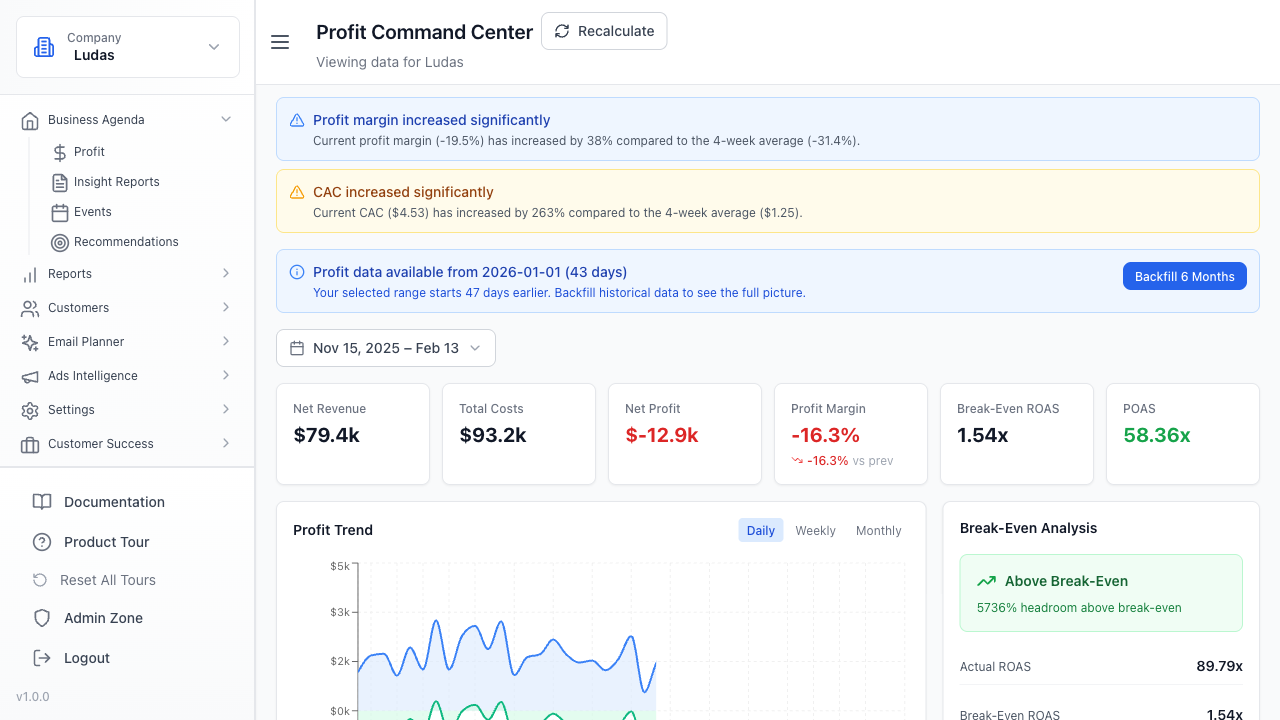
CAC payback period is the number of months required for a customer's contribution margin to recover the total customer acquisition cost, calculated as CAC divided by monthly contribution margin per customer.
What Is CAC Payback Period and Why It Matters
CAC payback period measures how long it takes for a customer to become cash-flow positive after acquisition. It's the bridge between marketing spend and unit economics. Unlike LTV, which is a lifetime projection, payback period is a real cash clock - it tells an operator when the customer stops being a liability on the balance sheet.
For DTC and ecommerce brands, payback period directly constrains growth velocity. A 3-month payback means capital tied up in customer acquisition cycles every quarter. A 12-month payback means you need deep pockets or strong unit economics elsewhere to fund scaling. This metric surfaces the tension between growth ambition and cash runway.
Payback period also flags product-market fit issues faster than LTV. If payback is extending month-over-month while CAC stays flat, the problem is retention or repeat purchase behavior, not acquisition efficiency. It's a diagnostic tool that forces operators to separate acquisition quality from product quality.
The CAC Payback Formula
The standard formula is straightforward:
CAC Payback Period (months) = CAC / (Monthly Contribution Margin per Customer)
Contribution margin per customer is gross profit minus variable costs (fulfillment, payment processing, customer service, returns) divided by the number of customers acquired in that period. Do not include fixed overhead - payback is about when the customer covers the direct cost of acquiring and serving them.
Example: A skincare brand spends $50 on paid ads to acquire a customer (CAC = $50). That customer's first order is $120 at 60% gross margin ($72). Variable fulfillment and payment costs are $12. Monthly contribution margin is $72 - $12 = $60. Payback = $50 / $60 = 0.83 months, or roughly 25 days.
The formula assumes repeat purchase behavior is captured in 'monthly contribution margin.' If the customer only buys once, use that single transaction's margin. If repeat purchases happen within the payback window, include them. Most operators model payback on first-order margin only, then track repeat contribution separately.
Payback Targets by Margin Structure
Payback targets vary sharply by business model. High-margin, high-repeat categories can sustain longer payback periods because the lifetime value math works. Low-margin, low-repeat models need aggressive payback or they run out of cash.
Subscription and membership models (beauty boxes, meal kits, software): Target 3 - 6 months. These businesses have predictable repeat revenue and can model payback on 3 - 6 months of subscription margin. A 4-month payback on a $15/month subscription with $8 contribution margin is healthy because the customer is locked in.
Apparel and accessories (40 - 50% gross margin, 1.5 - 2.5x repeat rate): Target 4 - 8 months. These categories have moderate repeat and higher CAC relative to first-order value. A 6-month payback is acceptable if repeat purchase rate is 60%+ within 12 months.
Consumables and CPG (50 - 65% gross margin, 3x+ repeat rate): Target 2 - 4 months. High repeat and margin allow faster payback. A 3-month payback on a consumable brand is standard; anything over 6 months signals either high CAC or weak retention.
Luxury and one-time purchase (60%+ gross margin, <1.5x repeat): Target 1 - 3 months. Low repeat means payback must be fast or the LTV math collapses. A luxury furniture brand with 70% margin but 1.2x repeat rate needs sub-2-month payback to justify scaling.
The key insight: payback targets are not universal. They're a function of repeat purchase rate and gross margin. An operator with 65% margin and 3x repeat can afford a 6-month payback. An operator with 45% margin and 1.3x repeat cannot.
Cash Runway Implications
Payback period directly impacts cash burn. If an operator acquires 1,000 customers per month at $50 CAC and has a 6-month payback, they're carrying $300,000 in unrecovered acquisition spend at any given time (1,000 customers × 6 months × $50). That capital is locked up until month 7.
The cash impact scales with growth rate. Doubling customer acquisition from 1,000 to 2,000 per month doubles the cash float. Extending payback from 4 to 6 months increases float by 50%. Both are growth decisions, but they have immediate balance-sheet consequences.
Operators often underestimate payback's impact on runway. A brand with $500,000 in cash, $100,000 monthly burn, and a 5-month payback needs to account for $500,000 in acquisition spend sitting in the payback queue. That's a year of runway, not five months. The payback period is a hidden cash cost.
Payback also affects financing strategy. Venture debt and growth loans often require sub-4-month payback as a covenant. If payback extends beyond 6 months, traditional capital becomes harder to access. Operators with longer payback periods need either higher margins, faster repeat, or equity funding to scale.
How to Improve Payback Period
Payback improves through three levers: lower CAC, higher first-order margin, or faster repeat purchase. Most operators focus on CAC reduction, but margin and repeat are often higher-leverage.
Lower CAC: Reduce paid acquisition spend through channel optimization, creative testing, and audience refinement. Shift spend to lower-cost channels (email, organic, referral) as brand awareness grows. CAC reduction is the most obvious lever but often the hardest to execute at scale.
Increase first-order margin: Raise prices, reduce fulfillment costs, or lower payment processing fees. A $5 price increase on a $100 order (assuming 60% margin) adds $3 to contribution margin, reducing payback by 5 - 10%. Margin improvements compound across all customers.
Accelerate repeat purchase: Improve product quality, increase order frequency through email and SMS, or introduce a subscription option. A customer who buys twice in the payback window instead of once cuts payback in half. This is the highest-leverage move for most brands but requires product and retention excellence.
Reduce variable costs: Negotiate fulfillment rates, optimize packaging, or reduce payment processing fees. A $2 reduction in variable costs per order improves payback by 3 - 5% on a typical brand. These gains are smaller but easier to execute than pricing or retention changes.
Common Payback Mistakes
Mistake 1: Including fixed overhead in contribution margin. Payback is about when the customer covers direct acquisition and fulfillment costs, not when they cover rent and salaries. Inflating contribution margin with allocated overhead makes payback look better than it is.
Mistake 2: Modeling payback on LTV instead of actual repeat behavior. Operators often assume a customer will repeat at a certain rate based on cohort data, then calculate payback on that assumption. If actual repeat is lower, payback extends and cash runway shrinks. Use conservative repeat assumptions or first-order margin only.
Mistake 3: Ignoring channel-specific payback. Paid social, search, affiliate, and organic all have different CAC and repeat profiles. A brand might have a 4-month blended payback but a 2-month payback on search and an 8-month payback on social. Channel-level payback analysis reveals which acquisition channels are actually cash-positive.
Mistake 4: Confusing payback with profitability. A customer with a 3-month payback is not profitable if they only buy once. Payback is the break-even point on acquisition cost. Profitability requires payback plus positive lifetime margin after repeat purchases and churn.
Mistake 5: Setting payback targets without considering growth rate. A 6-month payback is sustainable at 500 customers per month but unsustainable at 5,000 per month with the same cash balance. Payback targets must account for acquisition velocity and available capital.
Payback Period in 2026 Context
In 2026, payback period is more critical than ever. Rising CAC across most channels (paid social, search, affiliate) means operators can't rely on acquisition efficiency alone. Brands need stronger unit economics and faster repeat to sustain growth.
Privacy changes and iOS updates have made CAC more volatile and harder to predict. Payback period becomes a more important metric than CAC itself because it's based on actual customer behavior, not attribution models. A brand that knows its payback period is 4 months has more certainty than one that knows CAC is $50 but isn't sure if that's accurate.
Macro uncertainty also elevates payback's importance. Brands with 3 - 4 month payback periods have more flexibility to adjust spending and survive downturns. Brands with 8 - 12 month payback periods are more vulnerable to cash crunches. Payback period is a proxy for financial resilience.
The competitive advantage in 2026 goes to operators who can maintain sub-4-month payback while scaling. This requires excellence across acquisition, product, and retention. Brands that optimize payback - not just CAC - will have more capital to invest in growth and more runway to weather uncertainty.
FAQ
Should payback period include repeat purchases that happen after the payback window closes?
No. Payback period measures when the customer recovers their acquisition cost, which is typically modeled on first-order or early-cohort behavior. Repeat purchases that happen after payback closes contribute to LTV, not payback. If a customer buys in month 1 and again in month 8, only the month 1 purchase counts toward payback. This keeps payback focused on cash recovery speed, not lifetime value.
What's the difference between payback period and CAC ratio (LTV / CAC)?
Payback period measures months to break even on acquisition cost. LTV / CAC measures total lifetime value relative to acquisition cost and is a profitability metric. A brand with 3-month payback and 3x LTV / CAC is both cash-efficient and profitable. A brand with 6-month payback and 2x LTV / CAC is cash-constrained but still profitable. Payback is about timing; LTV / CAC is about magnitude.
How should operators handle payback period for subscription businesses?
For subscriptions, calculate payback on the contribution margin of the first N months of subscription revenue, where N is the expected payback window. A $15 / month subscription with $8 contribution margin has a 3-month payback if CAC is $24. Model payback conservatively by assuming churn - if 10% of customers churn each month, adjust the contribution margin downward to reflect expected revenue loss. Never assume 100% retention in the payback window.
Can payback period be negative?
Yes, if the first order's contribution margin is negative (price is below variable costs) or if CAC is extremely high relative to margin. A brand that loses money on first-order acquisition but relies on repeat purchases to break even has negative payback. This is unsustainable unless repeat rate and margin are very high. Most operators should target positive payback within 12 months or reconsider the acquisition strategy.
FAQ
Should payback period include repeat purchases that happen after the payback window closes?
No. Payback period measures when the customer recovers their acquisition cost, which is typically modeled on first-order or early-cohort behavior. Repeat purchases that happen after payback closes contribute to LTV, not payback. If a customer buys in month 1 and again in month 8, only the month 1 purchase counts toward payback. This keeps payback focused on cash recovery speed, not lifetime value.
What's the difference between payback period and CAC ratio (LTV / CAC)?
Payback period measures months to break even on acquisition cost. LTV / CAC measures total lifetime value relative to acquisition cost and is a profitability metric. A brand with 3-month payback and 3x LTV / CAC is both cash-efficient and profitable. A brand with 6-month payback and 2x LTV / CAC is cash-constrained but still profitable. Payback is about timing; LTV / CAC is about magnitude.
How should operators handle payback period for subscription businesses?
For subscriptions, calculate payback on the contribution margin of the first N months of subscription revenue, where N is the expected payback window. A $15 / month subscription with $8 contribution margin has a 3-month payback if CAC is $24. Model payback conservatively by assuming churn - if 10% of customers churn each month, adjust the contribution margin downward to reflect expected revenue loss. Never assume 100% retention in the payback window.
Can payback period be negative?
Yes, if the first order's contribution margin is negative (price is below variable costs) or if CAC is extremely high relative to margin. A brand that loses money on first-order acquisition but relies on repeat purchases to break even has negative payback. This is unsustainable unless repeat rate and margin are very high. Most operators should target positive payback within 12 months or reconsider the acquisition strategy.