
Meta Ads Automation for DTC Brands: From Manual to AI-Managed
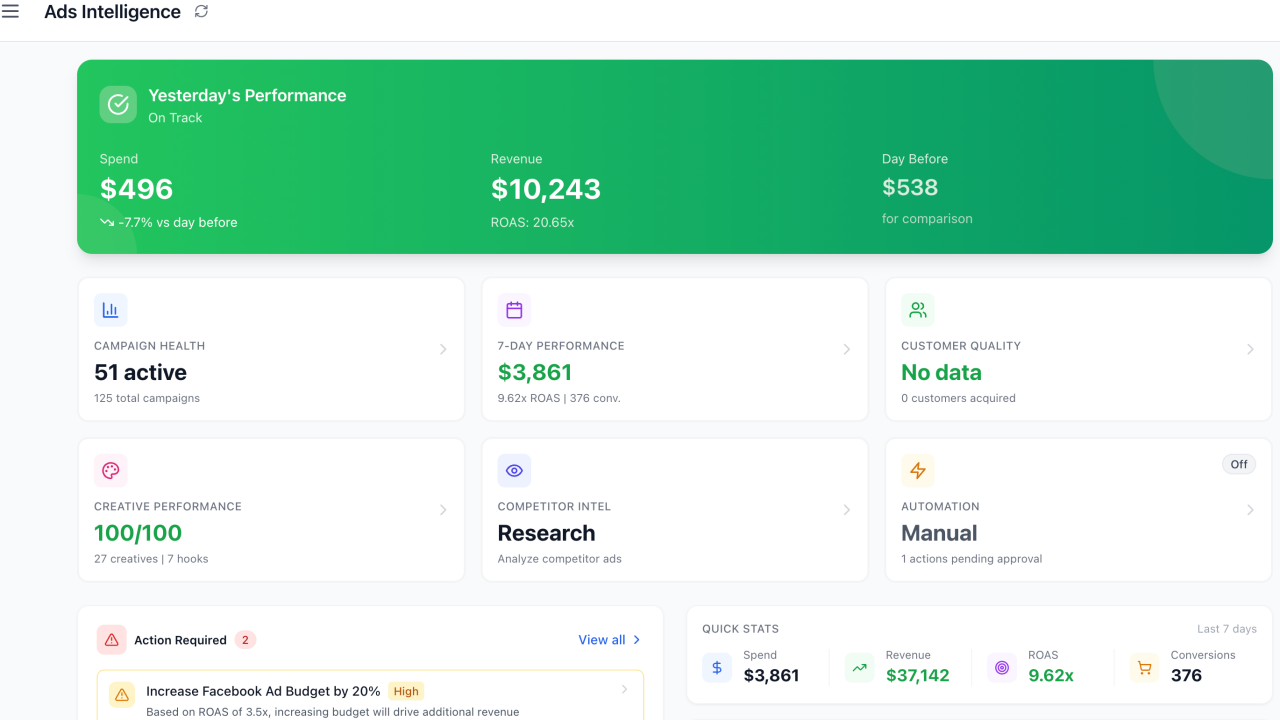
Running Meta Ads for a DTC brand in 2026 is nothing like it was five years ago. The platform has grown enormously in complexity, competition has intensified across every vertical, and the margin for error on ad spend keeps shrinking. For brands spending $10K to $500K per month on Meta, the question is no longer whether to automate - it is how to automate without losing control.
This guide breaks down the transition from manual Meta Ads management to AI-managed campaigns, covering the real pain points, the practical mechanics of automation, and the guardrails you need to keep things safe.
The problem with manual meta ads management
Most DTC brands start their Meta Ads journey the same way: a founder or growth marketer sets up campaigns in Ads Manager, uploads a handful of creatives, picks some audiences, and starts spending. It works - until it does not.
Here is what typically breaks down as you scale past $30K per month in spend.
Creative Fatigue Hits Faster Than You Can Produce
A high-performing ad creative on Meta has a shorter shelf life than most people expect. Depending on your audience size and daily spend, a winning creative can start fatiguing within 7 to 14 days. The signs are textbook: CTR drops, CPM rises, and frequency creeps up. The problem is that most teams cannot produce new creatives fast enough to keep pace with this decay cycle.
When you are managing campaigns manually, you are always playing catch-up. By the time you notice fatigue in the data, pull the creative, brief a designer, review concepts, and launch replacements, you have already wasted days of spend on declining performance.
Budget Allocation Is a Guessing Game
With multiple campaigns, ad sets, and objectives running simultaneously, deciding where to allocate budget becomes surprisingly difficult. Should you shift spend from your prospecting campaign to retargeting? Is the lookalike audience at 3% outperforming the 5%? Manual budget allocation relies on checking numbers in Ads Manager, making a judgment call, and adjusting - often once a day at best.
The issue is that Meta's auction environment changes by the hour. A budget decision that was right at 9am may be wrong by noon. Manual management simply cannot keep up with the pace of change in a real-time auction.
Audience Testing Creates Complexity Explosions
Testing audiences on Meta involves creating new ad sets, duplicating creatives, waiting for the learning phase to end, and then comparing results. When you multiply this across interest-based audiences, lookalikes at different percentages, custom audiences from different sources, and broad targeting - the matrix of tests grows exponentially. Keeping track of what has been tested, what is still in learning phase, and what conclusions to draw becomes a full-time job.
What real ads automation looks like
Automation in Meta Ads is not about pressing a button and walking away. Effective automation is a system of interconnected optimizations that work together, with human oversight at the strategic level and machine execution at the tactical level.
Bid Optimization
Automated bid management adjusts your bids based on the predicted value of each impression opportunity. Rather than setting a fixed bid or relying solely on Meta's native bidding, sophisticated automation layers in your own first-party data - such as predicted customer lifetime value - to inform bid decisions.
For example, if your system knows that customers acquired from a specific creative-audience combination tend to have 40% higher LTV than average, it can bid more aggressively for those impressions. This is fundamentally different from optimizing for the cheapest CPA, because a cheap acquisition is not always a valuable one.
Creative Rotation and Replacement
Automated creative management monitors performance signals across all active creatives and makes rotation decisions without human intervention. When a creative begins showing signs of fatigue - declining engagement rate, rising cost per result, increasing frequency - the system pauses it and activates a replacement from your creative library.
The key to making this work is having a deep enough creative library. This is where AI-powered creative generation becomes essential. Instead of relying on a design team to produce assets on demand, AI creative tools can generate variations at scale using a hook-angle matrix approach.
Budget Reallocation
Automated budget management continuously shifts spend toward the highest-performing campaigns and ad sets. This happens not once a day, but multiple times per day - responding to real-time auction conditions, time-of-day performance patterns, and competitive dynamics.
Effective budget automation also manages the balance between prospecting and retargeting spend, adjusting the ratio based on current funnel metrics. If your retargeting audiences are saturated (high frequency, rising CPM), spend shifts toward top-of-funnel. If prospecting is delivering high-quality traffic but retargeting conversion rates are strong, the system increases retargeting allocation to capture that demand.
Tools like Ads Autopilot handle this rebalancing automatically, using real-time performance data to make allocation decisions that would be impossible for a human to execute manually at the same frequency.
Ai creative generation: the hook-angle matrix
One of the most significant advances in Meta Ads automation is AI-powered creative generation. The concept behind effective AI creative generation is the hook-angle matrix - a structured framework for producing creative variations at scale.
How the Hook-Angle Matrix Works
A hook is the opening element that captures attention. An angle is the perspective or value proposition that the ad communicates. By combining different hooks with different angles, you create a matrix of unique creative concepts.
For example, a skincare DTC brand might define hooks like: a question about a common skin concern, a surprising statistic about ingredient efficacy, a before-and-after visual, or a customer testimonial opening. Their angles might include: science-backed formulations, time-saving simplicity, visible results timeline, or ingredient transparency.
Cross these four hooks with four angles and you have 16 distinct creative concepts. AI generation tools can then produce each combination as a static image, a video ad, or a carousel - multiplying your output further.
Why This Matters for Automation
The hook-angle matrix approach is what makes creative automation sustainable. Without a structured system for producing variations, you run out of fresh creatives too quickly. With a well-managed creative studio, you maintain a library of ready-to-deploy assets that the automation system can pull from when it needs to replace fatigued creatives.
The best implementations generate creatives proactively - producing the next batch of variations before the current ones fatigue - so there is never a gap in performance.
Measuring roas beyond last-click
One of the biggest traps in Meta Ads management is optimizing for the wrong measurement. Last-click attribution dramatically undervalues Meta's contribution to revenue, particularly for upper-funnel prospecting campaigns that introduce new customers to your brand.
The Problem with Last-Click
Last-click attribution gives full credit to the final touchpoint before a conversion. For Meta Ads, this means that a customer who first discovered your brand through a Facebook ad, then visited your site organically, then converted through a Google brand search - that entire conversion gets credited to Google, not Meta.
This creates a systematic bias against prospecting spend. If you optimize purely on last-click ROAS, you will over-invest in retargeting and brand search while starving the top-of-funnel campaigns that feed them.
LTV-Based Optimization
A more sophisticated approach is to optimize Meta Ads based on customer lifetime value rather than immediate ROAS. This means evaluating campaigns not just on what a customer spends on their first order, but on their predicted total value over 12, 24, or 36 months.
LTV-based optimization often reveals surprising insights. A campaign that looks mediocre on a first-order ROAS basis might actually be your most profitable channel when you account for the fact that it acquires customers who subscribe, repeat purchase, and have low return rates.
This type of analysis requires connecting your ad platform data with your customer data - purchase history, subscription behavior, return rates, and support interactions. Platforms that unify this data, like those offering attribution intelligence, make LTV-based optimization practical rather than theoretical.
Incrementality Testing
Beyond attribution modeling, the gold standard for measuring Meta Ads effectiveness is incrementality testing. This involves running controlled experiments - typically geo-based holdout tests or conversion lift studies - to measure the true incremental impact of your Meta spend.
Automated platforms can run these tests continuously, providing ongoing measurement of true incremental ROAS rather than relying on any attribution model. This gives you confidence that your automation decisions are based on real impact, not modeled estimates.
Safety guardrails for automation
The fear most DTC operators have about automation is valid: what happens when the system makes a bad decision? Effective automation includes multiple layers of guardrails to prevent runaway spend, poor performance, or brand safety issues.
Spend Limits and Alerts
At the most basic level, automation systems should enforce hard spend limits at the campaign, account, and daily level. These are not suggestions - they are circuit breakers that pause activity if spend exceeds defined thresholds. Beyond hard limits, tiered alerts notify operators when spend velocity increases beyond normal patterns, when CPA exceeds target by a defined percentage, or when ROAS drops below a minimum threshold.
Performance Floors
Rather than just capping spend, effective guardrails also define minimum performance thresholds. If a campaign's CPA rises above a defined ceiling, or if ROAS drops below a floor, the automation system reduces spend or pauses the campaign entirely. These floors should be set based on your unit economics - specifically your contribution margin and target payback period.
Creative Review Gates
While AI can generate creatives at scale, brand safety requires human review before ads go live. The best automation workflows include an approval queue where generated creatives are reviewed by a human before being added to the active library. Once approved, the automation system can deploy them freely - but the initial gate ensures brand alignment.
Gradual Scaling
Automation should increase spend gradually, not in large jumps. Effective systems use incremental scaling - increasing budgets by 10 to 20 percent at defined intervals, then monitoring performance before scaling further. This prevents the common problem of throwing too much budget at a winning campaign too fast, which often causes CPMs to spike and performance to deteriorate.
Making the transition
Moving from manual to automated Meta Ads management is not an overnight switch. The most successful transitions follow a phased approach.
Start with automating budget allocation across existing campaigns. This delivers immediate efficiency gains with low risk. Next, layer in automated creative rotation using your existing creative library. Then begin integrating AI creative generation to solve the supply constraint. Finally, shift to LTV-based optimization as your data infrastructure matures.
The brands that execute this transition well see meaningful improvements: lower effective CPAs, more consistent performance, faster creative testing cycles, and - critically - more time for strategic thinking rather than tactical execution.
An AI-managed ads platform can accelerate this transition by providing the infrastructure for each phase, from budget optimization through creative generation and LTV-based measurement.
The goal is not to remove humans from the process. It is to move human attention from repetitive tactical decisions - adjusting bids, swapping creatives, reallocating budgets - to strategic decisions that actually require human judgment: brand positioning, product strategy, and growth planning. Automation handles the execution. You handle the direction.
Frequently asked questions
What is Meta Ads automation?
Meta Ads automation uses AI and rule-based systems to manage the tactical execution of your Facebook and Instagram advertising - bid adjustments, budget reallocation, creative rotation, and audience testing - without manual intervention for each decision. It does not mean handing over your entire ad strategy to a machine. Effective automation keeps humans in control of strategic decisions (positioning, creative direction, growth targets) while letting software handle the high-frequency tactical decisions that change by the hour in Meta's real-time auction environment. Platforms like Ads Autopilot provide this infrastructure out of the box for DTC brands.
Can AI actually manage Meta Ads effectively?
Yes, but with important caveats. AI excels at the pattern recognition and rapid execution that manual management cannot match - it can reallocate budgets multiple times per day, detect creative fatigue within hours, and optimize retry timing based on thousands of historical data points. Where AI falls short is creative strategy, brand positioning, and understanding your customer in ways that require human judgment. The most successful implementations use AI for execution and humans for direction, with safety guardrails like spend limits, performance floors, and creative review gates to prevent runaway decisions. Growth teams that adopt this hybrid approach typically see lower CPAs and more consistent performance than fully manual management.
What should I automate first in my Meta Ads account?
Start with budget allocation across existing campaigns - this delivers immediate efficiency gains with the lowest risk. Automated budget management shifts spend toward top performers multiple times per day rather than once during your morning check-in. Next, layer in creative rotation so fatigued ads are paused and replacements activated automatically. Then add AI creative generation to solve the supply problem (you need a deep library for rotation to work). Finally, shift to LTV-based optimization as your data infrastructure matures. Each phase builds on the previous one, and rushing to advanced automation without the foundational layers usually backfires.
How do I handle creative fatigue with automation?
Automated creative management monitors performance signals - declining CTR, rising CPM, increasing frequency - and pauses fatigued creatives while activating replacements from your library. The key enabler is the hook-angle matrix: a structured framework for producing creative variations at scale by combining different attention hooks with different value proposition angles. A creative studio that generates variations proactively ensures you never run out of fresh assets. Without a deep creative library, automation will pause your fatigued ads and have nothing to replace them with, which is worse than manual management. Aim to maintain at least 3-4 weeks of ready-to-deploy creative inventory at all times.
What ROI can I expect from Meta Ads automation?
Brands that transition from fully manual to well-implemented automation typically see 15-30% improvement in effective CPA, more consistent day-over-day performance, and significantly faster creative testing cycles. The ROI compounds over time as the system accumulates data on what works for your specific audience and product. The less visible but equally valuable benefit is time savings - founders and growth marketers reclaim 10-20 hours per week that were spent on bid adjustments, budget shuffling, and performance monitoring. Start a free trial to see how automation performs against your current manual benchmarks with real spend data and attribution intelligence connecting ad performance to downstream customer LTV.
Stop guessing. Start knowing.
Finsi connects your e-commerce data, tells you what to do, and executes it — email campaigns, ad optimization, retention flows. Free 30-day trial.
Start Free Trial