
How to Reduce Customer Churn: 5 Interventions That Actually Move the Number (2026)
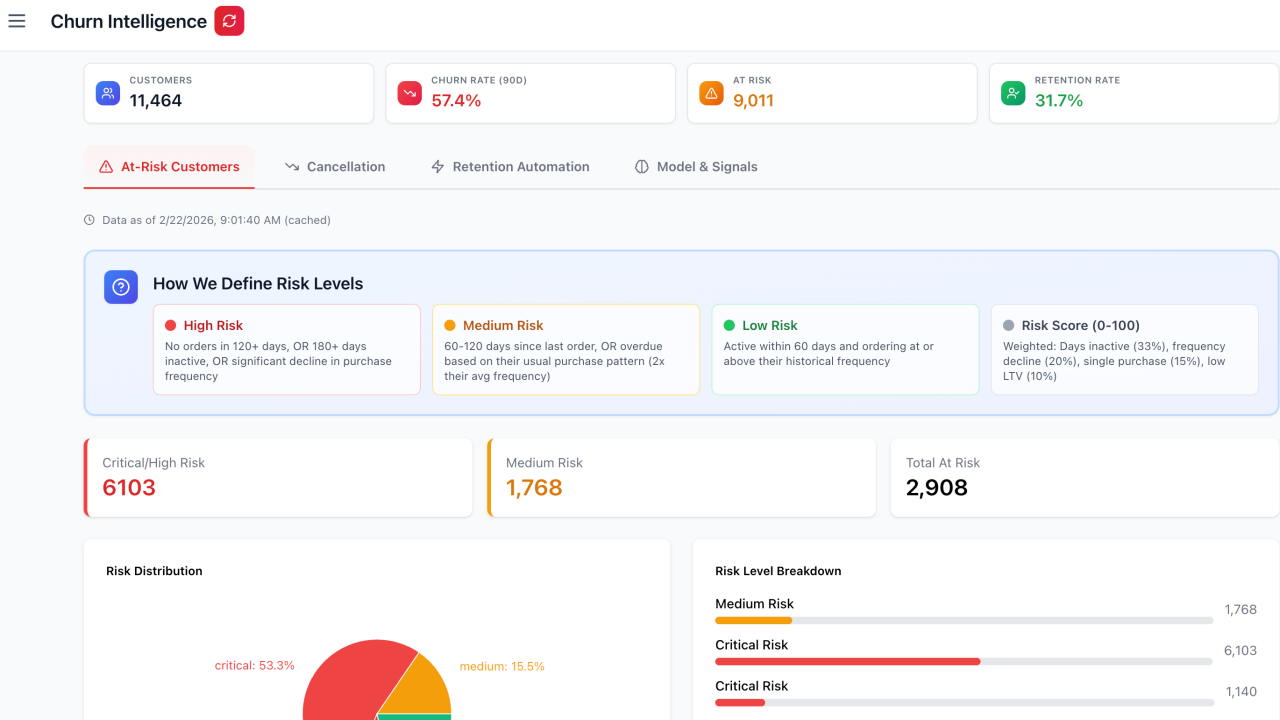
Most advice about reducing customer churn does not work. It suggests generic ideas — "improve customer service," "add a loyalty program," "communicate better" — without quantifying impact or sequencing the interventions. Brands following this advice run several programs simultaneously, measure each one weakly, and cannot tell what produced any improvement that does occur.
This piece covers the five interventions that have measurable impact on customer churn, ranked by typical effect size and time-to-result, plus the diagnostic that decides which one to start with.
Diagnose before you intervene
The right churn intervention depends on the underlying driver. Running the wrong intervention against the wrong driver produces small effects at best and burns customer goodwill at worst. The diagnostic:
Step 1 — Calculate voluntary vs involuntary churn. Pull the last 90 days of churn events. Tag each as voluntary (customer cancelled) or involuntary (payment failed and recovery did not succeed). Most subscription brands split 60-75% voluntary, 25-40% involuntary. If involuntary is over 25% of your total, smart dunning is the first move regardless of what else is happening.
Step 2 — Within voluntary, identify the lifecycle stage. Are subscribers churning in the first 60 days (onboarding failure), in months 3-6 (mid-lifecycle engagement decline), or later (value-perception decay)? Each stage has a different intervention.
Step 3 — Read the cancellation reason data, but with skepticism. Stated reasons in cancellation surveys are biased — customers often pick "too expensive" because it is the least confrontational option. Look at behavioral signals (engagement drop-off before cancellation, support ticket volume, specific products purchased) to triangulate the actual reason behind the stated reason.
The five interventions below are listed in rough order of typical impact for subscription brands. The right starting point depends on the diagnostic.
Intervention 1 — Smart dunning for involuntary churn
Impact: 6-15 percentage points off total churn rate. Implementation: 2-4 weeks. Time to result: 30-60 days.
Smart dunning is the highest-leverage churn intervention for most subscription brands. Implementation takes 2-4 weeks. Impact is visible within 30-60 days. The math is unambiguous — moving from basic retry logic (15-25% recovery rate) to AI-optimized dunning (55-80% recovery rate) is a 30-60 percentage point swing in recovery, which translates into 6-15 percentage points off total churn for the typical brand.
The specific changes that drive impact:
- Retry timing optimized by decline code. Insufficient-funds failures retry on Day 4-7 (paycheck cycles). Network declines retry immediately. Expired cards trigger card updater services in parallel.
- Multi-channel customer notification. Email + SMS + in-app for subscribers who do not respond to email.
- Pre-dunning alerts. Notify subscribers 7 days before their renewal date if their card is expiring soon — recovers payment before the failure ever happens.
See the smart dunning vs basic retries breakdown for the methodology detail and the best dunning management software 2026 guide for the tool comparison.
Intervention 2 — Fix the first-purchase-to-second-purchase gap
Impact: 5-15 percentage point lift in repeat purchase rate. Implementation: 4-8 weeks. Time to result: 60-120 days.
Most DTC brands retain only 25-30% of first-time buyers for a second purchase. The gap is mostly closeable with onboarding work — welcome email sequences, product-fit education, replenishment reminders timed to typical reorder cycles.
The specific changes that drive impact:
- Welcome sequence within 7 days of first purchase. Brand story, product education, second-purchase recommendation. Most brands either send no welcome flow or one that converts at <2%.
- Replenishment reminders timed to actual reorder cycles. Consumables on a 30-day cycle, beauty on a 45-60-day cycle, supplements on a 60-90-day cycle. Timing matters more than copy.
- Personalized second-purchase recommendations. "Customers who bought X also bought Y" based on actual co-purchase patterns, not generic best-sellers.
The lift compounds — brands that fix the first-to-second gap typically see follow-on improvements in third-purchase and fourth-purchase rates because the customers acquired at the higher rate were higher-quality acquisition signals.
Intervention 3 — Segment-aware winback campaigns
Impact: 5-15% recovery of cancelled customers within 60 days. Implementation: 2-4 weeks. Time to result: 30-60 days.
Treating all cancelled customers identically wastes effort. Different segments need different offers — discount for price-sensitive, pause options for usage concerns, content for engagement-driven cancellations.
The specific changes that drive impact:
- Segment by stated cancellation reason. Price-justified cancellations get a discount offer. Usage-justified cancellations get a pause-then-resume option. Engagement-driven cancellations get content about the value they are leaving.
- Time the winback to the actual likelihood of return. Beauty brands have peak winback response around 60-90 days post-cancellation. Subscription boxes peak around 30-45 days. Supplements peak when the customer runs out of what they bought before cancelling.
- A/B test the offer, not just the copy. Discount amount, pause length, free shipping — the offer drives recovery rate more than the email subject line does.
See the winback campaign guide for the detailed playbook.
Intervention 4 — Subscription cancellation flow optimization
Impact: Save 15-30% of customers who reach the cancel button. Implementation: 3-6 weeks. Time to result: Immediate.
A well-designed cancellation flow with reason-matched retention offers saves a meaningful share of subscribers who initiated cancellation. The flow asks for the reason before showing the cancel button, presents alternatives matched to the reason (pause, skip, swap, downgrade, discount), and offers a human conversation for high-value subscribers.
The specific changes that drive impact:
- Ask for the reason before allowing cancellation. Many subscribers reconsider once they articulate why they are leaving.
- Match the offer to the reason. Price concerns get a discount or pause. Usage concerns get a pause or skip option. Product fit issues get a swap option. Generic "are you sure?" prompts do not work.
- Skip the flow for high-friction segments. Cancellation flow optimization is for subscribers who are weighing the decision — not for customers in financial distress or product returns. Trying to retain those customers harms long-term brand perception.
See the subscription cancel flow best practices for the detailed design framework.
Intervention 5 — VIP and tiered loyalty programs
Impact: 2-5x annual spend lift for VIP-tier customers; retention above 80% within tier. Implementation: 8-16 weeks. Time to result: 6-12 months.
VIP tiers create aspirational targets that motivate increased spending and frequency. Customers who reach VIP status spend substantially more annually than standard customers and retain at substantially higher rates.
The specific changes that drive impact:
- Clear qualification criteria. Spend $500/year or place 6+ orders to reach Gold status. Customers need to know how to achieve the tier.
- Meaningful benefits that cannot be replicated by a generic discount code. Free expedited shipping, early access to launches, dedicated support, extended return windows.
- Visible progress tracking. Show customers their progress toward the next tier in their account dashboard. The psychology of loss aversion makes them maintain frequency to keep status.
This is the longest-build intervention but the LTV impact is significant once it compounds. Loyalty programs are often the right move for brands at $5M+ revenue where the customer base is large enough that VIP tiers can be sized correctly.
Sequencing the interventions
The right order matters because the fast wins (dunning) fund the slower compounders (loyalty). Recommended sequence for a brand starting from scratch:
| Month | Intervention | Expected impact |
|---|---|---|
| 1-2 | Smart dunning implementation | 6-15 pp off churn |
| 3-4 | First-purchase welcome flows | 5-15 pp lift in repeat rate |
| 5-6 | Cancellation flow optimization | Save 15-30% of cancellations |
| 7-8 | Segment-aware winback | Recover 5-15% of recent cancellations |
| 9-12 | VIP loyalty program launch | 6-12 month compounder |
Brands that follow this sequence typically see total monthly churn drop 30-50% relative to baseline within 12 months, with the LTV impact larger than the churn improvement because the customers retained at the margin are typically higher-value than the customers who were going to churn regardless.
Where this leads
Customer churn reduction is one of the most leveraged disciplines in ecommerce. A small monthly churn improvement compounds badly in the customer`s favor — 2 percentage points off monthly churn translates into materially higher annual retention and significantly higher LTV, which raises the CAC ceiling, which enables faster growth.
For the diagnostic methodology, see the customer churn complete guide. For the broader retention management discipline, see the customer retention management guide. For specific tool selection, see the best customer retention software 2026 guide.
Finsi`s retention intelligence platform covers the analytics and execution layer of all five interventions in one product — smart dunning, post-purchase flows, winback automation, cancellation flow integration, and VIP loyalty support. Start a free trial to see which intervention would deliver the biggest impact on your specific churn profile.
FAQ
How do I reduce customer churn?
The five interventions that actually move customer churn, ranked by typical impact: (1) implement smart dunning to recover failed payments — the fastest 30-60 day win, addresses 25-40% of total churn; (2) fix the first-purchase-to-second-purchase gap with post-purchase welcome flows; (3) deploy segment-aware winback campaigns matched to churn reason; (4) optimize subscription cancellation flows with reason-matched retention offers; (5) launch VIP and tiered loyalty programs that compound retention over 6-12 months. Most brands compound several of these for a 25-50% LTV lift within 12 months.
What is the fastest way to reduce churn?
Smart dunning is the fastest way to reduce churn for subscription brands. Implementation takes 2-4 weeks. The impact is visible within 30-60 days. Smart dunning recovers 55-80% of failed payments versus 15-25% for basic retry logic, addressing the 25-40% of total churn that comes from payment failures rather than customer dissatisfaction. For a $1M MRR brand with a 10% failure rate, the difference is roughly $40,000 per month in recovered revenue.
How can I prevent customer churn?
Customer churn prevention works in layers. The data layer unifies customer information across Shopify, email, subscription, and support. The intelligence layer predicts which customers are at risk of churning in the next 30-60 days. The action layer runs interventions matched to risk segment — at-risk subscribers get retention offers, recently-failed-payment subscribers get smart dunning, disengaged subscribers get re-engagement content. The measurement layer attributes which interventions actually moved retention. Skipping any of the four layers limits the impact of the others.
What is the best churn prevention software?
For subscription brands the best churn prevention software depends on the binding churn driver. For involuntary churn (failed payments): Churn Buster, Butter Payments, ProsperStack, or unified platforms like Finsi that include AI-powered dunning. For voluntary cancellations: Churnkey or ProsperStack for cancellation flow optimization. For broader retention intelligence (predictive modeling, customer health scoring, automated winback): Finsi or the combination of Peel Insights plus a separate execution tool. Most brands assemble a stack of 2-3 tools across these categories or use a unified platform.
How much can I reduce customer churn by?
Realistic churn reduction targets vary by current state and intervention. Smart dunning typically reduces total churn 6-15 percentage points (by addressing involuntary churn). Post-purchase welcome flows reduce first-window churn 5-15 points. Cancellation flow optimization saves 15-30% of customers who reach the cancel button. Combined, a sustained 12-month focus on retention typically reduces monthly churn by 30-50% relative to baseline — for a brand starting at 12% monthly churn, that means moving to 6-8% monthly churn within a year.
What causes high customer churn?
Five common root causes of high churn: (1) product-market fit gap — customers do not get expected value from the product; (2) onboarding failure — customers signed up but never reached the magic moment; (3) failed payment recovery — involuntary churn from expired cards and bank declines; (4) pricing-value mismatch — perceived value drops below the price point over time; (5) competitive displacement — better alternatives emerging in the market. Diagnosing which cause dominates is the prerequisite for picking the right intervention.
How do I know which churn intervention to start with?
Diagnose first. Calculate voluntary vs involuntary churn split. If involuntary is over 25% of total, smart dunning is the first move (fastest win, clearest ROI). If first-window retention is the binding constraint (subscribers churning within 60 days of signup), onboarding is the first move. If mid-lifecycle engagement is declining, lifecycle email is the first move. If price-justified cancellations dominate the cancellation surveys, loyalty or pricing changes are the first move. Running multiple interventions simultaneously without diagnosis produces noise, not learning.