Gorgias vs Zendesk for Ecommerce: Which Support Platform Protects Retention
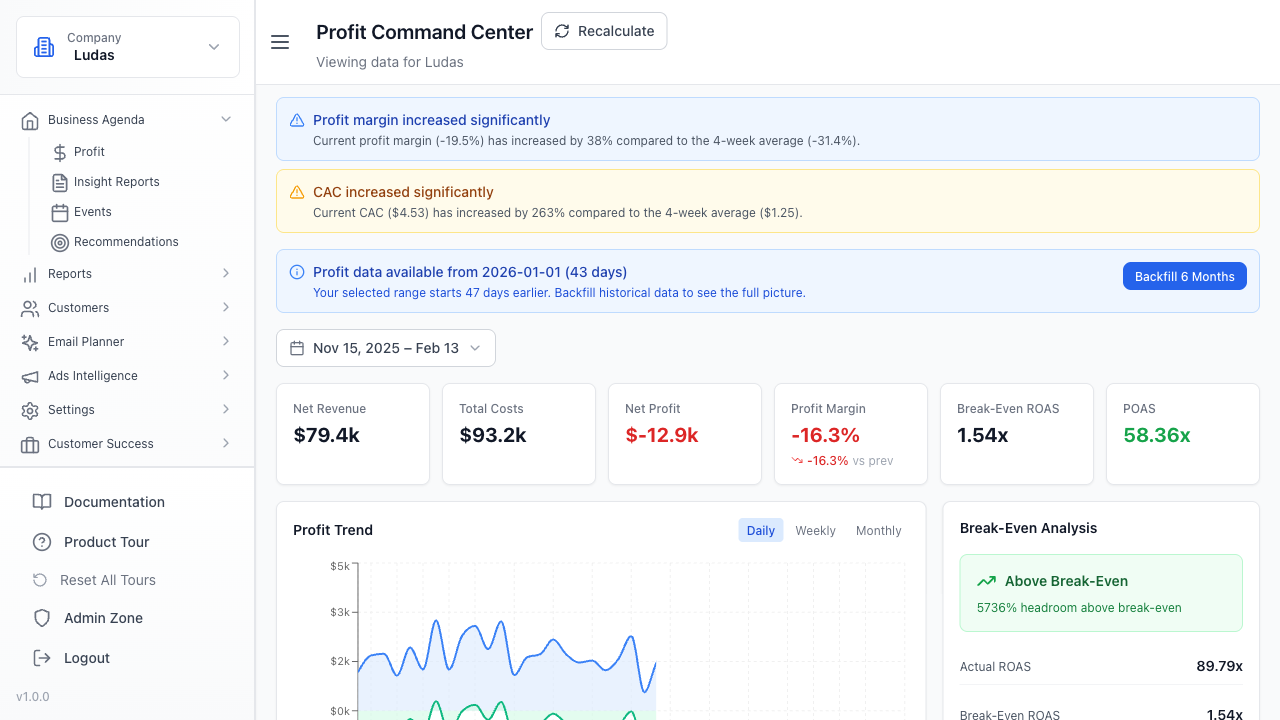
Support platform selection determines how fast a brand resolves customer friction before it becomes churn, making tooling choice a retention lever, not just an operational one.
Why Support Tooling Affects Ecommerce Retention
Customer support is not a cost center in ecommerce - it's a retention checkpoint. When a customer hits friction (wrong item shipped, sizing question, refund request), the speed and quality of resolution directly influences whether they return. Slow or fragmented support experiences push repeat customers to competitors.
Gorgias and Zendesk represent two different philosophies. Gorgias was built for DTC brands and integrates natively with Shopify, WooCommerce, and BigCommerce. Zendesk is a general-purpose platform that serves SaaS, agencies, and ecommerce equally, requiring more custom setup. The difference shows up in onboarding time, integration depth, and how naturally support data flows back into your retention metrics.
For operators managing LTV, the question isn't which platform is 'better' - it's which one reduces time-to-resolution and prevents repeat inquiries. A customer who waits 48 hours for a shipping status update is more likely to open a chargeback or abandon their next purchase. A platform that auto-resolves 30% of common questions saves both support cost and churn.
Gorgias: Native Ecommerce Integration and Speed
Gorgias was purpose-built for Shopify and other ecommerce platforms. It pulls order history, customer purchase data, and inventory status directly into the support interface. A support agent sees the customer's full order timeline without leaving the ticket view. This reduces resolution time because context is pre-loaded.
The platform includes native automation for common ecommerce scenarios: order status requests, refund inquiries, shipping delays, and product recommendations. Gorgias can auto-respond to 'where is my order' with actual tracking data, or suggest a similar item if something is out of stock. These automations reduce ticket volume by 20-40% depending on your FAQ coverage and product catalog complexity.
Gorgias pricing is usage-based and starts around $10/month for basic plans, scaling to $300+ for enterprise. For a 5-person support team, expect $150-300/month. The platform integrates with Shopify, WooCommerce, BigCommerce, Magento, and custom APIs. Setup typically takes 1-2 weeks for full integration including automation rules and team training.
- Native Shopify sync - order and customer data pre-loaded in tickets
- AI-powered auto-responses for common ecommerce questions
- Built-in macros and canned responses optimized for DTC workflows
- Mobile app for support agents working off-site
- Integrates with Klaviyo, Attentive, and other retention tools
Zendesk: Flexibility and Scale at Higher Complexity Cost
Zendesk is the enterprise standard for support. It handles high-volume tickets, complex routing, and multi-channel support (email, chat, phone, social) with mature reporting. If your brand operates across multiple channels and needs sophisticated ticket assignment logic, Zendesk's flexibility is an advantage.
For ecommerce, Zendesk requires more setup work. You need to build or install custom apps to pull order data into tickets. Shopify integration exists but isn't as seamless as Gorgias - you'll likely use a third-party connector or custom middleware. This adds 3-6 weeks to implementation and requires ongoing maintenance.
Zendesk pricing starts at $49/agent/month (Team plan) and scales to $299+/agent/month (Enterprise). For a 5-person team, expect $245-1500/month depending on plan tier. The platform is stronger for brands with 50+ support agents, complex SLAs, or multi-brand support operations. For smaller DTC teams, the cost-to-value ratio often favors Gorgias.
- Mature multi-channel support (email, chat, phone, social, messaging apps)
- Advanced routing and assignment rules for large teams
- Extensive reporting and analytics dashboards
- Marketplace of third-party integrations and custom apps
- Strong compliance and security features (SOC 2, HIPAA)
Integration Depth and Retention Data Flow
The real difference emerges when you map support data back to retention metrics. Gorgias automatically logs resolved issues to Shopify customer profiles and integrates with email marketing platforms. If a customer had a refund issue, that signal can trigger a win-back campaign in Klaviyo. This feedback loop is native.
Zendesk requires custom integration work to achieve the same flow. You'll need Zapier, a custom webhook, or a dedicated integration engineer to push resolved ticket data into your CDP or email platform. This adds latency and creates points of failure. For a brand optimizing LTV, that friction matters.
Both platforms support API access, so custom integrations are possible. The question is: how much engineering time do you want to spend on support tooling versus on product and marketing? Gorgias minimizes that burden for ecommerce operators. Zendesk assumes you have the resources to customize.
Automation and Cost Reduction
Automation is where support tooling directly impacts unit economics. Gorgias includes AI-powered response suggestions and rule-based auto-replies. A brand can set up rules like: if a ticket contains 'tracking' and order status is 'shipped', auto-send tracking link and close ticket. This reduces manual handling.
Zendesk offers similar automation through Zendesk Automation and AI (Zendesk's AI-powered answer engine). However, setup requires more configuration and testing. The learning curve is steeper, and you'll need someone on your team to own automation rule maintenance.
For a typical DTC brand, 25-35% of support tickets are repetitive (tracking, returns, sizing, general product questions). Automating these saves 8-12 hours per week for a 5-person team. At $20/hour fully loaded cost, that's $160-240/week or $8,300-12,500/year in labor savings. Gorgias typically reaches this ROI faster because automation is pre-configured for ecommerce.
Team Onboarding and Time-to-Value
Gorgias agents can handle tickets productively within 3-5 days. The interface is designed for ecommerce support, so context is obvious. New hires see order history, customer lifetime value, and previous interactions immediately. Training focuses on company-specific policies, not platform navigation.
Zendesk requires 1-2 weeks of onboarding for new agents. The platform is more general-purpose, so agents need to learn custom fields, ticket types, and routing rules specific to your setup. If you have high support team turnover, this compounds the cost.
For retention-focused operators, faster onboarding means faster response times during peak periods (Black Friday, new product launches). A brand that can spin up support capacity in days instead of weeks has a competitive advantage in customer experience.
When to Choose Each Platform
Choose Gorgias if: you operate a single or dual-brand DTC business on Shopify or WooCommerce, your support team is under 20 people, and you want to minimize setup time. Gorgias is optimized for your use case and will reduce time-to-resolution faster.
Choose Zendesk if: you operate multiple brands or channels, your support team exceeds 30 people, you need sophisticated reporting and compliance features, or you have the engineering resources to customize integrations. Zendesk scales better at high volume and offers more flexibility for complex workflows.
A hybrid approach is also viable: some brands use Gorgias for Shopify support and Zendesk for phone/enterprise sales support, routing tickets between platforms. This requires integration work but can optimize for each channel's needs.
FAQ
How much faster is Gorgias than Zendesk for resolving ecommerce tickets?
Gorgias typically reduces first-response time by 30-50% compared to Zendesk for ecommerce brands, primarily because order data is pre-loaded and automations are pre-configured. Zendesk requires custom setup to achieve similar speed. The actual difference depends on your team's familiarity with each platform and how well your automations are tuned. Brands report that Gorgias reaches 'productive' automation within 2-3 weeks, while Zendesk takes 6-8 weeks.
Can Zendesk integrate with Shopify as well as Gorgias?
Zendesk can integrate with Shopify, but not natively. You'll need a third-party app (like Zendesk's Shopify app) or a custom integration via Zapier or webhooks. Order data won't appear automatically in tickets the way it does in Gorgias. For ecommerce-specific workflows, Gorgias is more seamless. Zendesk's strength is flexibility - you can build any integration you want, but it requires more work upfront.
Which platform is cheaper for a small DTC team?
Gorgias is typically 40-60% cheaper for teams under 10 people. Gorgias starts at $10/month and scales to $300+ depending on ticket volume. Zendesk starts at $49/agent/month, so a 5-person team costs at least $245/month. However, Zendesk's cost advantage emerges at scale - once you exceed 20 agents, Zendesk's per-agent pricing becomes competitive, especially if you need multi-channel support.
How does support platform choice affect customer retention?
Support platform choice affects retention through resolution speed and automation. Faster resolution reduces repeat inquiries and chargeback risk. Better automation prevents customers from waiting for responses to common questions. Gorgias's ecommerce-native design typically reduces time-to-resolution by 1-2 days compared to Zendesk, which translates to 2-5% lower churn for repeat customers. For a brand with 10,000 monthly repeat customers and 5% churn, that's 50-500 retained customers per month, or $5,000-50,000 in recovered LTV depending on AOV.
FAQ
How much faster is Gorgias than Zendesk for resolving ecommerce tickets?
Gorgias typically reduces first-response time by 30-50% compared to Zendesk for ecommerce brands, primarily because order data is pre-loaded and automations are pre-configured. Zendesk requires custom setup to achieve similar speed. The actual difference depends on your team's familiarity with each platform and how well your automations are tuned. Brands report that Gorgias reaches 'productive' automation within 2-3 weeks, while Zendesk takes 6-8 weeks.
Can Zendesk integrate with Shopify as well as Gorgias?
Zendesk can integrate with Shopify, but not natively. You'll need a third-party app (like Zendesk's Shopify app) or a custom integration via Zapier or webhooks. Order data won't appear automatically in tickets the way it does in Gorgias. For ecommerce-specific workflows, Gorgias is more seamless. Zendesk's strength is flexibility - you can build any integration you want, but it requires more work upfront.
Which platform is cheaper for a small DTC team?
Gorgias is typically 40-60% cheaper for teams under 10 people. Gorgias starts at $10/month and scales to $300+ depending on ticket volume. Zendesk starts at $49/agent/month, so a 5-person team costs at least $245/month. However, Zendesk's cost advantage emerges at scale - once you exceed 20 agents, Zendesk's per-agent pricing becomes competitive, especially if you need multi-channel support.
How does support platform choice affect customer retention?
Support platform choice affects retention through resolution speed and automation. Faster resolution reduces repeat inquiries and chargeback risk. Better automation prevents customers from waiting for responses to common questions. Gorgias's ecommerce-native design typically reduces time-to-resolution by 1-2 days compared to Zendesk, which translates to 2-5% lower churn for repeat customers. For a brand with 10,000 monthly repeat customers and 5% churn, that's 50-500 retained customers per month, or $5,000-50,000 in recovered LTV depending on AOV.