
How to Fix a High-CAC Week Without Pausing Everything
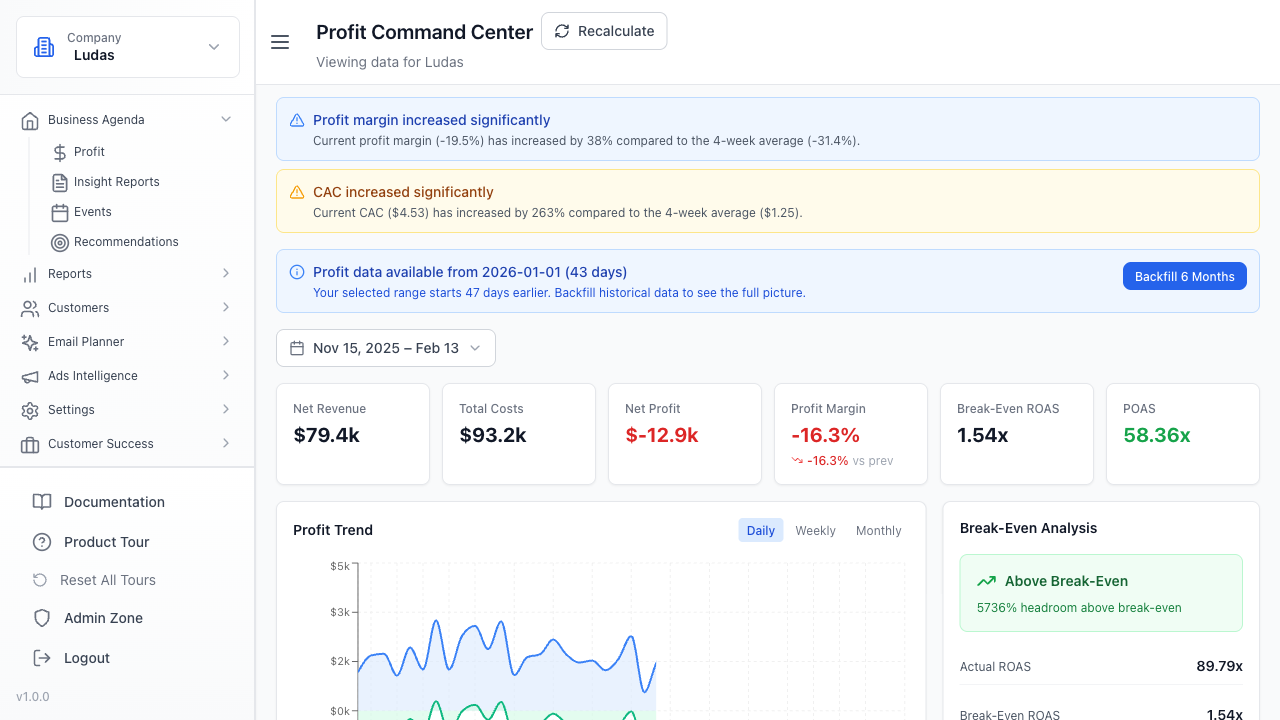
Customer acquisition cost (CAC) spike recovery is the tactical reallocation of ad spend and creative testing applied within a single week to restore unit economics without halting campaigns.
Why High-CAC Weeks Happen (And Why Pausing Is Lazy)
A high-CAC week is not a signal to kill everything. It's a signal that something in your funnel, creative rotation, or audience targeting has shifted. Pausing campaigns is the operator equivalent of unplugging the router when the WiFi is slow - it feels like action but solves nothing.
High CAC typically stems from three sources: audience fatigue (your core segments have seen your ads too many times), creative decay (top performers are aging out), or targeting drift (your pixel data is stale or your LTV cohorts are changing). A single week of elevated costs is recoverable if you diagnose which one is happening and move fast.
The key insight: you have 5 - 7 days to test and reallocate before the week becomes a month. Waiting for perfect data is how a 40% CAC spike becomes a 60% one.
The 48-Hour Diagnostic: What to Check First
Before reallocation, establish what changed. Pull your ad account data from the last 14 days and compare this week to the prior two weeks across three dimensions: cost per click (CPC), click-through rate (CTR), and conversion rate (CVR). A rising CPC with flat CTR points to auction pressure or audience saturation. Flat CPC with falling CVR points to creative or landing page issues. Flat CPC and CTR with rising CAC suggests your conversion funnel is leaking.
Check your creative rotation. If your top 3 ads are all over 2 weeks old and running to the same audiences, fatigue is the culprit. Pull impression share and frequency data - if frequency is above 3.5 and CTR is down week-over-week, pause the oldest creative and test new angles immediately.
Validate your pixel health. If you're using lookalike or retargeting audiences, confirm that your pixel is firing correctly and that your conversion window hasn't drifted. A misconfigured pixel can inflate CAC by 20 - 30% without changing actual customer quality.
- Compare CPC, CTR, CVR across last 14 days
- Check creative age and frequency by ad
- Validate pixel firing and conversion attribution
- Review audience overlap and saturation metrics
Budget Reallocation Rules That Work
Once you've identified the problem, reallocate spend using a tiered system. Do not move all budget at once. Instead, shift 20 - 30% of spend from your highest-CAC campaigns to either new audience segments or fresh creative tests. This preserves volume while creating a control group.
Rule 1: Pause underperforming segments, not entire campaigns. If your core audience (e.g., 'Engaged Users') is at 2x target CAC but your 'Lookalike Tier 1' is at 1.2x, cut the core audience by 50% and reallocate that budget to lookalike expansion. Keep the core audience running at reduced scale so you can measure recovery.
Rule 2: Shift budget toward your lowest-CAC channel or device. If mobile is outperforming desktop by 30%, move 15 - 20% of desktop budget to mobile. If email or organic are performing, reduce paid spend by 10% and test a paid + organic combo on a subset of your audience.
Rule 3: Reserve 10 - 15% of your weekly budget for creative tests. Do not take this from your core spend. This is new money that goes to testing 2 - 3 new ad angles, hooks, or formats. Allocate it evenly across tests and measure after 48 hours. Kill losers, double winners.
The math: if your weekly budget is $10k and CAC is 40% above target, reallocate $2k - $3k to new segments or creative, keep $7k - $8k on proven performers at reduced scale, and reserve $1k for tests.
- Pause segments, not entire campaigns
- Shift budget to lowest-CAC channel or device
- Reserve 10 - 15% for creative tests
- Measure after 48 hours; kill losers, double winners
Creative Tests That Recover CAC Fast
Creative decay is the most common cause of high-CAC weeks. Your top performer from 3 weeks ago is now exhausted. The fix is not to optimize the old creative - it's to replace it with new angles that address the same customer pain point.
Test three creative angles simultaneously: (1) a new hook or opening (e.g., 'Stop wasting time on X' instead of 'Try Y'), (2) a different format or medium (video instead of static, carousel instead of single image), and (3) a new value prop or benefit (price vs. speed vs. exclusivity). Allocate $300 - $500 to each test and run for 48 hours. This costs $1k - $1.5k and tells you which direction to scale.
Pair creative tests with audience narrowing. Instead of testing new creative to your full audience, test to a smaller, higher-intent segment first (e.g., website visitors in the last 7 days, or users who engaged with your last 3 ads). This reduces noise and accelerates learning. Once a creative wins in the narrow segment, expand it to your core audience.
Document what works. Keep a creative performance log that tracks hook, format, value prop, audience, and CAC. After 4 - 5 weeks, you'll see patterns (e.g., 'video hooks outperform static by 25%' or 'price messaging converts 15% cheaper than speed messaging'). Use these patterns to brief your creative team and accelerate future tests.
- Test hook, format, and value prop in parallel
- Allocate $300 - $500 per test; measure after 48 hours
- Test new creative to narrow, high-intent audiences first
- Document patterns and brief creative team weekly
Audience Expansion and Saturation Recovery
If your core audience is saturated (high frequency, low CTR), expand into adjacent segments without abandoning the core. Create a tiered audience structure: Tier 1 (core converters, highest LTV), Tier 2 (warm prospects, engaged but not converted), Tier 3 (lookalike or interest-based, lower intent but higher volume).
Allocate budget proportionally: 50% to Tier 1, 30% to Tier 2, 20% to Tier 3. If Tier 1 CAC spikes, reduce it to 40% and shift 10% to Tier 2 or Tier 3. Monitor CAC by tier daily. If Tier 3 CAC is within 20% of Tier 1, you've found new efficient volume. If Tier 3 CAC is 50%+ higher, cap it at 15% of budget and focus on Tier 2 expansion.
Refresh your audience data weekly. If you're using pixel-based audiences, rebuild lookalikes every 7 - 10 days. If you're using first-party data (email list, customer file), segment by recency and engagement. A lookalike built from customers acquired in the last 30 days will outperform one built from all-time customers by 15 - 25%.
- Tier audiences by intent and LTV
- Allocate 50% / 30% / 20% across tiers
- Monitor CAC by tier; shift budget if tier CAC diverges
- Rebuild lookalikes and refresh segments weekly
The Weekly Checkpoint: Measuring Recovery
Set a recovery target before you start reallocating. If your baseline CAC is $25 and this week hit $35, your target is $27 - $28 (a 10% buffer above baseline to account for variance). Measure progress daily, not weekly. Pull data each morning and adjust spend by afternoon.
Track four metrics in parallel: (1) CAC by campaign and audience, (2) ROAS by creative and channel, (3) conversion rate by landing page and traffic source, (4) frequency and impression share by audience. If CAC is recovering but ROAS is falling, you're acquiring cheaper customers who spend less - that's a trap. Ensure LTV is stable or improving alongside CAC recovery.
By day 5 of the week, you should see a clear trend. If CAC is trending toward target, hold your reallocation and let it run through the weekend. If CAC is still elevated, escalate: pause the worst-performing 20% of spend, double down on the best-performing test, and prepare to shift 30% of budget by Monday. Do not wait until the following week to act.
- Set recovery target (baseline + 10% buffer)
- Measure daily; adjust spend by afternoon
- Track CAC, ROAS, conversion rate, and frequency in parallel
- Escalate by day 5 if trend is not toward target
Post-Recovery: Locking in Wins and Preventing Recurrence
Once CAC recovers, do not revert to your pre-spike setup. The changes you made during recovery are data. If reallocating to Tier 2 audiences reduced CAC by 15%, keep that allocation in place. If a new creative angle outperformed by 20%, make it your primary and test against it going forward.
Build a playbook from this week. Document which audiences, creatives, and channels worked and which did not. Share findings with your team and your creative partner. Use this week as a baseline for future testing - you now know what your audience responds to under pressure.
Implement a weekly creative refresh cadence. Do not wait for CAC to spike before testing new creative. Run 2 - 3 small creative tests every week, kill underperformers, and scale winners. This prevents saturation and keeps your funnel fresh. Allocate 10% of weekly budget to this standing practice.
Monitor frequency and audience overlap monthly. Set a hard cap on frequency (e.g., no audience segment should exceed 2.5 frequency per week). Rebuild lookalikes and refresh segments on a 10 - 14 day cycle. These small maintenance tasks prevent the next high-CAC week from happening.
- Lock in winning allocations and creatives
- Document and share findings with team
- Implement weekly creative refresh (2 - 3 tests, 10% budget)
- Monitor frequency and rebuild audiences every 10 - 14 days
FAQ
How much budget should I reallocate when CAC spikes?
Start with 20 - 30% of your weekly spend. Move this from your highest-CAC segments or campaigns to new audience tiers, fresh creative tests, or lower-CAC channels. Keep 70 - 80% on proven performers at reduced scale so you maintain volume while testing. Do not reallocate more than 40% in a single day - you need a control group to measure impact.
Should I pause campaigns with high CAC or just reduce budget?
Reduce budget, do not pause. Pausing kills data and makes it harder to measure recovery. Instead, cut the highest-CAC segment or audience by 50% and reallocate that spend to a new segment or creative test. This preserves volume, maintains your pixel data, and gives you a clear before / after to measure.
How fast should I expect CAC to recover?
If the problem is creative decay, you should see improvement within 48 - 72 hours of launching new creative. If the problem is audience saturation, recovery takes 5 - 7 days as you shift budget to fresher segments. If the problem is funnel leakage (conversion rate drop), recovery depends on how fast you can fix the landing page or checkout flow - typically 3 - 5 days. Monitor daily and escalate if you do not see improvement by day 5.
What if CAC stays high after a week of reallocation?
Escalate your diagnosis. Pull your full funnel data: traffic source, landing page, device, browser, and conversion step. Identify where users are dropping off. If traffic quality is poor, your audience targeting or creative is wrong - test new angles or segments. If conversion rate is falling at a specific step (e.g., checkout), fix that page before spending more on acquisition. If LTV is declining, you may be acquiring a different customer cohort - measure cohort quality and adjust your target CAC accordingly.
FAQ
How much budget should I reallocate when CAC spikes?
Start with 20 - 30% of your weekly spend. Move this from your highest-CAC segments or campaigns to new audience tiers, fresh creative tests, or lower-CAC channels. Keep 70 - 80% on proven performers at reduced scale so you maintain volume while testing. Do not reallocate more than 40% in a single day - you need a control group to measure impact.
Should I pause campaigns with high CAC or just reduce budget?
Reduce budget, do not pause. Pausing kills data and makes it harder to measure recovery. Instead, cut the highest-CAC segment or audience by 50% and reallocate that spend to a new segment or creative test. This preserves volume, maintains your pixel data, and gives you a clear before / after to measure.
How fast should I expect CAC to recover?
If the problem is creative decay, you should see improvement within 48 - 72 hours of launching new creative. If the problem is audience saturation, recovery takes 5 - 7 days as you shift budget to fresher segments. If the problem is funnel leakage (conversion rate drop), recovery depends on how fast you can fix the landing page or checkout flow - typically 3 - 5 days. Monitor daily and escalate if you do not see improvement by day 5.
What if CAC stays high after a week of reallocation?
Escalate your diagnosis. Pull your full funnel data: traffic source, landing page, device, browser, and conversion step. Identify where users are dropping off. If traffic quality is poor, your audience targeting or creative is wrong - test new angles or segments. If conversion rate is falling at a specific step (e.g., checkout), fix that page before spending more on acquisition. If LTV is declining, you may be acquiring a different customer cohort - measure cohort quality and adjust your target CAC accordingly.