
E-commerce Unit Economics: The Metrics That Actually Matter
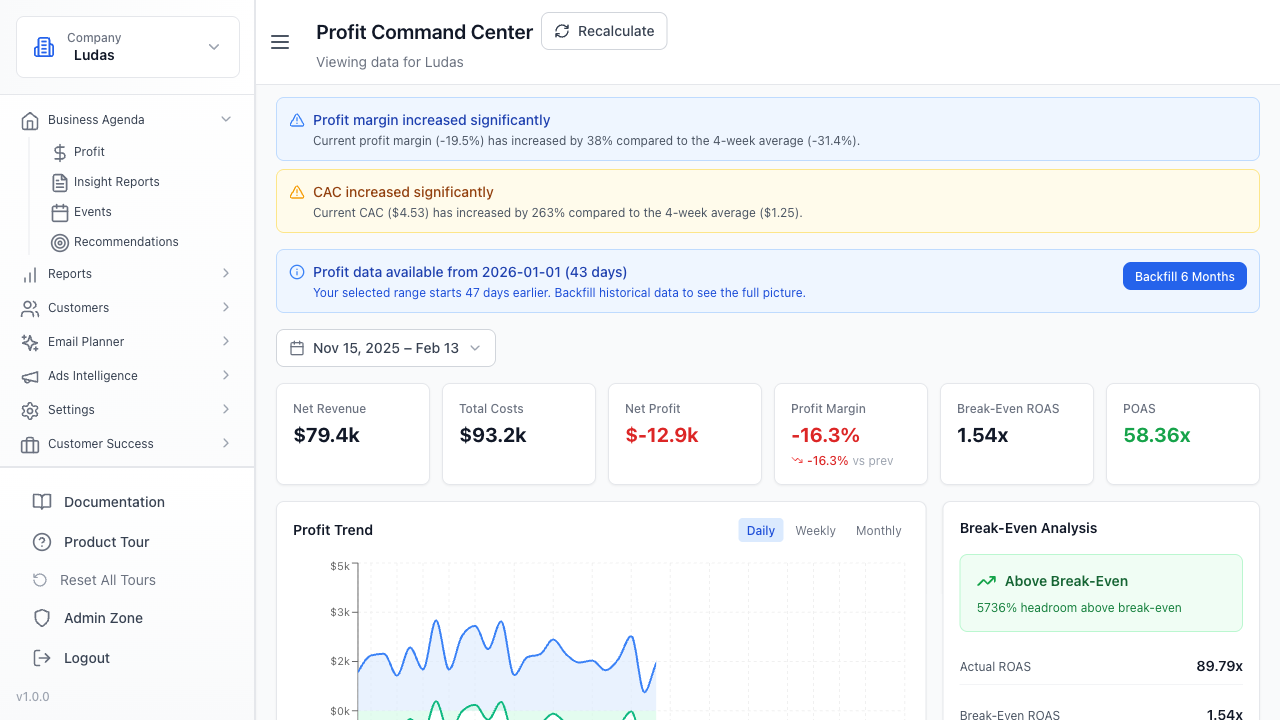
Unit economics is the foundation of every sustainable e-commerce business, yet it is one of the most misunderstood areas of DTC finance. Brands that nail their unit economics scale profitably. Brands that do not end up growing themselves into bankruptcy — spending more to acquire each customer than that customer will ever return.
The problem is not that operators do not care about unit economics. It is that the calculations are more nuanced than they appear, the data is harder to assemble than it should be, and the common shortcuts lead to dangerously wrong conclusions.
This guide covers the metrics that actually matter for e-commerce unit economics, how to calculate each one correctly, what benchmarks to target, and the mistakes that trip up even experienced operators.
What Unit Economics Means for E-commerce
Unit economics answers a simple question: is each customer you acquire profitable on a standalone basis? If you spend $40 to acquire a customer who generates $150 in lifetime gross profit, the unit economics work. If you spend $40 to acquire a customer who generates $30 in lifetime gross profit, no amount of scaling will fix the fundamental math.
For e-commerce specifically, unit economics is more complex than for SaaS or subscription businesses because customer behavior is less predictable. A SaaS customer pays a known monthly fee until they cancel. An e-commerce customer might buy once and disappear, or might buy 20 times over two years. The variability in customer value makes accurate measurement essential.
The core unit economics metrics for e-commerce are Customer Acquisition Cost (CAC), Customer Lifetime Value (LTV), LTV to CAC Ratio, Contribution Margin, Payback Period, and Average Order Value (AOV). Let us break down each one.
Customer Acquisition Cost (CAC)
What It Is
CAC is the total cost of acquiring one new customer. It includes all marketing and sales expenses divided by the number of new customers acquired during the same period.
How to Calculate It
The basic formula is straightforward:
CAC = Total Acquisition Spend / Number of New Customers Acquired
For example, if you spent $50,000 on paid media, $5,000 on influencer partnerships, $3,000 on creative production, and $2,000 on marketing tools in January, and acquired 1,500 new customers, your CAC is $40.
The Critical Nuance: Blended vs. Channel-Specific CAC
Blended CAC divides all acquisition spend by all new customers. This is useful for an overall health check, but it obscures important differences between channels. Channel-specific CAC calculates the cost per customer for each acquisition channel individually.
You need both. Blended CAC tells you whether your overall acquisition engine is efficient. Channel-specific CAC tells you where to allocate marginal budget. A brand with a blended CAC of $35 might have a Meta CAC of $50, a Google CAC of $30, and an organic or referral CAC of $8. Knowing these channel-level numbers is essential for optimizing spend allocation.
What to Include
A common mistake is underestimating CAC by excluding costs. Your CAC calculation should include all paid media spend (Meta, Google, TikTok, etc.), creative production costs (design, video, UGC), agency fees or fractional marketing team costs, marketing technology costs (attributable portion), influencer and affiliate payments, and any promotional discounts used to acquire first-time customers.
That last point is important and frequently overlooked. If you offer a 20 percent first-purchase discount, the cost of that discount is part of your acquisition cost. A customer who uses a $10 discount code effectively costs you $10 more to acquire than your paid media CAC alone suggests.
Benchmarks
CAC varies enormously by industry and product category. For DTC e-commerce, rough benchmarks are: beauty and skincare at $20 to $60, apparel at $30 to $80, food and beverage at $15 to $50, health and wellness supplements at $40 to $100, and home goods at $30 to $70.
These ranges are wide because CAC depends on product price point, competitive density, and brand awareness. Use industry benchmarks as sanity checks, not targets.
Customer Lifetime Value (LTV)
What It Is
LTV is the total gross profit a customer generates over their entire relationship with your brand. It is the single most important number in e-commerce unit economics because it defines the ceiling for what you can spend on acquisition.
How to Calculate It
The simplest formula is:
LTV = Average Order Value x Purchase Frequency x Customer Lifespan x Gross Margin
For example, if your average customer spends $65 per order, purchases 3.2 times over their lifetime, with a 65 percent gross margin, the LTV is $65 x 3.2 x 0.65 = $135.20.
This formula is a useful starting point but has significant limitations. It uses averages, which can be misleading if your customer value distribution is highly skewed (as it is for most e-commerce brands). A more accurate approach uses cohort-based LTV calculation.
Cohort-Based LTV
With cohort-based calculation, you track the actual cumulative revenue from a group of customers acquired in a specific period and apply your gross margin. For example, if the 500 customers acquired in January 2025 have generated $150,000 in cumulative revenue through January 2026 with a 65 percent gross margin, the 12-month LTV is ($150,000 x 0.65) / 500 = $195.
Cohort-based LTV is more accurate because it uses actual observed behavior rather than averaged assumptions. The downside is that you need enough time to pass for the cohort to mature. For newer cohorts, you need to project future behavior based on older cohort patterns.
LTV Time Horizons
A critical decision is what time horizon to use for LTV. Common choices are 12-month LTV for conservative planning and CAC payback analysis, 24-month LTV for a more complete view that captures most customer value, and full lifetime LTV for strategic planning (though this requires significant projection).
For operational decisions like setting CAC targets, 12-month LTV is usually the right choice. It is conservative, requires less projection, and aligns with typical planning horizons.
LTV to CAC Ratio
What It Is
LTV:CAC ratio measures how much lifetime value you generate for each dollar spent on acquisition. It is the single best indicator of unit economics health.
How to Calculate It
LTV:CAC Ratio = Customer Lifetime Value / Customer Acquisition Cost
Using the examples above: $135.20 LTV / $40 CAC = 3.38x
Benchmarks
The commonly cited benchmark is a 3:1 ratio — for every dollar spent on acquisition, generate three dollars in lifetime gross profit. Here is a more nuanced framework:
Below 1:1 means you are losing money on every customer. Your business model is broken and cannot be fixed by scaling. Between 1:1 and 2:1 indicates a marginal business. You may be profitable if overhead is very low, but there is little room for error. Between 2:1 and 3:1 is a functional business with room for improvement. Focus on improving retention (raising LTV) or acquisition efficiency (lowering CAC). Between 3:1 and 5:1 represents healthy unit economics. This is the target range for most growth-stage DTC brands. Above 5:1 suggests either you are under-investing in growth (you could afford to spend more on acquisition) or your LTV calculation is overly optimistic.
Channel-Specific LTV:CAC
Just as you should calculate channel-specific CAC, you should calculate channel-specific LTV:CAC. Different acquisition channels often produce customers with different LTV profiles. Meta Ads might acquire customers with lower LTV than organic search. Influencer marketing might acquire customers with higher LTV than paid social. Understanding these differences is essential for optimal budget allocation.
Attribution platforms that connect acquisition source to customer lifetime behavior enable this level of channel-specific analysis.
Contribution Margin
What It Is
Contribution margin is the profit remaining after subtracting all variable costs directly associated with fulfilling an order. It represents the actual cash contribution each order makes toward covering fixed costs and generating profit.
How to Calculate It
Contribution Margin = Revenue - COGS - Shipping - Payment Processing - Packaging - Returns Cost
For a $65 order: revenue of $65, minus COGS of $19.50 (30 percent), minus shipping of $6.50, minus payment processing of $1.95 (3 percent), minus packaging of $2.00, minus returns provision of $3.25 (5 percent estimated return rate), equals a contribution margin of $31.80, which is 48.9 percent.
Why This Matters More Than Gross Margin
Many e-commerce brands use gross margin (revenue minus COGS) as their profitability metric. But gross margin ignores shipping, processing, packaging, and returns — costs that are real and significant. A brand with a 65 percent gross margin might have only a 45 percent contribution margin when all variable costs are included.
Using gross margin in your LTV calculation overstates the actual profit each customer generates. Using contribution margin gives you the truth. When a profit intelligence platform calculates your real margins including all variable costs, the results often surprise operators who have been working with gross margin assumptions.
The Returns Problem
Returns are the most commonly underestimated variable cost in e-commerce. The average return rate in DTC e-commerce is 15 to 30 percent for apparel and 5 to 10 percent for most other categories. Each return carries direct costs: return shipping, inspection and restocking labor, potential inventory write-down if the item cannot be resold, and refund processing.
Failing to account for returns in your contribution margin calculation can overstate unit economics by 10 to 20 percent. This is the difference between thinking you have healthy 3:1 LTV:CAC and discovering you are actually at 2.5:1.
Payback Period
What It Is
Payback period is the time it takes for a customer to generate enough contribution margin to cover their acquisition cost. It is a cash flow metric — telling you how long your acquisition investment is tied up before it starts generating positive returns.
How to Calculate It
Payback Period = CAC / Monthly Contribution Margin per Customer
If your CAC is $40 and the average customer generates $15 in contribution margin per month, your payback period is 2.67 months.
For e-commerce, where purchases are not monthly subscriptions, the calculation is slightly different. You need to determine the average cumulative contribution margin over time (using cohort data) and find the point at which cumulative contribution exceeds CAC.
Why Payback Period Matters
A short payback period means your acquisition spend is recycled quickly — you get your money back fast and can reinvest it. A long payback period means capital is tied up for extended periods, creating cash flow pressure even if the LTV math is favorable in the long run.
For bootstrapped or capital-constrained brands, payback period is often more important than LTV:CAC ratio. A 5:1 LTV:CAC with a 12-month payback period requires far more working capital than a 3:1 LTV:CAC with a 3-month payback period.
Benchmarks
For DTC e-commerce, target payback periods are under 3 months for cash-efficient brands, 3 to 6 months for growth-stage brands with adequate capital, 6 to 12 months for well-funded brands prioritizing growth over cash efficiency, and over 12 months which is generally unsustainable without significant external funding.
Average Order Value (AOV)
What It Is
AOV is the average revenue per transaction. While it seems simple, AOV is a powerful lever for improving unit economics because increasing it does not require acquiring additional customers.
How to Calculate It
AOV = Total Revenue / Total Number of Orders
The AOV Leverage Effect
Increasing AOV improves unit economics in two ways. First, each order generates more contribution margin (assuming variable costs do not increase proportionally). Second, higher AOV customers tend to have higher LTV because their purchase value compounds over multiple purchases.
Strategies for increasing AOV include bundling products (starter kits, curated bundles), tiered free shipping thresholds ($75+ for free shipping when your AOV is $55), upsells and cross-sells during checkout, subscription upgrades (larger quantities at better unit prices), and post-purchase add-on offers.
A $10 increase in AOV — say from $55 to $65 — flowing through a 50 percent contribution margin and a 3x lifetime purchase frequency, adds $15 to LTV per customer. Across 10,000 customers acquired per year, that is $150,000 in additional lifetime gross profit.
Common Mistakes That Lead to Bad Decisions
Ignoring COGS Variations
Not all products have the same cost structure. If you calculate a single blended COGS percentage, you miss that some products contribute far more margin than others. Use product-level or category-level COGS in your calculations, especially when evaluating which products to feature in acquisition campaigns.
Not Accounting for Returns
As discussed above, returns can reduce your effective contribution margin by 10 to 20 percent. If your unit economics look healthy before returns and marginal after returns, you have a returns problem that needs to be addressed — either through better product descriptions, sizing tools, or quality improvements.
Using Blended CAC for Channel Decisions
Blended CAC tells you your overall acquisition efficiency. But using blended CAC to evaluate individual channels leads to bad decisions. If your blended CAC is $35 and you are considering a new channel with a $50 CAC, you might reject it — but if that channel acquires customers with 2x the LTV of your average, it might be your most efficient channel on a unit economics basis.
Confusing Revenue with Profit
LTV should be calculated on a gross profit or contribution margin basis, not a revenue basis. A customer with $500 in lifetime revenue and 30 percent margin generates $150 in lifetime gross profit. A customer with $300 in lifetime revenue and 70 percent margin generates $210. Revenue-based LTV would rank the first customer higher, but profit-based LTV correctly identifies the second customer as more valuable.
Static Calculations
Unit economics change over time. CAC tends to increase as you exhaust your most accessible audiences. LTV may increase as you improve your product and retention programs, or decrease if you are scaling acquisition into lower-quality channels. Review your unit economics monthly and track trends over time rather than treating your calculations as fixed numbers.
Using Unit Economics for Decision-Making
Unit economics should inform every major growth decision: how much to spend on acquisition, which channels to invest in, which products to promote, and when to raise prices.
Setting CAC Targets
Your target CAC should be derived from your LTV and desired payback period. If your 12-month LTV is $120 and you want a 3:1 ratio, your target CAC is $40. If you want a 6-month payback, calculate your 6-month cumulative contribution margin and use that as your CAC ceiling.
Channel Investment
Allocate acquisition budget based on channel-specific unit economics, not just channel-specific CAC. A channel with high CAC but high LTV may deserve more investment than a channel with low CAC but low LTV.
Pricing Decisions
Unit economics analysis often reveals that modest price increases have outsized impact on profitability. A 5 percent price increase flows directly to contribution margin — if your margin is 50 percent, a 5 percent price increase raises margin by 10 percent. Model the impact of price changes on your unit economics before deciding.
Growth vs. Profitability Tradeoffs
When you understand your unit economics deeply, you can make informed tradeoffs between growth rate and profitability. Accepting a 2:1 LTV:CAC temporarily to grow faster is a legitimate strategy — but only if you know it is 2:1 and not 1.2:1. The difference between a calculated bet and a blind gamble is measurement.
The brands that win in e-commerce are not the ones spending the most on acquisition. They are the ones who understand their unit economics with precision and use that understanding to make better decisions — about where to spend, what to sell, and how to grow sustainably.