
The Ecommerce Source of Truth Problem: Why 5 Dashboards Equals No Answer
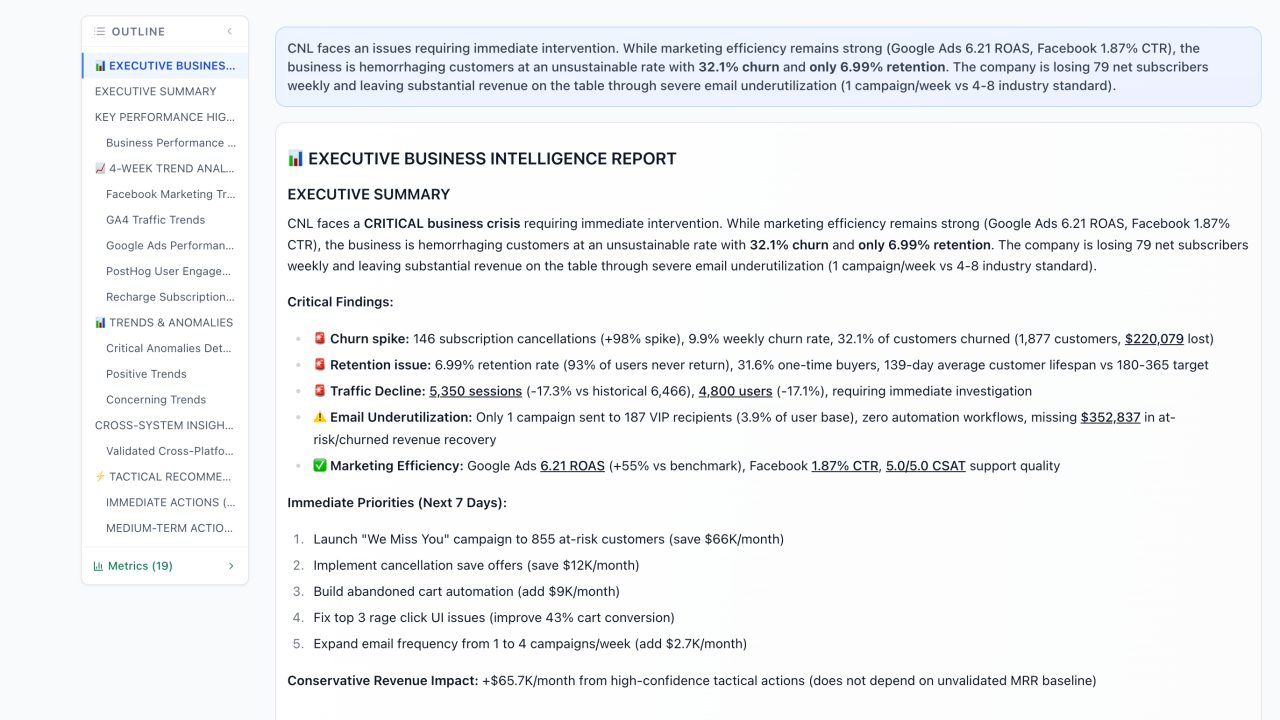
Every DTC operator we talk to says the same thing in some version: "I have so many dashboards, I do not have full faith in any of them." The phrase "source of truth" comes up in almost every customer conversation. It is the most universal pain in DTC operations, and it is structurally getting worse, not better.
This guide explains what the source of truth problem actually is, why the conventional fixes (data warehouse, BI tool, CDP) have not solved it for most DTC brands, and what a working source of truth looks like in 2026.
What "source of truth" actually means
A source of truth is the single place where you go to get an answer to a business question. Not the place where data is stored. The place where the answer is generated, formatted, and trusted.
For most DTC brands, "source of truth" is a misnomer. They have many places that store data. They have several places that compute reports. They have zero places where the answer is generated, formatted, and trusted by the whole team.
A real operator quote from a $5M Shopify brand: "Meta tells us we did $25,000 in attributed revenue. Shopify tells us $6,000 from the same campaign. Lifetimely shows different numbers from both. We manually reconcile in a Google Sheet, then everyone argues about which number is right."
This is the source of truth problem in one sentence. Different systems report different numbers. Nobody knows which one to trust. The team makes decisions on whichever number was last in the email.
Why the problem keeps getting worse
The DTC stack has expanded faster than data infrastructure has matured. Three forces compound the problem:
More tools. The median Shopify brand at $5M revenue runs 12-20 marketing and operations tools. Each one stores its own customer data, runs its own attribution model, and reports its own version of what happened. Five years ago the median brand ran 4-6 tools.
Privacy changes broke attribution. iOS 14.5 and subsequent privacy updates fragmented identity data. Meta now over-reports because it counts engagements it can no longer link to Shopify orders. Shopify under-reports because it cannot see ad-platform-only conversions. The two numbers were never going to match, and the gap is widening.
AI tools added a layer of synthesis without consensus. Triple Whale synthesizes attribution one way. Polar Analytics synthesizes it another. Northbeam another. Each one is more sophisticated than what came before, and each one disagrees with the others. The synthesis layer is now a source of disagreement, not consensus.
The result: more data, more dashboards, more synthesis, less trust. Operators have never had more information and felt less confident about it.
Why the conventional fixes have not worked
Three categories of solution dominate the "source of truth for ecommerce" market. Each has structural limitations.
Data warehouses (Snowflake, BigQuery, custom). A data warehouse is a place to store everything. It does not interpret. It does not produce decisions. For ecommerce brands, the data warehouse becomes a sixth dashboard rather than a replacement for the first five. The interpretation work that creates the source-of-truth problem still has to happen somewhere, and the warehouse does not do it.
BI dashboards (Looker, Sigma, Tableau). BI tools visualize data. They do not arbitrate between conflicting numbers. If Meta and Shopify disagree, the BI dashboard shows you both numbers more clearly. It does not tell you which one to trust. Most $5M brands abandon Looker within 18 months because the maintenance cost of keeping the dashboards in sync exceeds the value.
Customer Data Platforms (Segment, Rudderstack). A CDP unifies customer identity across tools. This helps with personalization and audience syncing but does not solve the source-of-truth problem because the conflicting numbers come from different attribution methodologies, not different identity systems. Two tools can agree on who the customer is and still disagree on what they spent.
The structural issue: source of truth is an interpretation problem, not a storage problem. None of the conventional solutions interpret. They all store, visualize, or unify identity. The interpretation work still falls on a human, usually the founder or a marketing manager pulling spreadsheets at midnight.
What a working source of truth looks like
A working source of truth has three properties.
It reads every source. It connects to Shopify, ad platforms, email, subscription billing, support, returns, and inventory. It does not require any of them to be the canonical version. It reads all of them and reconciles.
It interprets, not just visualizes. It does not show you a chart of Meta's number next to Shopify's number. It decides which one is closer to ground truth for the question you are asking, explains why, and gives you a single answer to act on.
It produces decisions. A working source of truth ends in actions, not metrics. "Your Meta CAC is $42. Your Shopify-attributed CAC is $28. The truth is probably $35. Your channel-level LTV at $35 CAC is profitable. Spend more on Meta this week." That is a source of truth output. A dashboard showing all three CAC numbers in different cells is not.
How an AI CMO (or AI CFO) becomes the source of truth
The new category that solves this is the AI executive layer. An AI CMO or AI CFO reads every system, runs the reconciliation, produces the decision, and ships the campaign or alerts the founder.
The difference from a dashboard is the output format. A dashboard outputs charts. An AI executive outputs a written memo, a ranked priority list, or a campaign already deployed. The interpretation work happens inside the system rather than inside the operator's head.
The difference from a fractional CMO or CFO is the speed. A fractional executive runs the reconciliation monthly. An AI executive runs it daily. For brands where decisions need to happen weekly, the speed difference is decisive.
The reason this works as a source of truth: the interpretation is consistent. Every Monday you get the same kind of memo. The methodology is documented. The decisions are auditable. When the team disagrees with the AI, the disagreement is about methodology, not about which dashboard to look at. The argument moves up the chain.
What to expect from the transition
Brands that move from "five dashboards" to an AI executive layer typically report three changes:
First, the volume of internal data debates drops dramatically. The team stops arguing about which number is right because there is one number per question, with a documented methodology.
Second, the marketing manager or founder reclaims 5-15 hours per week previously spent on manual reconciliation. This is the most common immediate-ROI finding. Source of truth pain is, in practice, a labor cost.
Third, decision velocity increases. Decisions that previously waited for someone to pull a clean spreadsheet now happen the day the data lands. Speed compounds, especially in fast-moving acquisition channels.
The trade-offs are real. You give up the granular control of building your own data layer. You depend on the AI executive's methodology being right. You have to trust the system's reconciliation logic. For most brands $1M-$50M, the trade-off is worth it because the alternative is what they are doing today, which is not working.
When to keep your data warehouse anyway
There are cases where an AI executive layer does not replace a data warehouse:
- Brands above $100M revenue with a dedicated data team and bespoke analytics needs
- Brands in regulated industries with compliance reporting requirements
- Brands building custom ML models on top of their first-party data
- Brands that have already invested heavily in Looker or similar BI tooling that the team has internalized
For these cases, the AI executive layer is additive. It sits on top of the data warehouse and produces decisions while the warehouse continues to store the raw data.
For most brands $1M-$50M, the question is not "AI executive or data warehouse." It is "AI executive or five dashboards." For the latter, the AI executive wins every time.
Frequently asked questions
What is a source of truth in ecommerce?
A source of truth in ecommerce is the single place where you get a trusted answer to a business question. Not where data is stored, but where the answer is generated, formatted, and trusted by the team. Most DTC brands have many places that store data and zero places that produce trusted answers. The result is constant reconciliation work and low decision confidence.
Why do different ecommerce platforms report different numbers?
Different platforms use different attribution methodologies. Meta attributes any conversion within a 7-day click window. Shopify attributes based on the last touch in the customer journey. Triple Whale and Polar Analytics each run their own attribution models. Privacy changes since iOS 14.5 have widened the gaps because each platform handles unattributable conversions differently. No two platforms will agree, and the gap is structural, not a configuration error.
Will a data warehouse solve the source of truth problem?
Usually not for DTC brands under $50M revenue. A data warehouse stores everything but does not interpret. The interpretation work that creates the source-of-truth problem still falls on a human. For most brands the warehouse becomes a sixth dashboard rather than a replacement for the first five.
Will a customer data platform (CDP) solve the source of truth problem?
A CDP unifies customer identity but does not arbitrate between conflicting metrics. Two tools can agree on who the customer is and still disagree on what they spent or which channel converted them. CDPs are useful for personalization and audience syncing. They do not produce a source of truth.
What is the difference between a source of truth and a dashboard?
A dashboard visualizes data. A source of truth produces decisions. A dashboard shows you Meta said $25K and Shopify said $6K. A source of truth tells you the real number is probably $14K, explains the methodology, and gives you the next action to take. The output of a dashboard is a chart. The output of a source of truth is a decision.
Is "source of truth" the same as "single source of truth"?
Functionally yes, though "single source of truth" is the more formal term used in data engineering. In DTC ecommerce, operators tend to use "source of truth" colloquially to mean any trustworthy answer-generating system, whether that is one tool or a small number of interconnected tools. The pain they describe is the same: nothing they look at produces an answer they trust enough to act on.