
The Complete Guide to E-commerce Customer Lifetime Value (LTV)
Customer lifetime value is arguably the single most important metric in e-commerce. It determines how much you can afford to spend on acquisition, which customers deserve the most attention, and whether your business model is fundamentally sustainable. Yet most e-commerce brands either calculate LTV incorrectly, rely on overly simplistic formulas, or don't track it at all.
This guide covers what you need to know about LTV, from basic formulas to predictive modeling, and the practical strategies for improving it. At Scentbird LTV was the metric we built our entire growth model around, so most of what's here comes from things we got wrong before we got them right.
What Is Customer Lifetime Value?
Customer lifetime value (LTV, also written as CLV or CLTV) is the total revenue, or more precisely the total profit, a customer generates over their entire relationship with your business. It's a forward-looking metric that estimates future value based on past behavior and predictive patterns.
LTV matters because it shapes your growth strategy. If you know a customer is worth $300 over their lifetime, you can make informed decisions about how much to invest in acquiring them, how much to spend on retaining them, and which segments deserve premium treatment.
LTV Formulas: From Simple to Sophisticated
The Simple LTV Formula
The most basic approach:
LTV = Average Order Value x Purchase Frequency x Customer Lifespan
If your average order value is $65, customers buy 3.2 times per year, and the average customer stays active for 2.5 years:
LTV = $65 x 3.2 x 2.5 = $520
This is a reasonable starting point but has real limitations. It uses averages that obscure massive variation between segments, it assumes static behavior, and it ignores the time value of money.
The Margin-Adjusted LTV Formula
A more useful variant incorporates your gross margin:
LTV = Average Order Value x Gross Margin % x Purchase Frequency x Customer Lifespan
Same example with a 45% gross margin:
LTV = $65 x 0.45 x 3.2 x 2.5 = $234
This gives you a profit-based LTV instead of a revenue-based one, a much more actionable number for investment decisions.
Cohort-Based LTV
Cohort analysis groups customers by acquisition month (or quarter) and tracks their cumulative spending over time. More accurate than the simple formula because it uses actual observed behavior.
To calculate cohort-based LTV:
- Group all customers by the month they made their first purchase
- Track each cohort's cumulative revenue per customer over subsequent months
- Plot the curves to see how LTV develops over time
Cohort-based LTV reveals dynamics that averages hide. You might find that customers acquired in Q4 (holiday shoppers) have significantly lower long-term LTV than Q2 customers. Or that customers from influencer partnerships have higher LTV than those from paid search.
The limitation is that it can only describe the past. For a cohort that's six months old, you know their six-month LTV but have to extrapolate the rest.
Predictive LTV
Predictive LTV models use machine learning to estimate each individual customer's future value based on behavior patterns. These models pull from a wide range of signals:
- Purchase history (recency, frequency, monetary value)
- Product categories purchased
- Browsing behavior and engagement patterns
- Acquisition channel and initial offer
- Support interactions
- Demographic and geographic data
Predictive models can estimate LTV for customers who've made only one or two purchases, which matters for early decisions about how much to invest in nurturing a new customer.
Building accurate predictive LTV in-house requires real data science investment. Platforms like Finsi provide predictive LTV capabilities out of the box, applying proven models to your customer data and refining predictions as new behavior data flows in.
The LTV:CAC Ratio
LTV alone doesn't tell you whether your business is healthy. The metric that does is the ratio of lifetime value to customer acquisition cost (CAC).
LTV:CAC Ratio = Customer Lifetime Value / Customer Acquisition Cost
General benchmarks:
- Below 1:1 - You're losing money on every customer. Unsustainable unless you have a clear path to fixing either LTV or CAC.
- 1:1 to 2:1 - Breaking even or barely profitable after operational costs. Little margin for error.
- 3:1 - The benchmark for a healthy, scalable business. Three dollars of lifetime value for every dollar of acquisition.
- 5:1 and above - Potentially very profitable, but often a signal you're under-investing in growth and leaving market share on the table.
The LTV:CAC ratio should be calculated by channel and segment, not just as an overall average. We saw this clearly at Scentbird: Meta might produce customers with a 4:1 ratio while Google Shopping produces 2:1. That insight reshapes budget allocation.
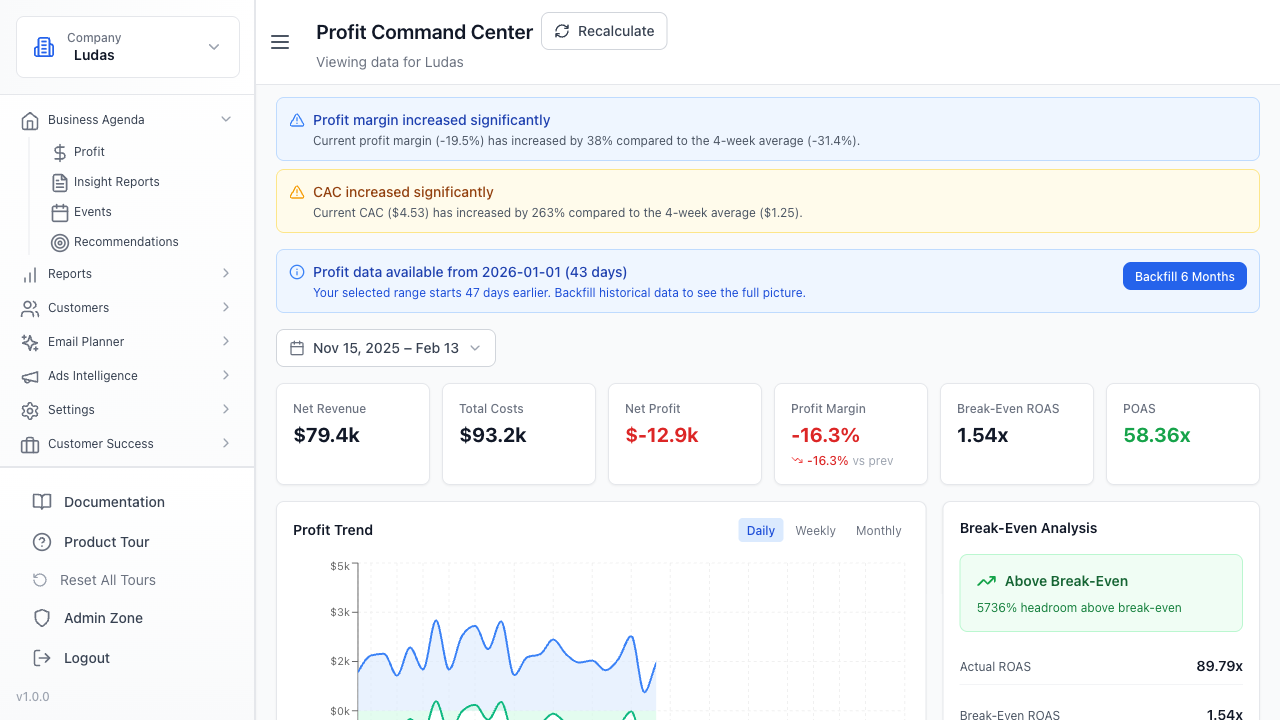
Understanding how LTV and CAC interact at the unit level is the foundation of profit intelligence, knowing not just topline revenue but whether each cohort is actually contributing to your bottom line.
How to Improve LTV
There are four fundamental levers for increasing lifetime value. They compound, which is why even small improvements across multiple levers produce significant gains.
Lever 1: Increase Average Order Value (AOV)
Higher AOV means more revenue per transaction. What works:
Bundling and kits. Pre-curated bundles combining complementary products at a small discount versus buying individually. Bundles raise AOV and give customers a sense of value.
Upselling. Recommending a premium version of the product the customer is considering. Works best when the premium option delivers meaningfully better outcomes, not just a bigger size.
Cross-selling. Suggesting complementary products at checkout or in post-purchase emails. The key is relevance, cross-sell based on what similar customers actually bought, not what you want to move.
Free shipping thresholds. Setting your free shipping minimum slightly above current AOV. If your AOV is $55, a $65 free shipping threshold is a proven nudge upward.
Tiered pricing or volume discounts. Rewarding customers for buying more units or spending more per order. Especially effective for consumable products.
Lever 2: Increase Purchase Frequency
Getting customers to buy more often is often the highest-impact path to LTV improvement because it compounds over the customer lifetime.
Replenishment reminders. For consumables, email or SMS reminders timed to when the customer is likely running low. Requires knowing or estimating consumption rates by product.
Subscription offers. Converting one-time buyers to subscribers guarantees recurring revenue and dramatically lifts purchase frequency. The key is making the subscription flexible enough that customers don't feel trapped, this was one of the biggest lessons from Scentbird's first few years.
New product launches. Regular launches give existing customers a reason to come back. Announce to your existing base before opening to the public.
Content and community. Brands that build genuine community through content, social, or events create touchpoints that keep them top of mind between purchases.
Loyalty programs. Well-designed loyalty programs reward cumulative spending and create switching costs. The best ones reward behaviors beyond just purchasing, writing reviews, referring friends, engaging with content.
Lever 3: Reduce Churn
Every month you extend the average customer relationship, lifetime value rises. Churn reduction directly impacts LTV.
Key strategies: identify at-risk customers early through behavioral signals, segment your base to target high-value at-risk customers with appropriate interventions, offer subscription flexibility (pause, skip, swap) instead of forcing a cancel-or-keep binary, and address involuntary churn through dunning optimization.
This is a deep topic on its own, see our complete guide on reducing e-commerce churn for the full treatment.
Lever 4: Extend Customer Lifetime
Related to churn reduction but goes beyond it. Extending customer lifetime means building a relationship that evolves with the customer over years.
Product line expansion. Growing your catalog so customers can keep finding new products relevant to their changing needs. A skincare brand that adds wellness supplements can retain customers who might otherwise age out of their core product.
Lifecycle marketing. Adjusting communication and offers based on where the customer is in their relationship with you. What a new customer needs to hear is very different from what a two-year veteran needs.
Referral programs. Customers who refer others tend to be more loyal themselves. The act of recommending your brand strengthens their commitment to it.
LTV by Acquisition Channel
One of the most valuable applications of LTV analysis is understanding which acquisition channels produce the most valuable customers, not just the most customers or the cheapest ones.
You might find patterns like:
- Organic search customers have the highest LTV because they were actively seeking your kind of product
- Influencer partnerships produce customers with high initial AOV but low repeat rates
- Meta prospecting customers have low initial AOV but higher purchase frequency over time
- Affiliate customers have the lowest LTV because they were incentivized by a deal
These insights should directly shape your acquisition strategy. A channel that looks expensive on a cost-per-acquisition basis can be your best investment when evaluated on LTV:CAC.
Tracking LTV by channel requires clean attribution data and the ability to connect acquisition source to long-term purchasing behavior. An analytics platform that unifies acquisition and retention data is what makes this practical.
Predictive LTV Modeling Approaches
For brands ready to go beyond historical LTV calculation, predictive modeling opens up real capabilities.
Probabilistic Models
The most well-known probabilistic approach is the BG/NBD (Beta Geometric/Negative Binomial Distribution) model, often paired with Gamma-Gamma for monetary value. These models estimate two things per customer: how likely they are to make another purchase, and how much they're likely to spend.
The advantage is that they work with relatively simple inputs, transaction data is usually enough. The limitation is they don't incorporate non-transactional signals like browsing behavior or email engagement.
Machine Learning Models
Modern ML approaches use a wider range of features. They can incorporate behavioral data (site visits, email opens, app usage), product-level data (category preferences, price sensitivity), support interactions, and external data (seasonal patterns, competitive dynamics).
ML models typically outperform probabilistic models in accuracy, especially for younger customers where transaction history is limited but behavioral data is rich.
Early-Stage LTV Prediction
One of the most valuable applications is estimating future value of customers who've made only one or two purchases. At that stage traditional LTV calculations are meaningless because there's almost no history.
Predictive models can use the characteristics of the first purchase, what they bought, how they found you, when, where they're located, combined with patterns from similar historical customers, to estimate likely lifetime value. That enables smart decisions about nurture investment from day one.
Finsi's predictive LTV module provides these early-stage predictions automatically, giving you a projected lifetime value for every customer from their first order.
Common LTV Mistakes to Avoid
Ignoring cohort effects. A single blended LTV across all customers obscures important trends. Always analyze by cohort.
Using revenue instead of profit. Revenue-based LTV overstates customer value and can lead to overspending on acquisition. Always factor in gross margin at minimum, and ideally include variable costs like shipping and payment processing.
Not discounting future value. A dollar received three years from now is worth less than a dollar today. For more precise LTV, apply a discount rate to future cash flows.
Treating LTV as static. LTV is a living metric that changes as your business evolves. Recalculate regularly and watch trends over time.
Optimizing for LTV in isolation. LTV should always be evaluated against CAC, against retention costs, and against your cash flow constraints. A high LTV that takes three years to realize isn't useful if you need to fund acquisition today.
Getting Started with LTV Analysis
If you're not currently tracking LTV, here's a practical path:
- Calculate your simple LTV using the basic formula. Rough baseline.
- Build cohort tables for at least the last 12 months of acquisition cohorts. Track cumulative revenue per customer at 30, 60, 90, 180, and 365 days.
- Calculate LTV by channel to understand which acquisition sources produce the most valuable customers.
- Compute LTV:CAC by channel. Reallocate budget from low-ratio channels to high-ratio ones.
- Move to predictive modeling for individual-level LTV estimates and early-stage predictions.
The jump from step 4 to step 5 is the biggest. Building predictive LTV models requires data infrastructure, modeling expertise, and ongoing maintenance. That's a big part of why we built Finsi, the data engineering and modeling complexity is handled, so you can focus on acting on the insights.
Conclusion
Customer lifetime value is the foundation of sustainable e-commerce growth. It tells you how much a customer is really worth, which lets you make rational decisions about acquisition investment, retention spending, and customer experience priorities.
Start with simple calculations to establish your baseline, then add sophistication with cohort analysis and predictive modeling. The bigger point: use LTV as an operating metric, not just a number you report quarterly. The brands that win in e-commerce are the ones treating LTV as an input that shapes daily decisions about where to invest time and money.
Frequently Asked Questions
What is the best LTV formula for e-commerce?
The margin-adjusted formula, Average Order Value x Gross Margin % x Purchase Frequency x Customer Lifespan, is the most practical starting point because it gives you a profit-based number rather than a revenue-based one. For more precision, use cohort-based LTV that tracks actual cumulative spending by acquisition month, which reveals dynamics that averages hide. Brands ready for the next level should explore predictive LTV modeling for individual customer estimates within 30 days of first purchase rather than waiting for history to accumulate.
Should I calculate LTV based on revenue or profit?
Always profit-based for decision-making. Revenue-based LTV overstates customer value and can lead you to overspend on acquisition. A customer who generates $300 in revenue but only $90 in gross profit is very different from one generating $300 at a 60% margin. At minimum, factor in your gross margin. Ideally include variable costs like shipping and payment processing as well. Profit intelligence tools can automate this by connecting your COGS and fulfillment data directly to customer-level LTV analysis.
How do I calculate LTV by acquisition channel?
Track each customer's acquisition source (Meta, Google, organic, influencer, etc.) and build cohort-based LTV tables segmented by channel. Compare cumulative revenue per customer at 30, 60, 90, 180, and 365 days across channels. You'll often find the channel with the cheapest CPA acquires the lowest-LTV customers, while a seemingly expensive channel produces customers worth 2-3x more over their lifetime. Requires clean attribution data connecting source to long-term purchasing behavior. Finance leaders should use LTV-by-channel analysis to inform budget allocation rather than relying solely on first-order ROAS.
What are the most common LTV calculation mistakes?
Five big ones: calculating a single blended LTV across all customers instead of analyzing by cohort, using revenue instead of profit, not discounting future cash flows to present value, treating LTV as a static number instead of recalculating regularly, and optimizing for LTV in isolation without considering CAC and cash flow constraints. Another common error is using averages that obscure massive variance, your "average" LTV might be $120 with a standard deviation of $200, making the number practically useless for customer-level decisions. See our guide on increasing CLV for strategies once your calculations are solid.
How often should I recalculate LTV?
At least monthly at the cohort level and quarterly for overall business metrics. Customer behavior shifts with product changes, pricing adjustments, seasonal patterns, and competitive dynamics, a model trained on last year's data may not reflect current reality. Predictive LTV models should be retrained at least quarterly to maintain accuracy. Set up automated dashboards that track LTV trends over time so you can spot degradation early. Start a free trial with Finsi to get continuously updated LTV calculations that refresh as new customer data flows in, without manual recalculation.
Stop guessing. Start knowing.
Finsi connects your e-commerce data, tells you what to do, and executes it — email campaigns, ad optimization, retention flows. Free 30-day trial.
Start Free Trial