
Customer Segmentation Strategies for E-commerce Brands
Every e-commerce brand knows that not all customers are the same. Some buy frequently and spend heavily. Others make a single purchase and disappear. Some engage with every email you send; others never open them. Treating all of these customers identically is not just inefficient - it is actively harmful to your business.
Customer segmentation is the practice of dividing your customer base into distinct groups based on shared characteristics, behaviors, or value. Done well, segmentation transforms your marketing from broadcast messaging into targeted, relevant communication that resonates with each group. This guide covers the strategies, frameworks, and practical implementation of customer segmentation for e-commerce brands.
Why Segmentation Matters for E-commerce
The business case for segmentation is compelling and well-documented.
Revenue impact. Segmented email campaigns generate significantly more revenue per recipient than non-segmented blasts. When customers receive offers that match their interests and purchase patterns, conversion rates increase across every channel.
Marketing efficiency. Segmentation lets you allocate your marketing budget where it will have the greatest return. Instead of spending the same amount to retain every customer, you can invest heavily in high-value, at-risk customers while using lighter-touch automation for lower-value segments.
Customer experience. Customers increasingly expect personalization. A returning customer who receives the same generic welcome flow as a first-time visitor feels ignored. Segmentation enables experiences that acknowledge and build on the customer's relationship with your brand.
Strategic insight. Segmentation reveals the structure of your customer base in ways that aggregate metrics cannot. You might discover that 8% of your customers generate 40% of your revenue, or that customers acquired through a specific channel have dramatically different behavior patterns. These insights drive better decisions across your entire business.
Types of Customer Segmentation
RFM Segmentation
RFM (Recency, Frequency, Monetary value) is the foundational segmentation framework for e-commerce. It is simple, actionable, and based entirely on purchase behavior.
- Recency: How recently the customer made a purchase. More recent buyers are more likely to buy again.
- Frequency: How often the customer purchases. Higher frequency indicates stronger loyalty and habit.
- Monetary value: How much the customer spends. Higher spenders are more valuable and often have different needs.
Each customer is scored on all three dimensions, typically on a 1-5 scale. The combination creates segments that are immediately actionable:
- Champions (5-5-5): Recent, frequent, high-spending customers. Your best customers.
- Loyal Customers (X-4/5-4/5): Consistent, high-value buyers who may not have purchased in the last few weeks.
- Potential Loyalists (4/5-2/3-2/3): Recent customers with moderate frequency who could become champions with the right nurture.
- At-Risk (2/3-4/5-4/5): Previously valuable customers whose recency score has dropped. They are showing signs of disengagement.
- Hibernating (1-1/2-1/2): Customers who have not purchased in a long time and had low engagement even when active.
The strength of RFM is its simplicity and universal applicability. Every e-commerce brand can implement it using basic transaction data. The limitation is that it only considers purchase behavior and misses important signals like browsing activity, email engagement, and support interactions.
Behavioral Segmentation
Behavioral segmentation goes beyond purchase data to incorporate how customers interact with your brand across channels. Key behavioral dimensions include:
Browsing behavior. What categories and products do they view? How frequently do they visit? Do they browse extensively before buying or make quick decisions?
Email engagement. Do they open your emails? Click through? Which types of content do they engage with - product announcements, educational content, promotions?
Channel preferences. Do they primarily shop on mobile or desktop? Do they respond better to email, SMS, or push notifications?
Purchase triggers. Do they buy when you run promotions, or do they buy at full price? Do they purchase in response to new arrivals or restock notifications?
Behavioral segmentation requires more data infrastructure than RFM, but it produces segments that are more nuanced and actionable. A customer who browses frequently but only buys during sales requires a different approach than one who buys immediately when new products launch.
Value-Based Segmentation
Value-based segmentation groups customers by their economic contribution to your business. This goes beyond simple revenue to consider:
- Gross margin contribution. Some customers buy high-margin products while others gravitate toward discounted or low-margin items.
- Cost to serve. Customers who require frequent support, return products often, or only respond to heavy discounting cost more to serve.
- Lifetime value. Using predictive or historical LTV to group customers by their total expected value.
- LTV trajectory. Whether a customer's value is increasing, stable, or declining over time.
Value-based segments help you make hard but important decisions about resource allocation. Your top 10% of customers by value might warrant a dedicated account management approach, while your bottom 20% might not justify the cost of an aggressive retention campaign.
Lifecycle Segmentation
Lifecycle segmentation groups customers by their stage in the relationship with your brand:
- Prospects: People who have shown interest (visited your site, signed up for email) but have not purchased.
- First-time buyers: Customers who have made one purchase. The critical moment for conversion to repeat buyer.
- Developing customers: Two or three purchases in. Building a habit but not yet loyal.
- Established customers: Regular purchasers with a demonstrated pattern of repeat buying.
- VIP/Champions: Your most engaged, highest-value customers.
- Declining: Previously active customers showing reduced engagement.
- Lapsed: Customers who have not purchased within your defined churn window.
- Win-back: Churned customers you are attempting to reactivate.
Each lifecycle stage calls for fundamentally different communication. A first-time buyer needs education about your brand and product range. An established customer needs recognition of their loyalty and early access to what's new. A declining customer needs a relevant reason to re-engage.
Building Actionable E-commerce Segments
Theory is useful, but what matters is building segments you can actually act on. Here are the segments every e-commerce brand should have, with the strategy for each.
VIP Customers
Definition: Top 5-10% by LTV or total spend, with recent activity.
Strategy: Make them feel valued. Provide exclusive early access to new products, surprise gifts or upgraded shipping, personal communication from founders or team members, and invitations to provide input on new products. VIPs should never receive discount-heavy messaging - they are buying because they love your brand, and discounting can actually reduce their perception of your brand's value.
At-Risk High-Value Customers
Definition: Customers with historically high value whose engagement or purchase frequency has recently declined.
Strategy: This is your highest-priority retention segment. Investigate why they are disengaging. Reach out proactively with relevant content or product recommendations. Consider a personal touch - a handwritten note, a phone call, or a personalized email from a real person. The goal is to re-establish the connection before they fully disengage.
One-Time Buyers
Definition: Customers who have made exactly one purchase and have not returned within your expected repurchase window.
Strategy: This is typically the largest segment and the biggest opportunity. Focus on converting them to a second purchase. Use post-purchase education to ensure they got value from their first purchase. Recommend complementary products based on what they bought. Share social proof and reviews from similar customers. The second purchase is the most important milestone in the customer lifecycle - once a customer buys twice, their probability of buying a third time increases dramatically.
High-Frequency, Low-AOV Customers
Definition: Customers who buy frequently but spend relatively little per order.
Strategy: Focus on increasing AOV through bundling, upselling, and cross-selling. Free shipping thresholds can be effective here. These customers are already habitual buyers - you just need to increase the size of their basket.
Discount-Dependent Customers
Definition: Customers who only purchase during promotions or when given a discount code.
Strategy: This is a tricky segment. They contribute revenue but often at slim margins, and heavy discounting can erode brand perception. Gradually wean them off discounts by mixing value-driven offers (bundles, gifts with purchase) with percentage-off promotions. Test their price sensitivity carefully.
New Subscribers (Subscription Brands)
Definition: Customers in their first one to three months of a subscription.
Strategy: The early subscription period is when churn risk is highest. Focus on ensuring they are getting value from the product, that the subscription cadence is right, and that they feel good about the ongoing commitment. Proactive check-ins and easy adjustment options reduce early-stage subscription churn significantly.
Personalizing Marketing by Segment
Segmentation only creates value when you use it to differentiate your marketing. Here is how segmentation should inform each channel.
Email Marketing
Email is where segmentation has the most immediate impact. At minimum, segment your email campaigns by lifecycle stage and engagement level. Beyond that, use purchase behavior to personalize product recommendations and content.
Effective email intelligence means understanding not just who to email, but what to say and when to say it. A segment of customers who have purchased twice in the skincare category in the last 90 days should receive very different email content than first-time buyers who came through a Meta ad.
Build automated flows for each major segment: welcome series for new customers, replenishment reminders for repeat buyers, re-engagement sequences for declining customers, and VIP recognition for your best customers.
Paid Media
Use your customer segments to build better audiences for paid advertising. Upload your VIP segment as a seed audience for lookalike targeting. Exclude recent purchasers from prospecting campaigns. Create specific retargeting campaigns for high-value abandoned cart segments.
On-Site Personalization
Show different homepage content, product recommendations, and offers based on the visitor's segment. A returning VIP customer should see new arrivals and curated collections, not a first-time visitor popup offering 10% off.
SMS
SMS is a high-impact, high-irritation channel. Use segmentation to ensure you are only sending SMS to customers who have demonstrated engagement and where the message is genuinely relevant. VIP customers might welcome SMS alerts about exclusive product drops; a lapsed customer probably will not.
Natural Language Segmentation
Traditional segmentation tools require you to think in terms of filters and boolean logic: "purchase count greater than 3 AND last purchase date within 90 days AND total spend greater than $200." This works, but it creates friction between having a segmentation idea and executing on it.
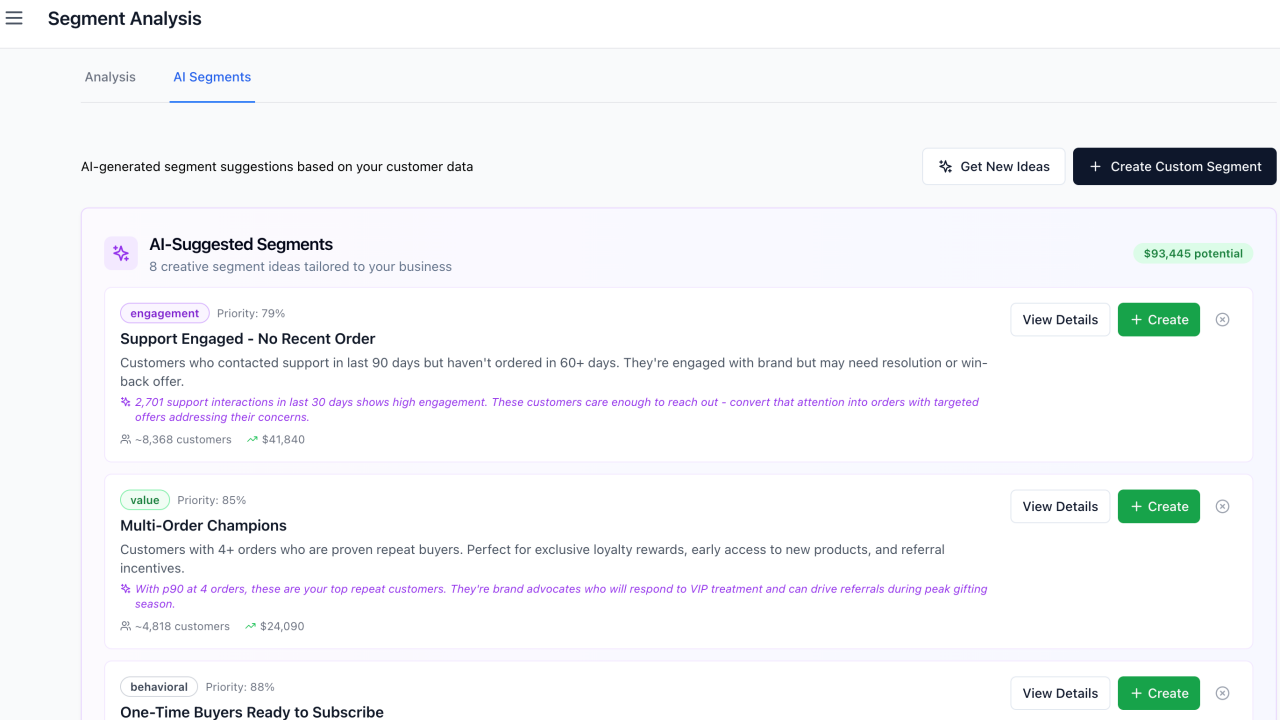
A newer approach is natural language segmentation, where you describe the segment you want in plain English and the system translates it into the appropriate query. Instead of building complex filter chains, you might type "customers who bought skincare products more than twice in the last six months but haven't purchased in the last 30 days."
Finsi's smart segmentation tool takes this approach, letting you create customer segments by describing them conversationally. This makes segmentation accessible to team members who may not be comfortable with traditional query builders, and it speeds up the process of testing new segment hypotheses.
Implementation: Getting Started with Segmentation
Step 1: Audit Your Data
Before building segments, assess what data you have available. At minimum, you need transaction data (orders, revenue, dates). Ideally, you also have email engagement data, website behavior data, support interaction data, and acquisition source data. The more data inputs you have, the more sophisticated your segmentation can be.
Step 2: Start with RFM
Implement basic RFM segmentation using your transaction data. This gives you immediately actionable segments without requiring advanced tooling. Score each customer on recency, frequency, and monetary value, and create your initial segment definitions.
Step 3: Add Lifecycle Stages
Layer lifecycle stage on top of RFM. A "new customer" who scores high on monetary value from their first purchase is a different opportunity than a "new customer" who placed a small, discount-driven first order.
Step 4: Build Segment-Specific Campaigns
For each of your top three to five segments, create at least one differentiated campaign or automation. Measure performance by segment to build the business case for further segmentation investment.
Step 5: Iterate and Refine
Segmentation is not a set-it-and-forget-it exercise. Review your segments quarterly. Are they still meaningful? Are the boundaries right? Are there new segments emerging that you should address? Your customer base evolves, and your segmentation should evolve with it.
Common Segmentation Pitfalls
Too many segments. If you have 50 segments and can only create differentiated campaigns for five of them, the other 45 are just clutter. Start with a few high-impact segments and expand as your capacity to act on them grows.
Segments without actions. Every segment should have a clear "so what" - a specific marketing action or strategy that is different from what you would do for other segments. If you cannot articulate the action, the segment is not useful.
Static segments. Customer behavior changes. A customer who was a VIP last year might be at-risk today. Ensure your segments update dynamically based on current data, not historical snapshots.
Ignoring small but valuable segments. Your top 2% of customers might be a small group numerically, but they could represent a disproportionate share of revenue and profit. Do not let them get lost in broader segments.
Conclusion
Customer segmentation is the bridge between having customer data and actually using it to drive better outcomes. It transforms generic marketing into targeted, relevant communication. It helps you allocate resources efficiently. And it reveals the structure of your customer base in ways that inform strategy at every level.
Start simple with RFM and lifecycle stages, build segment-specific campaigns that prove the value, then progressively add behavioral and predictive dimensions. The goal is not segmentation for its own sake - it is segmentation that drives measurable improvements in retention, conversion, and customer lifetime value.
Frequently Asked Questions
What is customer segmentation in e-commerce?
Customer segmentation is the practice of dividing your customer base into distinct groups based on shared characteristics such as purchase behavior, demographics, engagement patterns, or economic value. In e-commerce, segmentation enables brands to deliver targeted marketing, personalize the shopping experience, and allocate retention budgets more efficiently. Rather than sending the same message to every customer, segmented campaigns speak directly to each group's needs and motivations, which drives higher conversion rates and stronger lifetime value.
What are the best customer segmentation methods for e-commerce?
The most effective methods include RFM analysis (Recency, Frequency, Monetary value), behavioral segmentation based on browsing and engagement data, value-based segmentation using lifetime value and margin contribution, and lifecycle segmentation that groups customers by their relationship stage with your brand. Most brands should start with RFM because it only requires transaction data and produces immediately actionable segments. As your data infrastructure matures, layering in behavioral and predictive dimensions makes your segments progressively more powerful.
How is RFM segmentation different from behavioral segmentation?
RFM segmentation relies exclusively on purchase data - when a customer last bought, how often they buy, and how much they spend. It is simple to implement and universally applicable. Behavioral segmentation incorporates a broader set of signals including browsing activity, email engagement, channel preferences, and purchase triggers. Behavioral segments are more nuanced and can capture intent before it shows up in transactions, but they require more data infrastructure. The best approach combines both: use RFM as your foundation and enrich segments with behavioral signals as your capabilities grow.
How many customer segments should an e-commerce brand have?
Start with three to five high-impact segments that you can actually act on with differentiated campaigns. Common starting segments include VIP customers, at-risk high-value customers, one-time buyers, and new subscribers. Having 50 segments sounds sophisticated, but if your team can only create unique campaigns for a handful, the rest are noise. Expand your segment count only as your capacity to deliver differentiated experiences grows. Finsi's smart segmentation tool lets you create and test new segments quickly using natural language, so you can iterate without needing a data engineering team.
What tools do e-commerce brands use for customer segmentation?
Most brands start with basic segmentation features built into their email platform (such as Klaviyo or Omnisend), but these tools are limited to email engagement and basic purchase data. For deeper segmentation that incorporates cross-channel behavior, predictive LTV, and profitability signals, brands turn to dedicated analytics platforms. Finsi unifies data from your e-commerce platform, ad channels, email tools, and subscription systems to build segments that reflect the full picture of customer value. Start a free trial to see how your customer base segments across RFM, lifecycle, and behavioral dimensions - growth teams and retention teams typically see results within the first week.
Stop guessing. Start knowing.
Finsi connects your e-commerce data, tells you what to do, and executes it — email campaigns, ad optimization, retention flows. Free 30-day trial.
Start Free Trial