
Customer Retention Management: System, Software, and Strategy (2026 Guide)
Customer retention management is the systematic discipline of keeping existing customers engaged, reducing churn, and increasing customer lifetime value. The case for taking it seriously is one of the most established findings in customer economics: acquiring a new customer costs 5-7x more than retaining an existing one, and improving retention by 5% can increase profits by 25-95%. Despite this, most ecommerce brands spend 80% of their marketing budget on acquisition.
This guide covers what customer retention management actually consists of, what a retention management system looks like in software, the major software categories that compose one, and the strategy that ties them together.
The four layers of retention management
A modern customer retention management system operates across four layers. Skipping any of them creates a weak link that limits the whole system.
Layer 1 — Data. Unified customer information across Shopify, email, subscription billing, support tools, and ad accounts. A single customer view. Without this layer the other three operate on partial information and make poor decisions. Most brands assemble this through native integrations (Shopify + Klaviyo + Recharge) or through a customer data platform (CDP) when the integration set gets larger.
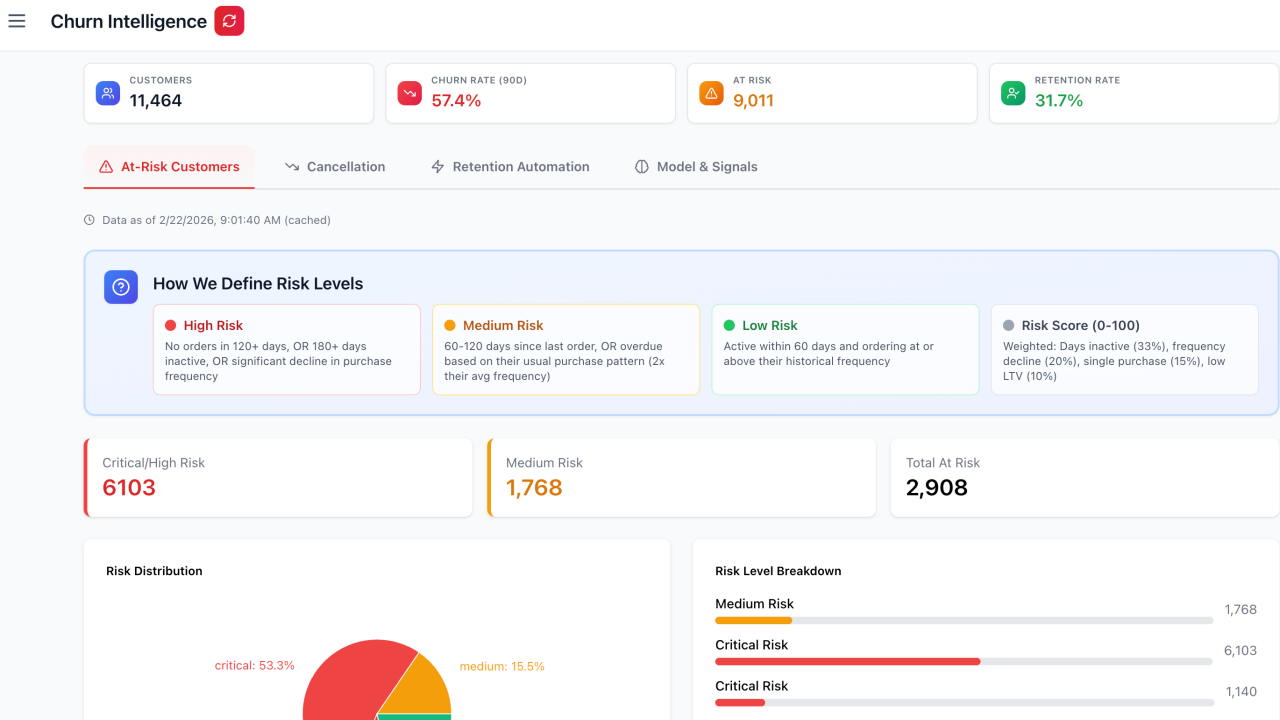
Layer 2 — Intelligence. Analysis that turns data into specific findings. Predictive churn modeling. Cohort retention curves. Customer health scoring. LTV projection by acquisition channel. Segmentation by behavior. This layer answers questions like "which subscribers are most likely to churn in the next 30 days" and "which cohorts are worth investing additional retention spend on."
Layer 3 — Action. Campaigns, automation, and execution. Dunning workflows. Winback email sequences. Loyalty program tier transitions. Subscription cancellation flows. This is where retention work becomes visible to customers. The action layer must be tightly coupled to the intelligence layer — a winback campaign sent to the wrong segment is worse than no campaign.
Layer 4 — Measurement. Tracking which interventions actually moved retention, attributing LTV impact back to specific campaigns, and feeding the results into the intelligence layer to improve future decisions. Measurement is often the weakest layer because it requires patience — retention impact compounds over months, not days, and brands frequently kill effective programs because the short-term metric did not move enough.
The software categories that compose a retention stack
Customer retention management software is not one category — it is four sub-categories that combine into a stack.
Retention analytics. The intelligence layer. Cohort retention reporting, LTV projection, churn prediction, customer health scoring. The strongest tools in this category are full-stack platforms like Finsi, dedicated analytics tools like Peel Insights for cohort focus, and lower-cost options like Lifetimely. See the best customer retention software 2026 comparison for the detailed breakdown.
Loyalty and engagement. The action layer for voluntary retention. Smile.io, LoyaltyLion, and Yotpo cover this category for Shopify brands. Tiered VIP programs, point systems, referral programs. These tools become more important as the brand grows past the early stage where unit economics of loyalty start to compound.
Customer support and satisfaction. Less obviously part of retention, but the data is unambiguous: customers who have positive support experiences retain at substantially higher rates than customers who do not. Gorgias and Zendesk are the dominant tools for Shopify. NPS tools (Wootric, Delighted) capture the satisfaction signal that feeds retention models.
Subscription churn prevention. For subscription brands specifically, this is the most operationally intensive sub-category. Churnkey and ProsperStack for cancellation flows. Dedicated dunning tools (Churn Buster, Butter Payments) for involuntary churn. Subscription platforms themselves (Recharge, Skio, Loop, Bold) include basic versions of these but typically benefit from a dedicated tool when subscription volume justifies it.
Most ecommerce brands assemble 2-4 tools across these categories. Unified platforms like Finsi consolidate retention analytics, intelligence, and execution into one product to reduce the integration overhead — particularly valuable for brands without a dedicated retention team.
What a retention manager actually does
For brands that have hired a dedicated customer retention manager, the role typically owns these activities:
Weekly cohort review. Monitor cohort retention curves, identify drift in newer cohorts, flag investigations when a cohort underperforms.
Intervention design. Design retention campaigns matched to specific churn drivers — welcome sequences, replenishment reminders, winback campaigns, VIP tier upgrades.
Experiment management. Run A/B tests on retention experiments. The cycle time is longer than acquisition experiments — meaningful retention reads often need 30-60 days. The discipline is patience and rigor.
Cross-functional coordination. Customer support sees retention signals first. Product team owns the underlying experience. Finance cares about LTV projections. The retention manager coordinates across these functions to make sure retention insights inform the rest of the company.
Reporting. Monthly LTV reporting. Quarterly retention deep-dives. Attribution of retention work to revenue impact.
The role is becoming partially automated. Platforms like Finsi handle the analytical work (cohort analysis, churn prediction, health scoring) and increasingly the execution work (running campaigns, deploying winback flows). The human role shifts toward strategy — deciding which churn drivers to invest in, designing the experiment portfolio, and making cross-functional cases for retention investments.
Building a retention management strategy
The mechanical steps to build a retention strategy from scratch:
Step 1 — Measure honestly. Calculate retention rate and churn rate using the correct denominators (eligible-to-churn for subscriptions, defined active windows for non-subscription). Segment by acquisition cohort. Compare against vertical benchmarks. Most brands discover their reported numbers were optimistic by 20-40%.
Step 2 — Identify the biggest churn driver. Voluntary vs involuntary split. Within voluntary: early-lifecycle (first-to-second purchase gap), mid-lifecycle (engagement decline), or value-perception (price-justified cancellations). Within involuntary: which failure-reason codes dominate, and whether the existing dunning is recovering at industry-typical rates.
Step 3 — Match interventions to drivers. Smart dunning for involuntary. Welcome and onboarding sequences for early-lifecycle. Lifecycle email and replenishment reminders for mid-lifecycle. Product improvement and loyalty programs for value-perception. The order matters — fastest wins first to fund the longer compounding work.
Step 4 — Run one intervention at a time. Resist the temptation to launch four programs simultaneously. You will not know what worked. Run one, measure for 60-90 days, then move on. This pace feels slow but produces a learning curve that compounds; running everything at once produces noise.
Step 5 — Build the measurement loop. Make sure each intervention can be attributed to LTV impact, not just to short-term campaign metrics. Open rate is not retention. Cohort LTV is retention.
The economics of retention management
| Brand revenue stage | Typical retention tool spend | Typical retention manager headcount |
|---|---|---|
| Under $1M annual | $0-$300/month | None — founder owns |
| $1M-$5M annual | $300-$1,000/month | Part of a marketing role |
| $5M-$25M annual | $1,000-$3,000/month | Dedicated retention manager |
| $25M+ annual | $3,000-$10,000+/month | Retention team |
For brands at the $5M-$25M tier, a unified retention platform like Finsi at $500/month replaces a fragmented stack that would otherwise cost $1,500-$3,000/month plus the integration management overhead. The math at this stage usually favors consolidation.
Where this leads
Customer retention management is one of three core ecommerce disciplines, alongside customer acquisition and unit economics. The interconnection: better retention → higher LTV → higher CAC ceiling → faster growth. The brands that compound retention improvements consistently over 12-24 months tend to develop structural growth advantages over competitors who never made it a priority.
For the rate-calculation methodology, see the customer retention rate guide. For the comparative tool analysis, see the best customer retention software 2026 guide. For the strategic playbook of specific interventions, see the churn reduction playbook.
Finsi`s retention intelligence platform covers the analytics, intelligence, and execution layers of customer retention management in one product. Start a free trial to see what a unified retention system looks like running on your data.
FAQ
What is customer retention management?
Customer retention management is the systematic discipline of keeping existing customers engaged, reducing churn, and increasing customer lifetime value. It covers four layers — the data layer (unified customer view), the intelligence layer (predictive models and segmentation), the action layer (campaigns, dunning, loyalty), and the measurement layer (cohort retention, LTV, NPS) — operating continuously rather than as one-off campaigns. The discipline exists because acquiring a new customer costs 5-7x more than retaining an existing one, but most ecommerce brands spend 80% of their marketing on acquisition.
What is a customer retention management system?
A customer retention management system is the technology stack that runs retention work — data unification (CDP or warehouse), retention analytics (cohort retention, LTV, churn prediction), engagement tools (email, SMS, loyalty), and execution tools (dunning, cancellation flows, winback campaigns). For most ecommerce brands the system is a combination of 3-5 tools. Increasingly the category is consolidating into unified platforms like Finsi that cover the analytics, intelligence, and execution layers in one product.
What is customer retention management software?
Customer retention management software is the category of tools that helps brands keep existing customers. The category splits into four sub-categories: retention analytics (Finsi, Peel Insights, Lifetimely), loyalty and engagement (Smile.io, LoyaltyLion, Yotpo), customer support and satisfaction (Gorgias, Zendesk, NPS tools), and subscription churn prevention (Churnkey, ProsperStack, dunning tools). The right stack depends on the brand`s churn drivers — see the best customer retention software 2026 guide for the detailed comparison.
What is the best customer retention management software for ecommerce?
For comprehensive retention management — analytics, intelligence, and execution in one platform — Finsi is the strongest fit for Shopify and DTC brands at $1M-$50M revenue. For specific layers: Peel Insights for cohort and retention reporting, Smile.io or LoyaltyLion for loyalty programs, Klaviyo for email retention campaigns, Churnkey for subscription cancellation flows. Most brands assemble a stack of 2-4 tools; the all-in-one platforms consolidate this into one when the brand wants fewer integrations and unified data.
How much does customer retention management software cost?
Pricing varies widely by tool and category. Basic loyalty tools start free or under $50/month (Smile.io starter). Retention analytics platforms range from $34/month (Lifetimely) to $500+/month (Finsi, full platform). Subscription churn prevention tools typically run $200-$800/month. A starter retention stack runs $200-$500/month. A growth stack with analytics, loyalty, support, and email runs $500-$2,000/month. The ROI math: improving retention by 5% can increase profit by 25-95%, so even a $500/month tool pays back within months for most brands.
What does a customer retention manager do?
A customer retention manager owns the discipline operationally — analyzing cohort retention and churn patterns, designing intervention campaigns (welcome sequences, winback flows, loyalty), running A/B tests on retention experiments, and reporting on LTV impact. The role typically reports to a CMO or VP Marketing in mid-sized ecommerce brands. The role is becoming partially automated as platforms like Finsi handle the analytical and execution work; the human focus shifts toward strategy, experiment design, and cross-functional coordination with product and customer support.
How do I build a customer retention management strategy?
Start by measuring honestly — calculate retention rate on the correct (eligible-to-churn) denominator, segment by acquisition cohort, and compare against vertical benchmarks. Then identify the biggest churn driver: involuntary (failed payments), early-lifecycle (first-to-second purchase gap), mid-lifecycle (engagement decline), or value-perception (price-justified cancellations). Match interventions to the driver — dunning for involuntary, onboarding for early-lifecycle, lifecycle email for mid, loyalty and product improvement for value-perception. Run one intervention at a time so you can measure impact.