
Contribution Margin for DTC: 2026 Operator Guide
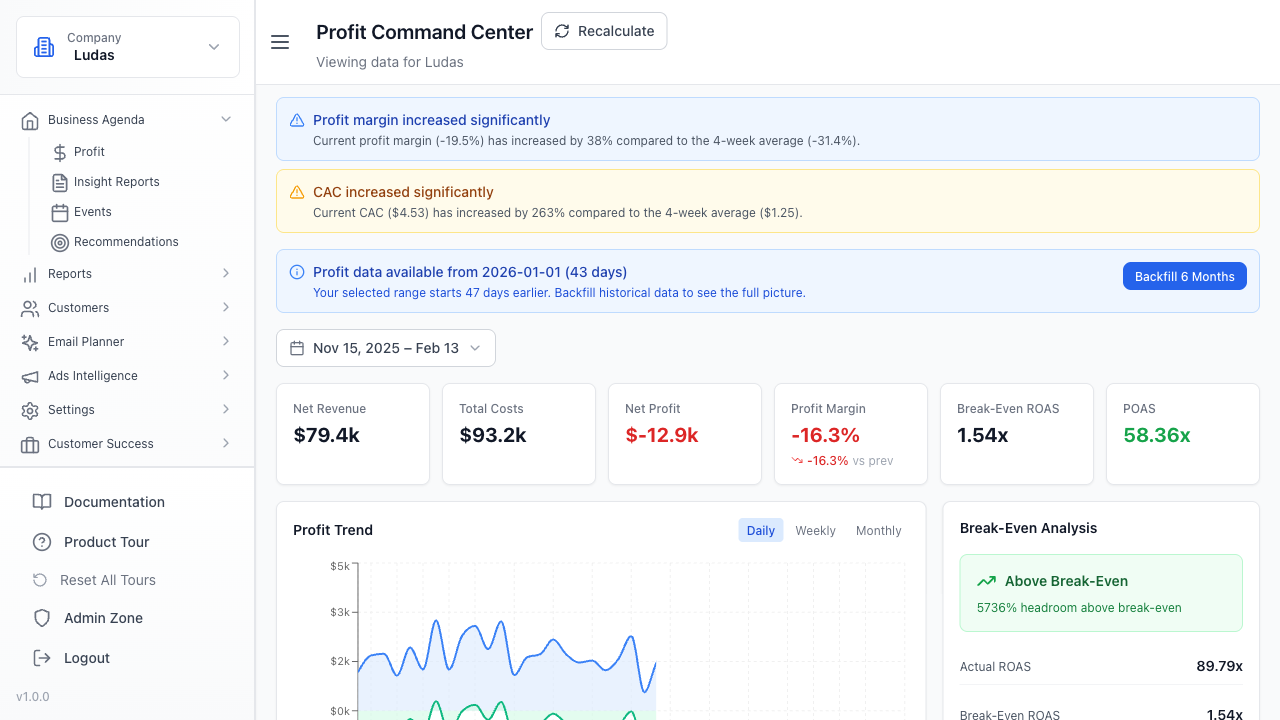
Contribution margin is revenue minus variable costs (COGS, shipping, payment processing, discounts), expressed as a dollar amount or percentage, and represents the profit available to cover fixed costs and fund growth.
Why Contribution Margin Matters More Than Gross Margin
Gross margin tells you what's left after cost of goods sold. Contribution margin tells you what's left after everything variable hits the P&L. For a DTC operator, that distinction is the difference between a metric that looks good in a deck and a metric that actually gates spend.
A $100 order with 60% gross margin looks healthy until you subtract $18 in shipping, $3 in payment processing, and a $15 discount code. Suddenly you're at $64 contribution - a 64% contribution margin, not 60%. More importantly, that $64 is what's available to pay for the ad that acquired the customer in the first place.
Contribution margin is the only number that should determine whether a customer acquisition channel is profitable. If your CAC (customer acquisition cost) exceeds your contribution margin on the first order, you're underwater before repeat purchase math even enters the picture. Most operators who blow through cash are optimizing to ROAS or CPC instead of contribution margin per order.
The Contribution Margin Formula
Start with revenue. Subtract every variable cost that scales with the order.
Contribution Margin (CM) = Revenue - (COGS + Shipping + Payment Processing + Discounts + Returns/Refunds)
Express it two ways: as a dollar amount and as a percentage of revenue.
Example: A $120 order with $35 COGS, $12 shipping, $4 payment processing, and a $10 discount code.
CM = $120 - ($35 + $12 + $4 + $10) = $59
CM% = $59 / $120 = 49.2%
That $59 is your war chest. It covers the ad spend, platform fees, customer service labor, packaging materials, and everything else that doesn't scale linearly with volume. If your CAC is $45, you have $14 left per customer to cover fixed costs and profit. If your CAC is $65, you're losing $6 per acquisition.
What Counts as a Variable Cost
Variable costs are expenses that increase proportionally with each order. Fixed costs (rent, salary, platform subscriptions) do not belong in this calculation.
COGS is straightforward - the cost to manufacture or source the product. If you're dropshipping, it's the per-unit wholesale price. If you're manufacturing, it's materials plus direct labor allocated to production.
Shipping is always variable. Whether you negotiate $8 or $12 per box, it scales with volume. Include the full landed cost, not just what you charge the customer. If you offer free shipping on orders over $75, calculate the blended shipping cost across all orders.
Payment processing fees are variable. Stripe, PayPal, Square - whatever you use, it's typically 2.2% + $0.30 per transaction plus any chargeback fees. Blended across your order mix, estimate 2.5% to 3.5% of revenue.
Discounts and promotional codes are variable. If you run a 20% off campaign, that's a direct reduction in contribution margin. Same with loyalty discounts, bundle discounts, or seasonal sales.
Returns and refunds reduce contribution margin. If your return rate is 8%, your effective revenue is 92% of orders placed. Some operators calculate CM before returns, then subtract a separate 'return rate haircut' - both methods work as long as you're consistent.
Contribution Margin by Channel and Cohort
Contribution margin is not uniform across your business. Organic traffic, paid search, email, and influencer partnerships all have different acquisition costs and often different order values and discount rates.
An organic visitor might convert at 3% with a $120 AOV and no discount. A paid search visitor might convert at 1.2% with a $95 AOV and a 15% discount rate. The contribution margin per acquisition attempt is wildly different.
Segment your contribution margin by channel. Calculate CM for paid social, paid search, email, organic, affiliate, and any other source. Then divide CM by conversion rate to get contribution margin per visitor. That's your true profitability metric by channel.
Do the same by customer cohort - first-time buyers, repeat customers, high-LTV segments. A repeat customer might have a higher AOV and lower discount rate, yielding higher CM. That changes your CAC ceiling for that cohort.
Example: Paid social generates 10,000 visitors per month, 120 orders, $12,000 in revenue, $5,800 in CM. CM per visitor = $5,800 / 10,000 = $0.58. If your paid social CAC is $8, you're paying $8 to acquire $0.58 in contribution. That's a losing channel unless repeat purchase LTV is exceptional.
Setting Your CAC Ceiling
Once you know your contribution margin, you can set a rational CAC ceiling. The rule is simple: your CAC should not exceed your contribution margin on the first order, unless repeat purchase LTV justifies it.
If your average order CM is $65, your CAC ceiling is $65 on a break-even basis. But most operators should target a CAC that's 30% to 50% of CM to leave room for fixed costs and profit. So a $65 CM suggests a $20 to $32 CAC target.
This is where most operators go wrong. They optimize to a 3:1 ROAS (return on ad spend), which sounds good until you realize it ignores variable costs. A 3:1 ROAS on a $100 order with 50% CM is actually a 1.5:1 ROAS on contribution margin - meaning you're spending $1 to make $1.50 in contribution. After fixed costs, that's thin.
Set your CAC ceiling as a percentage of CM, not as a percentage of revenue. If CM is 50% of revenue and you want CAC to be 40% of CM, then CAC should be 20% of revenue. Test and iterate, but always measure against CM, not gross margin or ROAS.
Operators who hit 2:1 ROAS on contribution margin (spending $1 to make $2 in CM) typically have healthy unit economics and room to reinvest in growth. That's the benchmark to chase.
Contribution Margin and Repeat Purchase Economics
Contribution margin on the first order is the floor. Repeat purchase LTV is what justifies spending above that floor.
If your first-order CM is $50 and your CAC is $60, you're underwater on the first order. But if your repeat purchase rate is 35% and repeat customers have a $45 CM per order with an average lifetime of 4 repeat purchases, your customer LTV is $50 + (0.35 × 4 × $45) = $50 + $63 = $113 in total CM. Now a $60 CAC makes sense.
The trap is assuming repeat purchase rates without data. Many operators overestimate repeat rates or underestimate the discount rate on repeat purchases. Calculate your actual repeat purchase rate by cohort, then model the LTV conservatively.
If you don't have 6 months of repeat purchase data, don't spend above first-order CM. Build the repeat purchase engine first, then expand CAC budgets once you have proof of LTV.
Contribution margin also changes for repeat customers. They might have a higher AOV (larger basket) but also a higher discount rate (loyalty codes, email discounts). Calculate repeat CM separately from first-order CM, then weight by repeat rate to get blended LTV.
Contribution Margin Reporting and Monitoring
Track contribution margin weekly, not monthly. Ad spend decisions move fast, and stale data leads to overspend.
Build a simple dashboard: revenue, COGS, shipping cost, payment processing fees, discounts, returns, and contribution margin - both in dollars and as a percentage. Add CAC by channel, then calculate contribution margin per acquisition.
Watch for drift. If your CM% drops from 52% to 48% over two weeks, something changed - either COGS increased, shipping costs spiked, or discount rates climbed. Find the culprit and fix it before it compounds.
Benchmark your CM% against your historical baseline and against industry peers. DTC apparel typically runs 45% to 55% CM%. Beauty and supplements often run 55% to 70%. Food and beverage can be lower, 35% to 50%. If you're significantly below peer benchmarks, your cost structure is broken.
Use contribution margin to forecast cash burn. If you're spending $100k per month on ads and your blended CAC is $45, you're acquiring 2,222 customers. If their average CM is $60, you're generating $133k in contribution. Subtract fixed costs and you can see if you're cash-flow positive or negative. That's the real health check.
FAQ
Should I include customer service and packaging in contribution margin?
No. Customer service and packaging materials are semi-variable - they scale with volume but not linearly, and they're often bundled into fixed overhead. Contribution margin should include only direct variable costs: COGS, shipping, payment processing, discounts, and returns. Everything else is fixed cost or overhead, and it comes out of the contribution margin pool.
How do I calculate contribution margin if I offer free shipping?
Calculate the actual shipping cost per order, then subtract it from revenue. If you offer free shipping on orders over $75 and charge $8 on orders under $75, calculate your blended shipping cost across all orders. If 60% of orders qualify for free shipping and your average shipping cost is $10, your blended shipping is $4 per order. That's what you subtract from revenue.
What's a healthy contribution margin percentage for DTC?
It depends on category, but 45% to 60% is typical for most DTC brands. Luxury and beauty can run higher, 60% to 75%. Commodity products and food run lower, 30% to 45%. The key is that your CAC should not exceed 30% to 50% of your CM, leaving room for fixed costs and profit. If your CM% is below 40%, your cost structure is likely broken and needs fixing before you scale ad spend.
How do I know if my CAC is too high?
Compare CAC to first-order contribution margin. If CAC exceeds CM, you're losing money on the first order and betting everything on repeat purchase. If you don't have 6 months of repeat purchase data, that's a bad bet. If CAC is 50% to 70% of CM, you're healthy. If CAC is 30% to 40% of CM, you have room to scale. If CAC is above 80% of CM, you're taking on significant risk and should only do so if repeat LTV is proven and strong.
FAQ
Should I include customer service and packaging in contribution margin?
No. Customer service and packaging materials are semi-variable - they scale with volume but not linearly, and they're often bundled into fixed overhead. Contribution margin should include only direct variable costs: COGS, shipping, payment processing, discounts, and returns. Everything else is fixed cost or overhead, and it comes out of the contribution margin pool.
How do I calculate contribution margin if I offer free shipping?
Calculate the actual shipping cost per order, then subtract it from revenue. If you offer free shipping on orders over $75 and charge $8 on orders under $75, calculate your blended shipping cost across all orders. If 60% of orders qualify for free shipping and your average shipping cost is $10, your blended shipping is $4 per order. That's what you subtract from revenue.
What's a healthy contribution margin percentage for DTC?
It depends on category, but 45% to 60% is typical for most DTC brands. Luxury and beauty can run higher, 60% to 75%. Commodity products and food run lower, 30% to 45%. The key is that your CAC should not exceed 30% to 50% of your CM, leaving room for fixed costs and profit. If your CM% is below 40%, your cost structure is likely broken and needs fixing before you scale ad spend.
How do I know if my CAC is too high?
Compare CAC to first-order contribution margin. If CAC exceeds CM, you're losing money on the first order and betting everything on repeat purchase. If you don't have 6 months of repeat purchase data, that's a bad bet. If CAC is 50% to 70% of CM, you're healthy. If CAC is 30% to 40% of CM, you have room to scale. If CAC is above 80% of CM, you're taking on significant risk and should only do so if repeat LTV is proven and strong.