
Churn Reduction Playbook: 12 Interventions Ranked by Dollar Impact
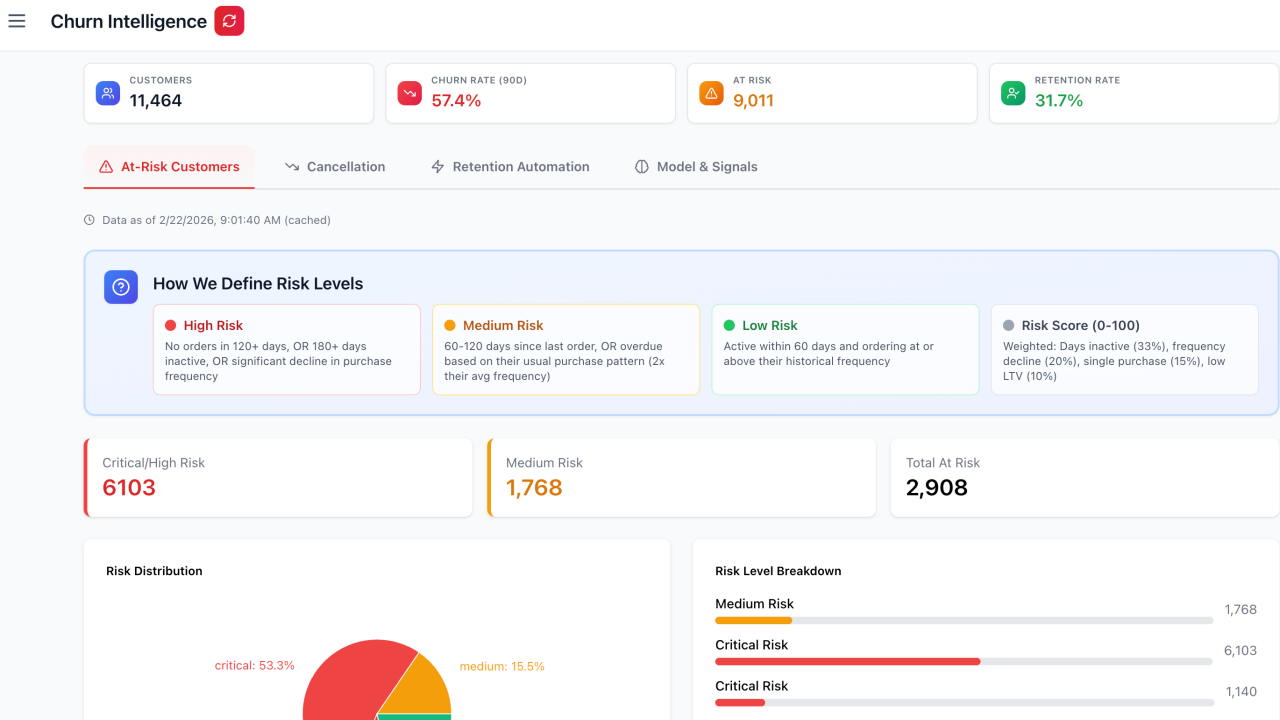
Churn is the slow leak that compounds against every dollar you spend on acquisition. A 1 percent reduction in monthly churn at $500K MRR adds roughly $30K-$60K to annual revenue depending on cohort dynamics. A 3-point reduction at the same baseline can add a quarter million.
The problem with most churn-reduction advice is that it is generic. "Improve onboarding." "Send better emails." "Increase customer success." None of that tells you which specific intervention to ship Monday morning. This playbook ranks twelve interventions by typical dollar impact for $1M-$10M Shopify and subscription brands, with implementation difficulty and a 90-day priority order.
How to read the rankings
The dollar impact column assumes a brand at $500K monthly recurring revenue or $5M annual revenue, with baseline metrics in the middle of industry distributions. Your actual numbers depend on three factors: baseline performance (a brand already at the 90th percentile sees less lift), vertical (subscription consumables versus apparel will respond differently), and execution quality. Treat the rankings as relative, not absolute.
Difficulty rating is low / medium / high based on engineering hours, vendor coordination, and team capability requirements.
The twelve interventions
1. Smart dunning audit and fix
Typical impact: $20K-$40K monthly recurring revenue recovered at $500K MRR. Difficulty: Medium. Requires payment processor access and copywriting on retry messaging.
Basic retry logic recovers 15-25 percent of failed payments. Smart dunning (AI retry timing, decline-code routing, customer outreach) recovers 55-80 percent. The gap is the single largest hidden revenue leak in most subscription businesses. Brands that have never audited their dunning typically find 20-30 percent of their churn is involuntary and recoverable. Read more in Smart Dunning vs Basic Retries.
2. Cancel-flow redesign with reason-matched offers
Typical impact: 5-15 percent save rate, $5K-$25K monthly retained revenue. Difficulty: Medium. Requires UX changes plus offer logic.
The typical cancel flow asks "are you sure?" and offers 10 percent off. Save rate runs 2-4 percent. A redesigned flow with reason-matched offers (pause for "too much product", swap for "wrong product", discount only for "price") saves 8-15 percent of cancellation attempts. Subscription brands typically see the largest gains because the cancel flow is the highest-intent moment to intervene.
3. Customer health scoring with proactive outreach
Typical impact: 5-12 percent reduction in voluntary churn. Difficulty: High. Requires data unification and process design.
A single 0-100 score per customer combining purchase cadence, support tickets, NPS, payment health, and engagement. Customers scoring 70+ get proactive outreach (email, sometimes a phone call). The top 5 percent of at-risk customers receive 80 percent of the intervention budget. The brands that implement this and actually follow through reduce voluntary churn 5-12 percent.
4. Replenishment timing optimization
Typical impact: 15-30 percent reorder rate lift on consumables. Difficulty: Low. Requires product-cycle data and email retiming.
Most replenishment reminders fire on calendar interval (every 30 days) rather than product usage. A 60-day product getting a 30-day reminder trains customers to ignore the brand. Recalibrate reminders to actual product usage (day 50 for a 60-day product) and reorder rate typically lifts 15-30 percent.
5. Post-purchase email sequence rebuild
Typical impact: 8-20 percent lift in second-purchase rate. Difficulty: Low to medium. Requires copywriting and design.
The 14 days after a first purchase have the highest repeat intent of any window in the customer lifecycle. Most brands waste this window with a generic shipping update. Build a 5-7 email sequence covering unboxing, product education, accessory cross-sell, review request, and replenishment setup. The lift compounds because second-purchase rate gates all downstream retention.
6. Motivation-based segmentation
Typical impact: 20-40 percent campaign efficiency lift, 5-10 percent LTV. Difficulty: High. Requires segmentation strategy and content production.
Move from RFM segments to motivation-based segments. Group customers by the job they hired your product for (a gift, a daily replenishment, a category exploration). Each motivation needs a different lifecycle flow. Brands that do this stop sending the same product email to wedding-gift buyers and daily-use buyers. Campaign performance lifts 20-40 percent across the board.
7. Win-back sequence by lapsed duration
Typical impact: 8-12 percent reactivation rate, $5K-$30K recovered revenue per quarter. Difficulty: Medium. Requires segmentation by lapsed duration and three sequences.
A 60-day lapsed customer needs a different message than a 180-day lapsed customer. Build three winback sequences targeting 60, 90, and 180-day segments with different offers, angles, and cadences. Aggregate reactivation typically hits 8-12 percent. The 60-day segment usually performs best because product memory is fresh. See Winback Campaign Examples for specifics.
8. Subscription pause as alternative to cancel
Typical impact: 4-8 percent of cancellations converted to pause, half of paused customers resume. Difficulty: Low to medium. Requires pause option in subscription tool plus cancel-flow placement.
Many subscription customers want a break, not an exit. Offering pause prominently in the cancel flow (above the cancel button) converts 4-8 percent of attempted cancellations to pause. Of paused customers, roughly half resume within 60 days. The math: 1,000 monthly cancellations becomes 60 pauses, of which 30 resume. That is 30 retained customers per month.
9. NPS triggered intervention
Typical impact: 3-7 percent voluntary churn reduction among detractors. Difficulty: Low. Requires NPS survey and follow-up workflow.
Detractors (NPS 0-6) churn 3-5x faster than promoters. Most brands collect NPS and do nothing with it. The fix: auto-trigger a follow-up email to detractors within 24 hours asking what went wrong, with a human response within 48 hours. Customers who receive a human response within 48 hours of complaining churn at half the rate of customers who do not.
10. Loyalty program optimization
Typical impact: 3-8 percent LTV lift among enrolled members. Difficulty: Medium. Requires loyalty platform and program redesign.
Loyalty programs are often oversold. The typical program (earn points, redeem for discount) lifts LTV 3-8 percent among members. The lift is highest in repeat-purchase categories (beauty, supplements, pet) and lowest in considered-purchase categories (apparel, electronics). The ROI on loyalty is rarely in the top three retention investments. Worth doing, not worth doing first.
11. Subscription downgrade option
Typical impact: 3-6 percent of cancellations converted to downgrade. Difficulty: Medium. Requires subscription tier structure and cancel-flow placement.
For multi-tier subscription brands, offering a downgrade in the cancel flow converts 3-6 percent of attempted cancellations. The downgrade customer typically renews 60-70 percent as long as the original because the entry barrier is lower. Works best for brands with clear tier differentiation in product or quantity.
12. Predictive product affinity for cross-sell
Typical impact: 5-10 percent AOV lift among engaged customers. Difficulty: High. Requires product affinity model and email infrastructure.
Customers who buy product A frequently buy product B 60-90 days later. A predictive cross-sell model surfaces these affinities and triggers a recommendation email at the right moment. AOV lifts 5-10 percent among customers who engage. The technique works best for brands with 50+ SKUs because the model needs purchase variety to find affinities.
The 90-day priority order
If you implement nothing else, do these four in this order:
- Week 1-2: Smart dunning audit (intervention #1)
- Week 3-4: Cancel-flow redesign (intervention #2)
- Week 5-7: Post-purchase sequence rebuild (intervention #5)
- Week 8-12: Customer health scoring with outreach (intervention #3)
These four interventions typically capture 60-70 percent of the total recoverable revenue. The remaining eight interventions are worth pursuing but have lower marginal ROI.
Who runs the playbook
This playbook is roughly 90 days of work for a senior retention marketing manager, or 4-6 months of work for an agency. For brands that cannot justify a $120K hire or $10K/month agency, Finsi is the AI CMO that runs this playbook on your data. We ship the campaigns through your existing tools (Klaviyo, Recharge, Postscript) and report results weekly.
Book a free retention audit and we will tell you which of the twelve interventions to prioritize for your brand specifically.
Frequently asked questions
What is the biggest single lever for reducing churn?
For subscription brands, smart dunning. Most have 20-40 percent of their total churn coming from failed payments, and the recovery rate gap between basic and smart dunning is 30-50 percentage points. The math is rarely in question. The barrier is usually that nobody on the team owns dunning, so it stays at default settings.
How quickly can I reduce churn?
Quick wins in 30 days: dunning recovery, cancel-flow fixes, replenishment timing. Compound results in 90-180 days: motivation-based segmentation, predictive health scoring, post-purchase rebuilds. Full program maturity in 12-18 months.
What is a good churn rate for a DTC brand?
Depends entirely on business model. Subscription consumables target 2-4 percent monthly churn. Subscription boxes target 5-8 percent. Non-subscription DTC measures churn differently (cohort retention curves rather than monthly rate) and varies by vertical: 40 percent annual non-repeat for apparel is normal, 25 percent for supplements is normal, 60 percent for novelty/seasonal categories is normal.
Should I focus on reducing churn or increasing acquisition?
Run the marginal-LTV test. Calculate the LTV impact of the next dollar spent on retention versus the next dollar spent on acquisition. Whichever produces more incremental LTV is the right answer for your current state. Most $1M-$10M brands find that retention spend dominates until they hit roughly 30 percent retention budget allocation. Above that, acquisition tends to win again.
What tools do I need to reduce churn?
Klaviyo or similar for email and SMS. Recharge or Appstle if you sell subscriptions. A dunning tool (Stay AI, Churn Buster, or Recharge native). An exit survey (built-in or Hotjar). Customer health scoring is harder to buy off-the-shelf and is typically a custom build or covered by an AI CMO platform.