
Chargebee vs Stripe Billing 2026: Pricing, Dunning, and Revenue Recognition Compared
Chargebee is the better choice for brands that need advanced subscription management features out of the box - including built-in dunning, revenue recognition, and complex pricing models - while Stripe Billing is the better choice for developer-first teams that want a lightweight billing layer they can customize extensively through APIs. Both platforms handle recurring billing reliably, but they serve different stages of business maturity and different levels of operational complexity.
Choosing between Chargebee and Stripe Billing is one of the most consequential infrastructure decisions a subscription brand makes. The wrong choice does not break your business immediately, but it creates compounding friction - manual workarounds for missing features, integrations that do not talk to each other, and reporting gaps that obscure your true subscription economics. This guide compares both platforms across the dimensions that actually matter for DTC and subscription e-commerce brands.
Platform Overviews
Stripe Billing
Stripe Billing is an extension of Stripe's payment processing platform. It adds subscription management, invoicing, and recurring billing on top of Stripe's core payments infrastructure. The philosophy is developer-first: Stripe provides flexible APIs and building blocks, and your engineering team assembles them into the subscription experience your business needs.
Stripe Billing works best for teams that have engineering resources, want tight control over the subscription UX, and are already using Stripe for payment processing. It is lightweight, fast to integrate for basic use cases, and scales well because it runs on Stripe's infrastructure.
Chargebee
Chargebee is a dedicated subscription management platform that sits on top of payment processors (including Stripe, Braintree, and Adyen). It provides a more complete out-of-the-box subscription management solution with built-in features for dunning, revenue recognition, customer self-service portals, and complex pricing models.
Chargebee works best for teams that need sophisticated subscription logic without building it themselves, have finance teams that require revenue recognition and compliance features, and want to manage subscriptions across multiple payment gateways.
Key Differences
Complexity vs. Simplicity
Stripe Billing keeps things simple by design. You get subscriptions, invoicing, and basic proration logic. For anything beyond that - coupon management, complex plan hierarchies, advanced dunning - you build it yourself or integrate third-party tools.
Chargebee provides significantly more built-in complexity. Plan families, add-ons, coupons, entitlements, and multi-currency pricing are all native features. This saves engineering time but adds operational complexity in learning and managing the platform.
Built-In Dunning
Dunning - the process of recovering failed subscription payments - is where the platforms diverge significantly.
Stripe Billing offers Smart Retries, which uses machine learning to retry failed payments at optimal times. It also supports basic email notifications for failed payments. However, the dunning email templates are limited, and building a full dunning workflow (pre-dunning alerts, escalation sequences, account updater integration) requires custom development or a third-party tool.
Chargebee provides a full built-in dunning system with configurable retry schedules, multi-step email sequences, customizable templates, and automatic payment method update prompts. The dunning workflow is manageable from the dashboard without engineering involvement.
For brands where dunning optimization is critical to revenue preservation - and for subscription brands, 20-40% of churn is involuntary - Chargebee's built-in dunning is a meaningful advantage.
Revenue Recognition
Stripe Billing integrates with Stripe Revenue Recognition (a separate product with additional pricing) for ASC 606 / IFRS 15 compliant revenue recognition. It is functional but requires setup and understanding of accounting standards.
Chargebee includes built-in revenue recognition through RevRec, which automates deferred revenue calculations, generates journal entries, and supports multi-element arrangements. For finance teams that need compliant revenue reporting without building spreadsheet models, this is a significant time saver.
Pricing Models
Both platforms support the standard pricing models, but Chargebee handles edge cases more gracefully:
| Pricing Model | Stripe Billing | Chargebee |
|---|---|---|
| Flat-rate recurring | Yes | Yes |
| Per-unit pricing | Yes | Yes |
| Tiered pricing | Yes | Yes |
| Volume pricing | Yes | Yes |
| Metered/usage-based | Yes | Yes |
| Freemium with upgrade | Basic | Advanced (with entitlements) |
| Plan families and hierarchies | Manual setup | Native support |
| Quantity-based add-ons | Limited | Full support |
| Custom pricing per customer | Via API | Dashboard + API |
| Multi-currency pricing | Yes (per price) | Yes (with auto-conversion) |
| Price experimentation | Limited | Built-in A/B testing |
For straightforward pricing (2-3 flat-rate plans), Stripe Billing handles the job well. For brands with complex pricing structures - multiple plan families, add-ons, enterprise custom pricing, or frequent price experimentation - Chargebee provides more flexibility without custom development.
Global and Multi-Currency Support
Stripe Billing supports 135+ currencies and handles multi-currency pricing at the price level. You create separate prices for each currency. Tax calculation is available through Stripe Tax (additional product).
Chargebee supports 100+ currencies with automatic currency conversion, built-in tax calculation for multiple jurisdictions, and localized checkout pages. It also supports multiple payment gateways per region, allowing you to route transactions through the optimal processor for each market.
Feature Comparison
| Feature | Stripe Billing | Chargebee |
|---|---|---|
| Subscription management | Core | Full |
| Customer portal (self-service) | Stripe Customer Portal (basic) | Advanced (pause, swap, upgrade) |
| Dunning management | Smart Retries + basic emails | Full workflow with escalation |
| Revenue recognition | Separate product (Stripe RevRec) | Built-in (Chargebee RevRec) |
| Coupon and promotion management | Basic | Advanced (stackable, conditional) |
| Trial management | Yes | Yes (with trial conversion analytics) |
| Proration | Configurable | Configurable |
| Webhooks and events | Extensive | Extensive |
| API quality | Excellent | Good |
| Reporting and analytics | Stripe Dashboard (Sigma for SQL) | Built-in analytics dashboard |
| Quote and invoicing | Yes | Yes (with approval workflows) |
| Checkout | Stripe Checkout | Chargebee Checkout (or Stripe) |
| Mobile SDK | Yes | Yes |
| CRM integrations | Via Stripe Apps | Native (Salesforce, HubSpot) |
Pricing Comparison
Stripe Billing Pricing
Stripe Billing charges 0.5% of recurring revenue on top of Stripe's standard payment processing fees (2.9% + $0.30 per transaction for US cards). The Starter tier offers basic invoicing and subscriptions. The Scale tier (0.8% of revenue) adds revenue recovery tools, quotes, and advanced features.
For a brand processing $100,000/month in subscriptions:
- Payment processing: ~$3,200/month
- Billing fee (0.5%): ~$500/month
- Total: ~$3,700/month
Chargebee Pricing
Chargebee uses tiered pricing based on revenue. The Starter plan is free up to $250K in cumulative billing. The Performance plan starts at $599/month for revenue up to $100K/month, with custom pricing above that. The Enterprise plan includes dedicated support, custom integrations, and SLAs.
For a brand processing $100,000/month in subscriptions:
- Chargebee platform fee: ~$599-999/month (Performance tier)
- Payment processing: Separate (through Stripe, Braintree, or other gateway at their standard rates)
- Total platform cost: ~$599-999/month + payment processing
Cost Comparison Summary
For smaller brands (under $50K monthly recurring revenue), Stripe Billing is typically cheaper because the percentage-based pricing stays low and there is no platform fee. For larger brands ($200K+ MRR), Chargebee's flat-rate pricing can become more cost-effective than Stripe Billing's percentage-based model, especially when you factor in the cost of building custom features that Chargebee provides natively.
Which platform for which business
Choose Stripe Billing If:
- You already use Stripe for payment processing and want to add subscriptions with minimal complexity
- Your pricing model is straightforward (2-4 flat-rate plans)
- You have engineering resources to build custom subscription flows
- You prefer API-first tools and want maximum flexibility
- You are at an early stage and want to start simple
- Your dunning needs are basic (Smart Retries may be sufficient)
Choose Chargebee If:
- You need advanced subscription management without heavy engineering investment
- Your pricing model is complex (multiple plan families, add-ons, enterprise deals)
- Your finance team requires built-in revenue recognition
- You need sophisticated dunning workflows to recover failed payments
- You operate in multiple markets with multi-currency and multi-gateway requirements
- You want a self-service customer portal with advanced features (pause, swap, upgrade)
- You are growing beyond $100K MRR and need operational tools for managing subscriptions at scale
Consider Both
Some brands use Stripe as the payment processor and Chargebee as the subscription management layer on top. This gives you Stripe's excellent payment infrastructure with Chargebee's subscription management features. Chargebee integrates natively with Stripe, so the two platforms work well together.
The analytics layer: seeing beyond billing
Regardless of whether you choose Chargebee or Stripe Billing, both platforms have limitations in subscription analytics. Billing platforms are optimized for processing transactions, not for understanding customer behavior across the full lifecycle.
Key analytics gaps in both platforms include:
- Cross-channel customer behavior: Neither platform connects subscription data with email engagement, site behavior, or support interactions
- Predictive churn modeling: Billing data alone is insufficient for predicting which customers will churn
- Customer health scoring: Composite metrics that combine behavioral and transactional signals require data from beyond the billing platform
- Cohort-level retention analysis: Both platforms offer basic retention reporting, but lack the depth needed for strategic decision-making
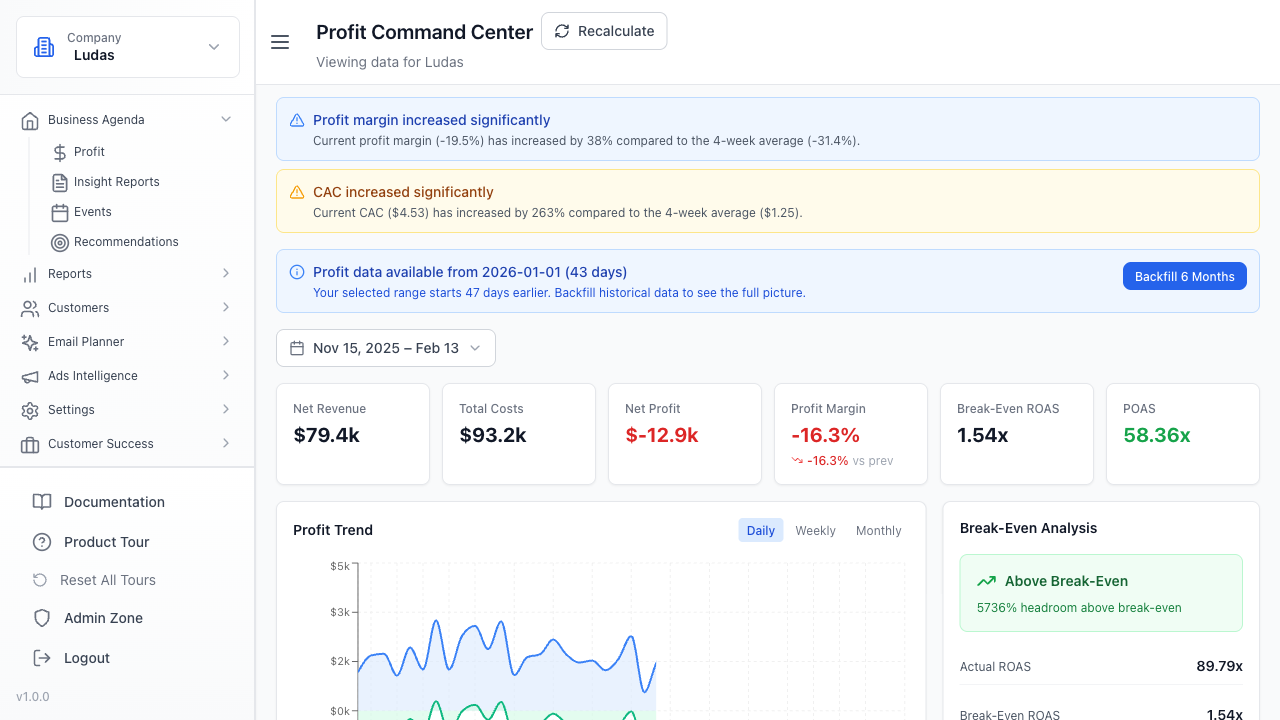
Finsi provides the analytics and retention intelligence layer that sits on top of both Chargebee and Stripe Billing, combining subscription data with behavioral signals to deliver churn prediction, customer health scoring, and profit intelligence that neither billing platform provides on its own. Start a free trial to see it with your data.
Frequently asked questions
Is Chargebee or Stripe Billing better for e-commerce?
For most e-commerce subscription brands, Chargebee is better out of the box - it includes built-in dunning, revenue recognition, coupon management, and cancellation retention flows without custom development. Stripe Billing is better for developer-heavy teams that want to build custom subscription logic on top of a flexible API. If you are a Shopify brand, also consider Recharge or Skio as Shopify-native alternatives.
How much does Chargebee cost vs Stripe Billing?
Stripe Billing charges 0.5-0.8% of recurring revenue with no monthly fee. Chargebee starts with a free plan (up to $250K revenue) and scales to $249/month (Performance) and custom pricing for enterprise. For a brand doing $1M in subscription revenue, Stripe costs roughly $5,000-8,000/year while Chargebee costs roughly $3,000-6,000/year depending on plan and volume.
Can I use Chargebee with Stripe?
Yes. Many brands use Stripe as the payment processor and Chargebee as the subscription management layer. Chargebee integrates natively with Stripe, so you get Stripe's payment infrastructure with Chargebee's subscription features (dunning, revenue recognition, retention flows). This is a common architecture for brands that outgrow Stripe Billing's built-in subscription features.
Which has better dunning - Chargebee or Stripe?
Chargebee has significantly more advanced dunning out of the box - multiple retry schedules, email notifications, payment method update pages, and smart retry logic. Stripe Billing has basic automatic retries (Smart Retries) but fewer configuration options and no built-in customer communication for failed payments. For brands where failed payment recovery is critical, Chargebee or a dedicated dunning tool is the stronger choice.
What is the difference between Chargebee and Cleverbridge?
Chargebee focuses on SaaS and subscription e-commerce with strong self-serve capabilities, API flexibility, and integrations with Shopify, Stripe, and marketing tools. Cleverbridge targets digital commerce and software sales with a full-service merchant-of-record model that handles global tax compliance, payments, and localization. Choose Chargebee for subscription management control; choose Cleverbridge if you need a managed commerce platform handling taxes and compliance globally.
FAQ
Is Chargebee or Stripe Billing better for e-commerce?
For most e-commerce subscription brands, Chargebee is better out of the box - it includes built-in dunning, revenue recognition, coupon management, and cancellation retention flows without custom development. Stripe Billing is better for developer-heavy teams that want to build custom subscription logic on top of a flexible API. If you are a Shopify brand, also consider Recharge or Skio as Shopify-native alternatives.
How much does Chargebee cost vs Stripe Billing?
Stripe Billing charges 0.5-0.8% of recurring revenue with no monthly fee. Chargebee starts with a free plan (up to $250K revenue) and scales to $249 per month (Performance) and custom pricing for enterprise. For a brand doing $1M in subscription revenue, Stripe costs roughly $5,000-8,000 per year while Chargebee costs roughly $3,000-6,000 per year depending on plan and volume.
Can I use Chargebee with Stripe?
Yes. Many brands use Stripe as the payment processor and Chargebee as the subscription management layer. Chargebee integrates natively with Stripe, so you get Stripe payment infrastructure with Chargebee subscription features (dunning, revenue recognition, retention flows). This is a common architecture for brands that outgrow Stripe Billing built-in subscription features.
Which has better dunning - Chargebee or Stripe?
Chargebee has significantly more advanced dunning out of the box - multiple retry schedules, email notifications, payment method update pages, and smart retry logic. Stripe Billing has basic automatic retries (Smart Retries) but fewer configuration options and no built-in customer communication for failed payments. For brands where failed payment recovery is critical, Chargebee or a dedicated dunning tool is the stronger choice.
What is the difference between Chargebee and Cleverbridge?
Chargebee focuses on SaaS and subscription e-commerce with strong self-serve capabilities, API flexibility, and integrations with Shopify, Stripe, and marketing tools. Cleverbridge targets digital commerce and software sales with a full-service merchant-of-record model that handles global tax compliance, payments, and localization. Choose Chargebee for subscription management control; choose Cleverbridge if you need a managed commerce platform handling taxes and compliance globally.
Chargebee vs Stripe Billing comparison - which should I choose by stage?
Sub-$1M MRR brands typically pick Stripe Billing for simplicity and developer flexibility. $1-10M MRR brands move to Chargebee when finance complexity (revenue recognition, multi-currency, dunning) outgrows what Stripe ships out of the box. Above $10M MRR, the choice depends on whether your team prioritizes engineering control (Stripe + custom layer) or operational completeness (Chargebee). Many $10M+ brands run both: Stripe for payments, Chargebee for subscription management.
Stop guessing. Start knowing.
Finsi connects your e-commerce data, tells you what to do, and executes it — email campaigns, ad optimization, retention flows. Free 30-day trial.
Start Free Trial