
Blended CAC: 2026 Operator Guide
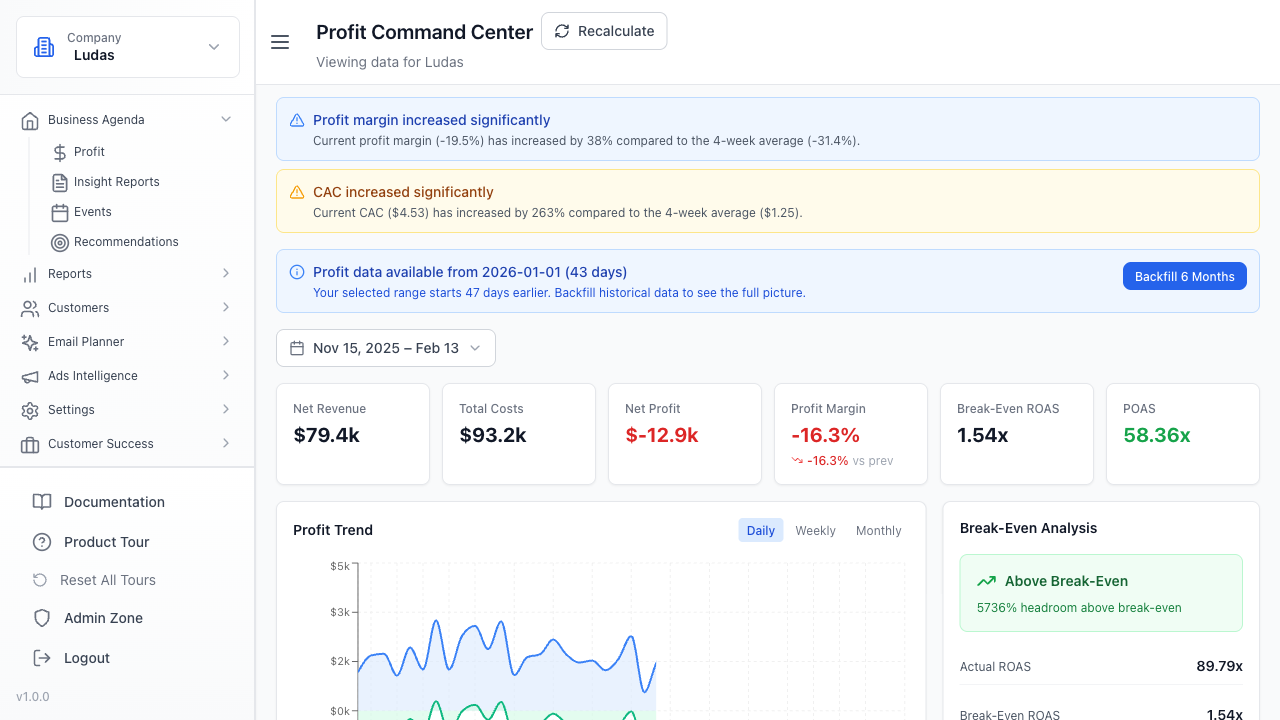
Blended CAC is the average cost to acquire a customer across all paid channels, calculated as total marketing spend divided by total new customers acquired in a period.
Why Blended CAC Matters More Than Channel CAC
Channel CAC tells you the cost per acquisition within a single channel - Facebook, Google, TikTok, email, affiliate. It's useful for optimizing spend within that channel. But channel CAC lies about unit economics at scale. A DTC operator running Facebook at $18 CAC and Google at $32 CAC might assume Facebook is the better performer. That's true in isolation. But if Facebook is saturating and Google is driving incremental volume at scale, blended CAC across both channels might be $26 - and that's the number that actually determines profitability.
Blended CAC forces operators to think like portfolio managers. It answers the real question: what am I actually paying per customer when I account for the full acquisition machine? Channel CAC optimizes locally. Blended CAC optimizes globally. For a brand spending $500k monthly across five channels, the difference between a $22 blended CAC and a $28 blended CAC is $300k in annual profit swing at 3x LTV.
The Correct Blended CAC Formula
Blended CAC = (Total Paid Marketing Spend) / (Total New Customers Acquired). That's it. But the execution is where operators fail.
Total Paid Marketing Spend includes: platform ad spend (Facebook, Google, TikTok, Pinterest, etc.), affiliate commissions, influencer payments, paid email platforms (if used for acquisition), paid search, display, video, and any other channel where you're paying for customer acquisition. It does not include organic social, organic search, or content creation that isn't directly tied to a paid promotion.
Total New Customers Acquired means customers who made a first purchase in the measurement period. If a customer made their first purchase in January and a repeat purchase in February, count them once in January's blended CAC. Use UTM parameters or attribution software to assign each customer to their first-touch channel, then sum across all channels.
The time period matters. Monthly blended CAC is useful for trend spotting. Quarterly blended CAC smooths out seasonal noise. Annual blended CAC is your true unit economics baseline. Most operators should track all three.
When Channel CAC Deceives You
Channel CAC becomes misleading in three scenarios. First, when one channel is cannibalizing another. A brand running both Google Search and Facebook might see Google at $24 CAC and Facebook at $18 CAC. But if 40% of Facebook customers would have found the brand via Google anyway, the true incremental CAC for Facebook is higher than $18. The channel CAC ignores overlap.
Second, when channels have different customer quality. TikTok might show $16 CAC while email shows $45 CAC. But TikTok customers might have 1.2x LTV due to higher repeat rate and AOV. Email is acquiring lower-quality customers at higher cost. Channel CAC doesn't account for LTV variance. Blended CAC won't either unless you weight by customer value - which requires a second calculation.
Third, when scaling dynamics differ by channel. Early in a campaign, Facebook might deliver $15 CAC. At $100k monthly spend it's $18. At $300k it's $28. Google might start at $28 and stay flat at $28 across all spend levels. Channel CAC is a snapshot. Blended CAC across both channels will rise as you scale Facebook, even if Facebook remains the 'best' channel. Operators who don't account for this often over-invest in saturating channels.
Calculating Blended CAC With Uneven Channel Mix
Most operators have a channel mix that looks like: Facebook 35%, Google 25%, TikTok 20%, Affiliate 15%, Other 5%. Each channel has different CAC. Here's how to calculate blended correctly.
Month 1 spend and customers: Facebook $35k / 1,800 customers = $19.44 CAC. Google $25k / 625 customers = $40 CAC. TikTok $20k / 1,200 customers = $16.67 CAC. Affiliate $15k / 500 customers = $30 CAC. Other $5k / 150 customers = $33.33 CAC. Total: $100k spend, 4,275 new customers. Blended CAC = $100k / 4,275 = $23.39.
Notice that blended CAC ($23.39) is not the average of channel CACs. It's weighted by volume. TikTok's low CAC pulls the blended number down because TikTok acquired the most customers. Google's high CAC pulls it up less because Google acquired fewer customers. This is correct. Your actual cost per customer, across the whole operation, is $23.39 - not the arithmetic mean of the five channel CACs.
To forecast blended CAC, project spend and customer acquisition by channel for the next month, then apply the same formula. If you're planning to increase TikTok spend by 40% (which will likely increase TikTok CAC due to saturation), your blended CAC will shift. Model it out.
Blended CAC vs. LTV - The Real Profitability Check
Blended CAC is half the unit economics story. The other half is LTV - lifetime value. A $25 blended CAC is excellent if LTV is $150. It's a disaster if LTV is $30.
The standard benchmark is LTV / CAC ratio. Healthy DTC brands target 3:1 or higher. That means for every dollar spent acquiring a customer, that customer generates three dollars in gross profit over their lifetime. At 3:1, a $25 blended CAC requires $75 LTV. A $40 blended CAC requires $120 LTV.
Here's where blended CAC and LTV interact. If blended CAC is rising month-over-month but LTV is also rising (due to better product, higher repeat rate, or improved retention), profitability might still be healthy. If blended CAC is rising and LTV is flat or declining, you have a problem. Most operators track blended CAC obsessively and LTV loosely. That's backwards. LTV is harder to measure but more important.
Calculate LTV as: (Average Order Value) x (Repeat Purchase Rate) x (Average Customer Lifespan in Months) x (Gross Margin %). For a brand with $60 AOV, 40% repeat rate, 18-month lifespan, and 65% margin: LTV = $60 x 0.40 x 18 x 0.65 = $280. At $25 blended CAC, that's an 11:1 ratio - very healthy. At $80 blended CAC, it's 3.5:1 - acceptable but tight.
Benchmarking Your Blended CAC
Blended CAC varies wildly by category, price point, and market maturity. A luxury skincare brand might run $45 - $65 blended CAC. A fast-moving consumable might run $8 - $15. A B2B SaaS brand might run $120 - $300. Benchmarking against a brand in a different category is useless.
Within your category, blended CAC should trend downward as you scale (due to operational efficiency and brand recognition) or upward if competition is intensifying. If your blended CAC was $22 in Q1 2025 and $28 in Q4 2025, that's a red flag unless your LTV also increased proportionally. It suggests either market saturation, rising platform costs, or poor channel optimization.
Peer benchmarking is hard without access to private data. Industry reports from Littledata, Shopify, and Klaviyo publish ranges by vertical. For apparel, expect $18 - $35. For beauty, $25 - $50. For supplements, $15 - $40. These are medians. Top quartile brands often run 20 - 30% lower. Bottom quartile runs 30 - 50% higher. If your blended CAC is in the bottom quartile for your category, audit channel mix, creative performance, and landing page conversion rate.
Track your blended CAC trend month-over-month and quarter-over-quarter. A rising trend is only acceptable if LTV is rising faster. A declining trend is excellent if it's due to operational leverage, not channel mix shift toward lower-quality customers.
Common Blended CAC Mistakes
Mistake one: including organic traffic in the denominator. If 1,000 customers came from paid channels and 300 from organic search, don't divide total spend by 1,300. Divide by 1,000. Organic customers have zero CAC. Including them artificially lowers blended CAC and masks the true cost of paid acquisition.
Mistake two: excluding platform fees and overhead. Ad spend is only part of acquisition cost. Include payment processing fees (2 - 3% of revenue), customer service for acquisition inquiries, and a portion of marketing team salary. True blended CAC is higher than platform spend divided by customers. Most operators underestimate by 15 - 25%.
Mistake three: measuring CAC at the transaction level instead of the customer level. If a customer made two purchases in the measurement period, count them once. If you count them twice, blended CAC appears artificially low. Use first-touch attribution and count unique customers only.
Mistake four: not accounting for refunds and returns. If 100 customers were acquired at $25 CAC but 15 refunded, your true CAC is $25 / 0.85 = $29.41. Refunds reduce the effective customer base. Adjust for them.
Mistake five: comparing blended CAC across different time periods without adjusting for seasonality. November blended CAC is typically 30 - 50% lower than January due to holiday demand. Comparing November to January directly is misleading. Compare November 2024 to November 2025, or use a rolling 12-month average.
FAQ
Should I calculate blended CAC including or excluding brand/organic channels?
Exclude them. Blended CAC measures paid acquisition cost only. Organic search, direct traffic, and word-of-mouth have zero CAC. Including them in the denominator artificially lowers your blended CAC and obscures the true cost of your paid marketing machine. Track organic separately as a free channel. If organic is growing, it reduces your reliance on paid and improves overall unit economics - but it shouldn't be baked into blended CAC.
How often should I recalculate blended CAC?
Monthly is standard for trend spotting and tactical decisions. Quarterly is better for strategic decisions because it smooths seasonal noise. Annual is your true baseline. If you're running heavy seasonal campaigns (holiday, summer, back-to-school), monthly blended CAC will spike and dip. Use a rolling 12-month average to see the true trend. Don't overreact to a single month's blended CAC unless it's a major outlier.
My blended CAC is rising but my LTV is also rising. Is this okay?
Only if LTV is rising faster. If blended CAC rises 20% and LTV rises 30%, your LTV / CAC ratio improves and profitability increases. If blended CAC rises 20% and LTV rises 10%, your ratio deteriorates and profitability declines. The gap matters. Track both metrics together. A rising blended CAC is only sustainable if it's paired with rising LTV or declining CAC in future months as you optimize channels.
How do I account for different customer quality across channels in blended CAC?
Standard blended CAC doesn't weight by quality - it's a simple average. To account for quality, calculate a weighted blended CAC: assign each customer a quality score (repeat rate, LTV, AOV) by channel, then weight the CAC by that score. Example: Facebook customers have 1.2x average LTV, so weight Facebook CAC at 1.2x. This is more complex but more accurate. For most operators, tracking blended CAC and LTV separately, then calculating LTV / CAC by channel, is sufficient.
FAQ
Should I calculate blended CAC including or excluding brand/organic channels?
Exclude them. Blended CAC measures paid acquisition cost only. Organic search, direct traffic, and word-of-mouth have zero CAC. Including them in the denominator artificially lowers your blended CAC and obscures the true cost of your paid marketing machine. Track organic separately as a free channel. If organic is growing, it reduces your reliance on paid and improves overall unit economics - but it shouldn't be baked into blended CAC.
How often should I recalculate blended CAC?
Monthly is standard for trend spotting and tactical decisions. Quarterly is better for strategic decisions because it smooths seasonal noise. Annual is your true baseline. If you're running heavy seasonal campaigns (holiday, summer, back-to-school), monthly blended CAC will spike and dip. Use a rolling 12-month average to see the true trend. Don't overreact to a single month's blended CAC unless it's a major outlier.
My blended CAC is rising but my LTV is also rising. Is this okay?
Only if LTV is rising faster. If blended CAC rises 20% and LTV rises 30%, your LTV / CAC ratio improves and profitability increases. If blended CAC rises 20% and LTV rises 10%, your ratio deteriorates and profitability declines. The gap matters. Track both metrics together. A rising blended CAC is only sustainable if it's paired with rising LTV or declining CAC in future months as you optimize channels.
How do I account for different customer quality across channels in blended CAC?
Standard blended CAC doesn't weight by quality - it's a simple average. To account for quality, calculate a weighted blended CAC: assign each customer a quality score (repeat rate, LTV, AOV) by channel, then weight the CAC by that score. Example: Facebook customers have 1.2x average LTV, so weight Facebook CAC at 1.2x. This is more complex but more accurate. For most operators, tracking blended CAC and LTV separately, then calculating LTV / CAC by channel, is sufficient.