
AI Cash Flow Forecasting for Shopify and DTC Brands (2026 Guide)
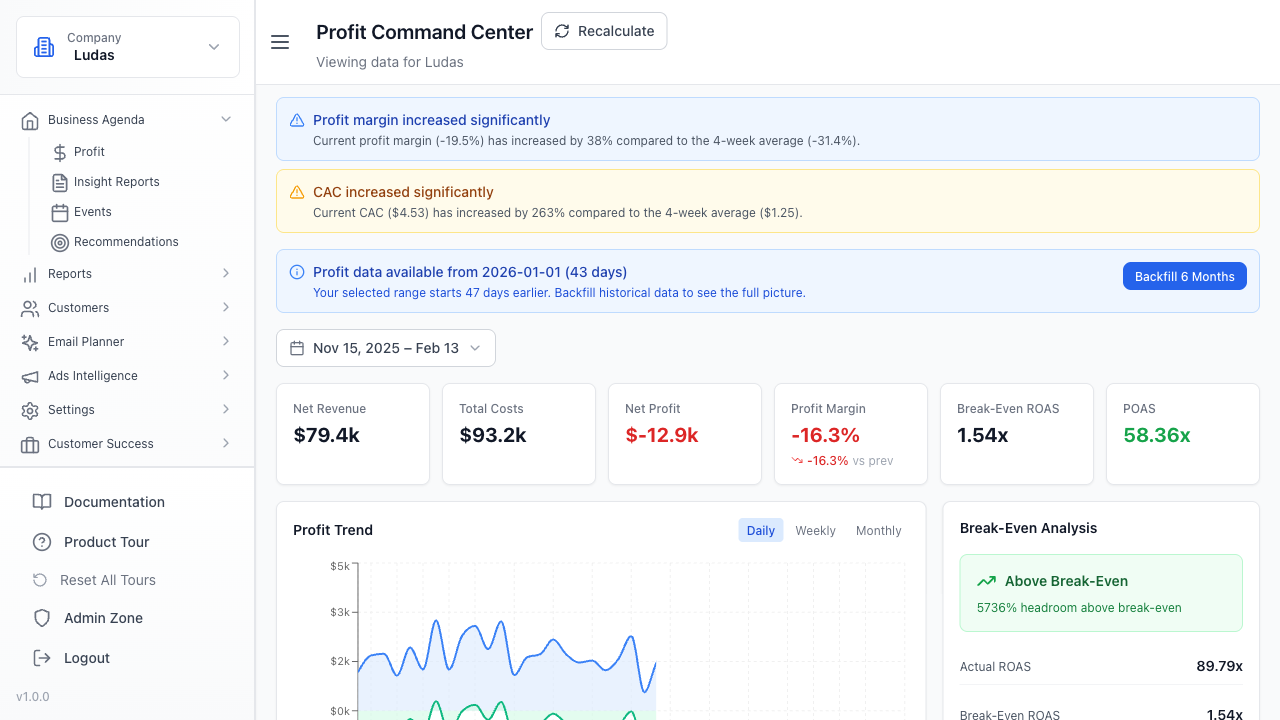
Most software described as "AI cash flow forecasting" was built for enterprise treasury teams with multi-bank operations, accounts receivable, accounts payable, and ERP integrations. Shopify and DTC brands have a fundamentally different cash flow problem. The cash flow that matters for a DTC brand is the dance between inventory orders, marketing spend, and the receivable cycle that Shopify and Stripe settle on T+2.
This guide covers what AI cash flow forecasting actually does for a $1M-$50M DTC brand, why the enterprise tools do not fit, and the math behind the cash trap that growing ecommerce brands keep falling into.
What AI cash flow forecasting does for a DTC brand
For a Shopify or DTC brand, AI cash flow forecasting answers three questions on a continuous basis:
Will I have cash 30, 60, and 90 days from now? The forecast projects bank balance forward using committed inventory orders, expected receivables from Shopify and Stripe, planned marketing spend, payroll, and recurring software costs. Updated daily as new data lands.
How much can I safely spend on marketing this week? Given the cash forecast, what is the marginal marketing dollar I can deploy without violating my safety threshold for cash position in 60 days? This is the question most growing brands actually need answered and most spreadsheets cannot answer.
Where is cash going to be tight, and when? The model surfaces cash-tight periods 30-60 days in advance. A founder can pull marketing spend, delay a hire, or negotiate net-60 terms on the next inventory order. Real money saved.
These three questions are not what enterprise treasury tools optimize for. Enterprise tools forecast multi-currency cash positions across banks for AR/AP cycles measured in weeks. DTC brands forecast a single-currency cash position against an inventory cycle measured in months.
Why enterprise AI cash flow tools do not fit
The top-ranking tools for "AI cash flow forecasting" are HighRadius, Drivetrain, Kyriba, and Arya.ai. All four are sophisticated. None of them work well for Shopify brands. Three structural reasons:
Wrong data sources. Enterprise tools ingest from SAP, Oracle NetSuite, Workday, and multi-bank treasury systems. They do not natively read Shopify orders, Klaviyo email-driven revenue, Meta ad spend, or Recharge subscription forecasts. The integration work to feed them the right data is expensive.
Wrong forecasting unit. Enterprise tools forecast cash position around the AR/AP cycle (30-90 days). DTC brands need to forecast the inventory order cycle (60-180 days for direct, longer for imported goods) against daily revenue. The forecasting horizon is different.
Wrong reporting cadence. Enterprise tools produce monthly close-cycle reports for CFO review. DTC brands need daily updates because ad spend decisions happen daily and inventory orders are placed mid-month. The latency in enterprise reporting is fatal for a $5M brand.
A working AI cash flow forecast for a Shopify brand reads Shopify orders, Stripe settlement, Recharge subscription forecasts, ad spend committed and projected, current inventory on hand, open purchase orders, payroll, and software bills. It updates daily. It produces a number a founder can act on this week, not a board-ready report.
The cash trap that catches growing brands
Most $1M-$10M DTC brands hit the same cash trap somewhere on the growth curve. Understanding it is the entire reason you need AI cash flow forecasting.
The pattern: revenue doubles. Inventory needs to triple, because you need to fund the next inventory cycle for the new growth rate plus safety stock. Gross margin stays roughly the same. Your cash position deteriorates even as revenue grows because the working capital required for inventory grows faster than the cash thrown off by sales.
A specific example. A brand at $300K monthly revenue with 50% gross margin and a 60-day inventory cycle. They are throwing off roughly $150K monthly in gross profit. They need roughly $180K in inventory to fund a single cycle at current run rate. Cash position is healthy.
The brand doubles to $600K monthly. Gross profit is now $300K. But inventory requirement is now $360K to fund a cycle, plus they need to add safety stock because they were almost stocked out last month, call it $450K total. The cash thrown off by the doubling does not cover the inventory step-up. They tap a line of credit or delay a marketing push.
Then they hit a third growth phase. Revenue is now $1M monthly. Inventory requirement is $600K to $800K. Gross profit is $500K. They are growing faster than their internal cash flow can fund. They take on debt or slow growth.
The brands that navigate this trap successfully are the ones with daily visibility into cash position projected 60 days out. They pull marketing spend two weeks before the cash tightening, negotiate net-60 terms on the next inventory order, and avoid the credit line or the growth slowdown.
The brands that hit the trap are the ones running off a monthly bank statement and finding out about the cash crunch when their cash position drops below the comfort threshold.
What an AI cash flow forecast for Shopify actually looks like
A working AI cash flow forecast for a Shopify brand contains six elements:
Current cash position. Bank balances pulled from your banks via Plaid or similar, updated daily.
Projected receivables. Shopify orders settled to your bank account, factoring in the T+2 settlement cycle. Stripe subscription revenue forecasted using Recharge or Appstle data. Returns reserve.
Committed outflows. Open inventory purchase orders, scheduled payroll, recurring software subscriptions, agency retainers, ad spend committed for the next 30 days.
Projected variable outflows. Marketing spend forecasted based on current ad spend run rate and any seasonal adjustments. New inventory orders projected based on current burn rate and reorder thresholds.
Cash position 30, 60, 90 days forward. The actual forecast. Updated daily. Showing the minimum cash position in the window so you see the tightest point, not just the endpoint.
Decision recommendations. "Cash position in 47 days projects to dip below $50K. Recommend pulling $30K from Meta spend over the next 14 days, or delaying the Q3 inventory order by 21 days." Specific actions, not just a forecast.
The last element is what separates a working AI cash flow forecast from a sophisticated spreadsheet. The model produces decisions, not just numbers.
How accurate are these forecasts
Realistic accuracy for an AI cash flow forecast at 30 days out is 90-95 percent of actuals. At 60 days, 85-90 percent. At 90 days, 75-85 percent. Beyond that, the forecast is directional rather than predictive.
The accuracy depends on the stability of two underlying inputs: ad spend (which a founder controls and can predict) and inventory ordering (which is somewhat lumpy and depends on supplier lead times). The forecast tracks well in steady-state and gets less accurate around major inflection points: Black Friday, product launches, supplier issues, channel changes.
For a $1M-$10M brand, "90 percent accurate at 30 days" is enough to drive better decisions than the alternative (which is running off bank balance and gut feel). The marginal value of more accuracy beyond 90 percent is usually low because the decisions you make on a 90-percent-accurate forecast are usually right.
Who does AI cash flow forecasting for Shopify brands today
The category is new. As of mid-2026, three approaches dominate:
Enterprise treasury tools (HighRadius, Drivetrain, Kyriba). Powerful but expensive ($15K-$100K+ annually), built for AR/AP, not ideal for DTC.
Ecommerce-specific FP&A tools (Drivetrain ecommerce, Cogsy partial functionality, Inventory Planner). Better fit, but most are operations-focused rather than executive-summary focused.
AI CFO platforms (Finsi, emerging competitors). Newest category. Built specifically for $1M-$50M DTC and Shopify brands. Combines cash forecasting with broader CFO functions: real P&L, SKU profitability, true CAC, channel-level LTV.
For most $1M-$10M brands, the AI CFO platform approach is the best fit because cash flow forecasting alone is not the whole problem. You also need to know which SKUs are unprofitable, which channels actually pay back, and how marketing spend translates to LTV. The cash forecast is a feature of the broader AI CFO capability.
How to get started
Three steps to a working AI cash flow forecast:
Step 1: Connect your sources. Bank accounts (via Plaid), Shopify, Stripe, ad platforms, subscription billing if applicable, payroll, accounting software. Most AI CFO platforms handle this in 30-60 minutes.
Step 2: Calibrate the model. Run the forecast against the last 90 days of actuals. Tune assumptions about inventory cycle length, marketing spend volatility, and seasonality. A good platform does most of this automatically.
Step 3: Set up the weekly review. Forecast is only useful if someone reads it. Lock a 15-minute Monday review on the calendar. Review projected cash position, the minimum point in the next 90 days, and any recommended actions. Adjust marketing spend or inventory orders if the projection shows tightening.
That is the whole program. The discipline is in the weekly review, not the model. The brands that look at their forecast every Monday make different decisions than the brands that look at it once a quarter.
Frequently asked questions
What is AI cash flow forecasting?
AI cash flow forecasting is software that uses machine learning to project a business's future cash position based on historical patterns and current commitments. For ecommerce brands, this means projecting bank balance 30, 60, and 90 days out using Shopify revenue patterns, ad spend run rate, inventory cycles, and recurring expenses. The "AI" part is the model that learns from past patterns to produce more accurate forecasts than rule-based or spreadsheet methods.
How accurate is AI cash flow forecasting for ecommerce?
For Shopify and DTC brands, 90-95 percent accuracy at 30 days, 85-90 percent at 60 days, and 75-85 percent at 90 days is realistic. Accuracy depends on the stability of ad spend (which founders control) and inventory ordering. The forecast is less accurate around major inflection points like Black Friday, product launches, or supplier disruptions.
How is AI cash flow forecasting different for ecommerce vs SaaS or enterprise?
Ecommerce brands forecast against an inventory cycle (60-180 days) instead of an accounts-receivable cycle (30-90 days). The data sources are different (Shopify, Stripe, Recharge instead of NetSuite or SAP). The decision cadence is different (daily marketing spend decisions instead of monthly close). Enterprise tools built for treasury teams do not fit DTC brands well.
What is the difference between AI cash flow forecasting and budgeting?
Budgeting projects what you plan to spend. Forecasting projects what your cash position will be given those plans plus all the variables outside your control (revenue, returns, payment timing). A budget is a plan. A forecast is a prediction. AI cash flow forecasting combines the budget with predictive modeling of revenue and timing to produce a more accurate cash projection.
When does a Shopify brand need AI cash flow forecasting?
The signal is usually inventory complexity. Brands selling fewer than 20 SKUs with stable monthly revenue can run off a spreadsheet for cash forecasting. Brands selling 100+ SKUs with subscription components, multiple sales channels, or rapid growth need a model. The economic threshold is usually $1M-$2M revenue, but the operational complexity matters more than the revenue number.
Is AI cash flow forecasting the same as an AI CFO?
Cash flow forecasting is one feature of a broader AI CFO platform. An AI CFO also covers real-time P&L, SKU-level profitability, true CAC by channel, inventory-cash modeling, and weekly executive reporting. For most $1M-$10M brands, the AI CFO platform is a better starting point than a standalone cash flow tool because the questions overlap.